
Category Archives: Authors A-H

Authors listed by last name A-H

Why AI Will Break Us Before It Serves Us – by Chaim Goldberg

The Ferrari 2026 Paradox

Harvard research meets Biblical wisdom:
A roadmap for leaders drowning in output but starving for capacity.

Introduction: The Boy with the Ferrari Brain

In a world where the Machine can answer every “How” with infinite speed, the Human is losing the capacity to ask “Why.” This is the tragedy of the AI age: We have built a Ferrari engine for a bicycle chassis. To survive the acceleration, we must rebuild the only thing the machine cannot replicate: The three-dimensional architecture of the Human Soul.

Years ago, I served as the principal of a specialized high school dedicated to “gifted” teenagers diagnosed with severe ADHD. I remember vividly sitting in my office with a 14-year-old boy. Let’s call him David. David had an IQ that could frighten a university professor. His ability to process information, generate ideas, and see patterns was nothing short of breathtaking. But David was falling apart. He had been expelled from three schools in two years. He couldn’t maintain a friendship, he couldn’t organize his morning, and he was plagued by anxiety.

Looking at him, I realized the tragedy of his existence: David possessed a Ferrari engine—immense power, speed, and potential—but it was installed in a bicycle frame.

This was not just a metaphor for attention deficit; I now realize it is the fundamental gap between Artificial Intelligence and Human Consciousness. The Machine is a linear data processor. It has power, but no structure. But the Human Being is a complex architecture held together by three tensions: The relationship with Self, the relationship with Others, and the relationship with Purpose (Authority). The machine has no “Self” to discipline, no “Other” to bond with, and no “Purpose” to serve.

David’s tragedy was that he had the engine of a machine but lacked the architecture of a human. Every time he pressed the accelerator, the chassis didn’t just shake; it shattered.

For years, I thought this was a specific educational challenge. But as we approach 2026, I realize I was looking at a prophecy. Today, looking at the corporate world and the AI revolution, I see “David” everywhere.

Humanity has collectively become that student. We have acquired “Superpowers.” With Generative AI, our ability to produce, analyze, and create has become virtually unlimited. We have upgraded our engine to a level our ancestors couldn’t imagine. But we haven’t upgraded our chassis. We are vibrating apart because our Character—the integrity of those three relationships—cannot hold our Capacity.

Part 1: The Diagnosis – The Death of Judgment

To understand this crisis, we don’t need to look to Silicon Valley, but to Stockholm harbor in 1628.

On August 10th of that year, the Swedish Empire launched the Vasa. It was the most magnificent warship ever built, a symbol of absolute power. King Gustavus Adolphus ordered it to be equipped with 64 heavy bronze cannons and spectacular gold ornamentation. It was designed to rule the Baltic Sea.

Yet, the Vasa sailed less than 1,300 meters. A light gust of wind—not a storm, just a breeze—tipped the ship. Water rushed into the open gun ports, and within minutes, the engineering marvel sank before the eyes of a horrified crowd.

The inquiry revealed a painful conclusion: The ship was top-heavy. It had too much Power (Cannons) and too much Purpose (The King’s ambition), but it lacked the most basic element: Internal Ballast. It had no center of gravity to counter the weight of its own weaponry.

This is the “Vasa Syndrome” of the modern leader.

Recent research from Harvard Business School and MIT, particularly the work on “The Jagged Frontier” by scholars such as Jacqueline Lane and David Autor, points to a similar phenomenon in the AI era. AI has commoditized “Output.” It has solved the problem of creating value at speed. But as Lane’s research warns, while AI accelerates our Creative Output, it often degrades our Creative Capacity—our ability to judge, discern, and maintain strategic depth.

We are loading our decks with the heavy gold cannons of AI, automation, and data, but we are ignoring the ballast in the hold. And when the first breeze of a crisis hits—a market shift, an ethical dilemma, a team conflict—we capsize.

The solution is not to discard the cannons (we cannot return to a pre-AI world). The solution is to build a deeper hull and fill it with ballast. We need a new architecture.

To fix a structural flaw in the human soul, we cannot look to the engineers who built the engine. They deal with speed. We must look to the architects who designed the driver. We need a blueprint that predates the crisis.

Part 2: Decoding the “Vayishma”: The Art of Deep Listening

For centuries, management consultants have looked to the Bible, specifically Exodus Chapter 18, as the first case study in “Delegation.” They see Jethro, Moses’s father-in-law, observing Moses’s exhaustion and advising him to appoint “Captains of Thousands and Captains of Hundreds.”

It’s a great lesson in organizational efficiency. But it is an optical illusion.

If we read the text through the lens of ancient Hebrew wisdom—specifically the teachings of the great Kabbalist and philosopher Rabbi Yehuda Leon Ashkenazi (Manitou)—we discover that Jethro was not an efficiency consultant. He was an Architect of the Soul.

The text begins with the words “Vayishma Jethro”—”And Jethro Heard.” What did he hear? Why did he come?

He realized that “Freedom” (the Exodus) without “Structure” is simply Chaos. He understood that you cannot pour high spiritual content (“Torah” or, in our case, infinite AI knowledge) into an unstable human vessel.

Jethro’s advice was based on a three-layered internal transformation. He taught that before a leader can manage others (Output), he must stabilize himself (Capacity).

Let us explore these three layers as the blueprint for the AI era.

1. The Vasa Warning: When Gold Cannons Sink the Ship (The Choice of 2026)

The first thing Jethro heard about was the Exodus from Egypt. In Hebrew, Mitzrayim (Egypt) shares the root Meitzar—meaning “Constriction” or “Boundary.” The ancient world was deterministic. You were born a slave, you died a slave. Your “nature” was your destiny.

But this is not just ancient history; it is the fundamental human duality. Every human being is a hybrid. On one side, we have a biological body subject to fixed natural laws and instincts—this is our internal “Egypt,” our internal machine. On the other side, we possess a deep Inner Identity and a Sovereign Will capable of breaking those boundaries. That is our constant potential for “Exodus.”

The AI revolution challenges this duality because AI appeals directly to our “machine” side. AI models are probabilistic; they are trained on historical data. If we rely on them blindly, we surrender our Sovereign Will and become trapped in a feedback loop of yesterday’s data.

The Harvard study showed that when humans use AI for decision-making, they often fall asleep at the wheel. When the machine presents a convincing narrative, human judgment shuts down. We lose our agency.

The first layer of the Jethro architecture is Self-Government. It is the technical process of ensuring the “Human” governs the “Machine.” In the biblical story of Joseph, we see two ministers in prison: The Baker and the Butler. The Baker is passive (birds eat from the basket on his head). The Butler is active (he presses the grapes into the cup). The Baker dies; the Butler survives.

In 2026, the leader who lets the algorithm dictate the email, the strategy, or the vision is the Baker. The leader who acts as the Curator—using the AI as raw material while applying a rigid internal “Constitution” of values and judgment—is the Butler.

Here is the good news: Reclaiming this sovereignty is not a mystical event reserved for prophets. It is a technical, structural skill. It can be learned, practiced, and mastered remotely—even through a digital protocol—just as one trains a muscle. To survive the speed of the Ferrari engine, you must have the brakes of self-discipline. You must define who you are, separate from the machine.

2. Why AI Can’t Do “Face-to-Face”

The second thing Jethro heard about was the War with Amalek. Amalek represents the ultimate “Zero-Sum Game.” It is the philosophy of “Me OR You.” It is the archetype of the first murder in history: Cain killing Abel because he believed the world wasn’t big enough for two distinct successes.

In the corporate world, this is the “Scaling Ceiling.” Another notable insight from the Harvard research is that small teams using AI can generate substantial value (e.g., a startup of 3 people generating $1.5M in revenue), but they encounter a ceiling effect. Why? AI cannot replace the complex friction and trust required for human collaboration.

Jethro told Moses: “Nabol Tibol”—”You will surely wear away… for you are not able to perform it yourself.” He wasn’t just telling Moses to offload work. He was teaching him the Brotherhood Equation.

In a world where knowledge is a commodity, “being smart” is no longer a differentiator. Everyone has the same GPT-5. Therefore, technical brilliance is largely automated. The only friction that generates value is human friction. The new differentiator is Complementarity. Cain sees the other as a competitor. Abel sees the other as a partner.

The Jethro leader understands that while AI can replace tasks, it cannot replace the Covenant. The structure of “Captains of Thousands” isn’t about power; it’s about acknowledging that I am incomplete. I need the unique “Image of God” found in my colleague—that spark of intuition that no Large Language Model can replicate—to build something sustainable.

I must be candid with you: From my experience guiding leaders through the Jethro program, this is the earthquake moment. This is where we leave the cold realm of automation and enter the living, breathing world. You can learn technical skills from a screen, but becoming “Abel”—learning to live in true resonance with another—requires a visceral, “Face-to-Face” transmission. It demands the inherent intensity of personal coaching because trust is not a concept you download; it is an energy you generate between souls. No amount of text on this page can describe the electricity of that shift. You have to experience it to believe it.

3. The Antinomy: How to Find Meaning in Randomness

The final and deepest layer is what Jethro heard last: The Giving of the Torah (Sinai). This addresses the crisis of Meaning.

The philosopher Immanuel Kant famously identified an “Antinomy” (a logical deadlock) regarding the creation of the world. Reason alone cannot prove if the world was created (has purpose) or if it is Eternal/Random (has no purpose).

This is not just an intellectual puzzle; it is the deepest existential struggle of the human condition. The decision we make here dictates our entire destiny. If the world is Random/Eternal, then I am merely a biological accident, driven by survival and statistics. If the world is created, then I am here for a specific purpose, carrying a unique frequency that the universe is awaiting.

AI is stuck in the “Eternal/Random” side. It operates Ex Misto—”Something from Something.” It takes existing data and rearranges it. It cannot create Ex Nihilo—”Something from Nothing.” It cannot agonize over purpose because it has no soul with which to agonize.

But the human being? We are created in the Image of the Creator. We have the capacity for true Novelty. Lane’s research explicitly highlights this: AI excels at making “Valuable” ideas (functional, practical), but humans still hold the edge in “Novelty” (ideas that break the paradigm).

The “Vasa” ship had power, but it sank because it lacked the “Why.” In 2026, a leader’s primary role is to be the Compass. To look at the “Chaos” of infinite data generated by AI and perform the act of Genesis: “And God divided the light from the darkness.” To distinguish between what is likely (AI prediction) and what is right (Human Vision).

And here lies the crux of the matter: You cannot resolve this Antinomy with a prompt. A machine can give you answers, but it cannot give you meaning. Decoding your unique destiny—deciding to live as a “Created” being with a specific purpose—requires deep, interpersonal resonance. It requires a mentor, a “Jethro,” who can look you in the eye and help you hear the call that is buried under the noise. This level of clarity arises only from the friction between two human souls. It is a biological and spiritual necessity that no software can replace.

Conclusion: The Return of the Driver

Let us return to David, my student with the Ferrari engine. We didn’t fix David by slowing him down. We fixed him by building his chassis—teaching him habits, boundaries, social connection, and a sense of purpose that was bigger than his impulses.

The corporate world is now facing the same curriculum. For decades, the goal of strategy was “Competitive Advantage”—how to beat the other guy. That is the logic of Cain. That is the logic of a world of scarcity.

But in an AI world of abundance, where “Output” is free, the goal shifts. We are moving from an era of Acquiring Knowledge to an era of Building Character.

The goal is no longer to be “better” than your neighbor (the AI will eventually be “better” than both of you at technical tasks). The goal is to reveal your Intrinsic Value—that unique frequency that only you can transmit.

Here lies the ancient Hebrew secret regarding the architecture of the human soul. For the average person, these three forces (Self, Others, God) are in constant conflict. The Hebrew tradition holds the secret of Integration (Peace). It teaches that a proper human “Chassis” acts as the foundation. Only when this foundation is combined with the insights of “Abel” (Brotherhood) and a deep, personal internal clarification regarding the nature of the universe, do we gain the capacity to weave these three parts into a single vector of Will.

We stand at a historic crossroad. Science is reaching breathtaking peaks with AI (building the ultimate “Engine”). Simultaneously, the return of the People of Israel to their land is a “replication” of the ancient Exodus, offering the opportunity to reconnect human Will with Divine Purpose in the world of action. This is an excellent opportunity for the coming year: To lead the peak of universal science with the depth of Israeli wisdom.

The question is: How ready are we to “hear” the shifting beat of the wings of history?

“The Jethro Principle” is not a management hack. It is the ancient engineering required to build the Ferrari and discover Man in his full power on the historical track toward a better future. It asks you to stop wrestling with the steering wheel and start building the vessel.

The engine is ready. It’s time to build the chassis.
Jethro I leave you with this question: In a future where the machine can answer every “How” with perfect efficiency—do you possess an internal architecture strong enough to define the “Why,” or will you become the highly efficient administrator of your own irrelevance?
Here’s the question:
Are you running a Ferrari engine on a Bicycle chassis? [Take the 4-Minute Structural Audit Here] (https://bit.ly/Ferrari-Audit-Deb)

English Appendix: The Research Alignment

How the “Jethro Principle” architecture correlates with current academic findings (2024-2026).

The Crisis (Research Diagnosis) The Solution (Jethro Principle) The Application
1. The “Jagged Frontier” & Loss of Judgment

Harvard research (Lakhani et al.) shows that while AI boosts output, it causes humans to “fall asleep” and lose critical judgment, leading to a 19% drop in correctness on tasks outside the AI’s frontier [1].

Layer 1: Man vs. Self

The transition from “Baker” (passive) to “Butler” (active Curator). Establishing a “Constitutional Self” that judges the machine’s output.

Building the “Ballast”

Protocols for human-in-the-loop verification and self-discipline.

2. Hollowing Out of Middle Management

Gartner predicts that by 2026, 20% of organizations will flatten their hierarchies, eliminating middle management [2]. MIT’s David Autor warns of the devaluing of “common expertise” [3].

Layer 2: Man vs. Others

The “Brotherhood Equation.” Moving from “Competition” (Cain) to “Complementarity” (Abel).

The “Crew” Structure

Focusing on interpersonal resonance and trust—skills that cannot be automated.

3. The Crisis of Meaning

Cognitive Scientist John Vervaeke describes a “Meaning Crisis”—a loss of connection to reality and truth in an age of information overflow [4].

Layer 3: Man vs. God

Breaking the “Antinomy.” Moving from a Random/Eternal worldview to a Created/Purposeful one.

The “Compass”

Defining the “Why.” Leadership becomes the act of distinguishing light from darkness (Vision).

References & Further Reading:

  1. Harvard Business School: Navigating the Jagged Technological Frontier: Field Experimental Evidence of the Effects of AI. (Lakhani, Dell’Acqua et al., 2023). Read Study
  2. Gartner Research: Top Strategic Predictions for 2025 & 2026: The Hollowing of Middle Management. Read Report
  3. MIT Economics: The Work of the Future: Building Better Jobs in an Age of Intelligent Machines. (David Autor et al.). Read Article
  4. John Vervaeke: The Meaning Crisis: Wisdom, Purpose, and the Search for Coherence. Explore Concept


Photo by Georg Eiermann on Unsplash

A Zionist for Zohran, Sort of… by Rafaela Amrita Crevoshay

Counter intuitive? It certainly sounds incongruent. But dig a bit deeper and you’ll discover that Z and me share some unconventional complexities that match up. We both live in the cultural orbit of North India, and the Middle East. It includes language music, food, and politics. These things unite us more that they separate us yet superficially,  we don’t match up. He’s a partisan Muslim, I’m a Zionist Jew. Reconciliation would seem off the table. But I like this guy and that motivated me to excavate his background and his character despite an apparent ideological gulf that separates us. 

Continue reading A Zionist for Zohran, Sort of… by Rafaela Amrita Crevoshay

Renewing Diversity Part 11: The Mysterious World of Diversity and Economics – by Carlos Cortés

I’ve always been a bit perplexed when it comes to the intersection of economics and diversity.  Maybe this is inevitable because of the sprawling, multifaceted, and contentious nature of the field of economics itself.  As the old saying goes, “You can stack all of the world’s economists end to end and never reach a conclusion.”

So rather than belaboring you with false certainties and pat generalizations about the economics-diversity nexus, I’ll tell you a story.  It’s a story about one acquaintance and two friends, each of whom contributed to my still-developing thinking about this topic.  Here goes.

Continue reading Renewing Diversity Part 11: The Mysterious World of Diversity and Economics – by Carlos Cortés

20 Interview Questions I Should Have Asked – by Sharon Hurley Hall

More than 300,000 Black women have lost their jobs this year. As a Black woman who’s navigated similar systems, it’s made me think about the interview processes I faced: extremely stressful, multiple rounds, and not a person who shared my identity at any of them. I know from my own experience that there are double-takes as you walk in the door. There’s extensive questioning about birth, nationality and my right to be there, and extreme scrutiny of my qualifications. And even if I then get the job, there’s no guarantee it’s a safe place to work. 

I know I’m not the only one to experience this. But what if you could use the interview process to get the answers you really need as a Black person? You might not get the job, but you’d be a whole lot clearer about whether it was the right workplace for you.

Here are 20 questions I wish I’d been able to ask.  Continue reading 20 Interview Questions I Should Have Asked – by Sharon Hurley Hall

Domestic Violence and the man in the mirror – by Terry Howard

Hey fellas, it’s me, your humble columnist.

I decided to send you a letter and gift you with a mirror to gaze at as you read this narrative. You see, the gift of self-reflection (and mirrors) are the greatest gifts you can give yourself if, taken together, they lead to positive change on your part and on that of others.

But first, I’ll ask you how’s everything in the bar, the locker room or on the golf course while you’re “shooting the breeze” with the boys? Lots of talk about sports, national politics, your trip to Europe and, eh, I’m guessing, the opposite sex, huh? 

Continue reading Domestic Violence and the man in the mirror – by Terry Howard

Faith, Science and the First Amendment – by Richard Foltin

What to Know About Religious Beliefs in the Classroom

This article was originally published by Freedom Forum

Among 2025’s marquee U.S. Supreme Court cases was Mahmoud v. Taylor, in which a group of Maryland parents claimed a First Amendment right to opt their children out of certain LGBTQ+-inclusive readings in local public school classrooms. The parents argued that mandatory exposure to the books’ themes, which contradicted their religious beliefs, undermined their First Amendment right to direct their children’s religious upbringing. The court ultimately ruled in favor of the parents, saying that the schools’ lack of an opt-out option interfered with the parents’ right to the free exercise of religion.

While the case did not deal with the teaching of science, it has much in common with a long history of parents’ concerns about public school science curricula and health classes that conflict with their religious beliefs.

This article explores these teachings that may conflict with religious beliefs and how the First Amendment comes into play. It also discusses key court cases on this issue.

Continue reading Faith, Science and the First Amendment – by Richard Foltin

“Toni,” what else could I have done? – by Terry Howard

Today’s story is about “Toni” and the point her story makes as we look back on October, National Domestic Violence Awareness Month. 

ME: Good morning, Toni. How was your weekend?

TONI: (Subdued) Okay, I guess.

ME: Wait, are you okay? Is that a bruise on your forehead. Did you take a fall? 

TONI: No, my husband beat me up again. Yesterday he hit me upside my head with the Holy Bible. Can you believe it?

ME: Oh my! I, uh, I’m so sorry, and…

TONI: Thanks for asking. I’ll be okay. This is my second marriage, and like my ex-husband, this husband beats me up too. The story of my life is that I seem to attract abusive men. 

Continue reading “Toni,” what else could I have done? – by Terry Howard

Thoughts on Intercultural Competence for International Educators – by Darla Deardorff

At the beginning of August 2025, I wrapped up teaching my 4 week intercultural summer course at Harvard with 31 students from numerous countries around the world. During our intense and transformative time together, we explored deep questions of identity, communication, and connection across difference. From our shared learning and lived experiences, the following key themes emerged, which I’d like to share with you:

  • The urgency of resisting dehumanization — even when it begins with something as seemingly small as name-calling
  • The power of recognizing the humanity in others: “This is a human being in front of me”
  • The necessity of cultivating empathy regularly in ourselves
    The value of intergenerational collaboration and learning across generations
  • The insight gained from seeking discomfort daily and staying curious
  • The discipline of intentional reflection — the practice of regularly pausing to step back and reflect
  • The importance of developing intercultural conflict resolution competencies
  • The imperative to embrace our shared humanity
  • The transformative effect of integrating intercultural micro-practices into daily life
  • The significance of co-creating solutions with stakeholders, rather than imposing intercultural problem-framing and solutions from the outside

One core takeaway was the vision of living an intercultural lifestyle – an intercultural way of being — rooted in seeing and hearing others fully, approaching every person with cultural humility, and acknowledging that each of us carries unseen challenges. It’s a commitment to listening for understanding, to stepping beyond our comfort zones with courage and resilience, and to seeking connection and common ground. Most of all, it’s a way of life that honors the deep interconnectedness of all living beings.

The Process Model of Intercultural Competence (Deardorff, 2006, 2022) highlights a number of crucial elements that are essential to intercultural competence including openness, curiosity, empathy, reflection and listening for understanding as a key skill. These qualities will be indispensable in any environment and especially where trust and cooperation determine success or failure.

WHAT IS INTERCULTURAL COMPETENCE? 

Successful intercultural interactions are at the heart of what international education is all about. So what is intercultural competence? What does it mean to interact successfully across differences? And what is necessary for us to get along together as humans on this one planet? The last question is the key question underlying the concept of intercultural competence, the focus of my research which led to the development of one of the first research-baased frameworks on intercultural competence. Through my research, I worked with leading intercultural scholars through a Delphi methodology in reaching consensus on a definition and essential elements comprising intercultural competence, resulting in the first grounded research-based framework, or model, of intercultural competence. The framework is comprised of the following:

Attitudes: Based on my study, several essential attitudes emerged, those of respect, openness, and curiosity. Openness and curiosity not only imply to move beyond one’s comfort zone and what is known but also to continue to learn more about others. In communicating respect to others, it is important to demonstrate that others are seen, heard, and valued, especially those who do not hold the same values. These attitudes are foundational to the further development of knowledge and skills needed for intercultural competence.

Knowledge: In regard to knowledge necessary for intercultural competence, intercultural scholars concurred on the following: cultural self-awareness (meaning the ways in which one’s culture has influenced one’s identity and worldview), culture-specific knowledge , deep cultural knowledge including understanding other world views, and sociolinguistic awareness. There are many definitions that have been used for the word “culture.” For purposes of this discussion, “culture” involves the values, beliefs and norms held by a group of people (with group being broadly defined – including religious groups, sports groups, etc.). Culture shapes how individuals communicate and behave, that is, how they interact with others based on expectations of the group(s) to which they belong. The one element agreed upon by all the intercultural scholars was the importance of understanding the world from others’ perspectives.

Skills: The skills that emerged from this study were ones that addressed the acquisition and processing of knowledge: observation, listening, evaluating, analyzing, interpreting, and relating. Here, listening for understanding is one of the most crucial skills – and one that we as humans don’t practice often enough.  Instead, we tend to listen to react (how will I respond?  What is MY opinion of what is being said) in which we are often more focused on ourselves in the interaction than on deeply listening with our heart to others. 

Internal Outcomes: These attitudes, knowledge, and skills ideally lead to an internal outcome that consists of flexibility, adaptability, an ethnorelative perspective and empathy. These are aspects that occur within the individual as a result of the acquired attitudes, knowledge and skills necessary for intercultural competence. Through these elements, individuals are able to see from others’ perspectives and to respond to them according to the way in which the other person desires to be treated. Individuals may reach this outcome in varying degrees of success, depending on their knowledge and experience of the specific context.  

External Outcomes: The summation of the attitudes, knowledge and skills, as well as the internal outcomes, are demonstrated through the behavior and communication of the individual, which become the visible outcomes of intercultural competence experienced by others. This then becomes the summary definition of the intercultural scholars involved in the initial Delphi study, that intercultural competence is “the effective and appropriate behavior and communication in intercultural situations, ” more recently updated to “effective and appropriate behaviour and communication across difference” – whatever those differences may be including gender, generation, religion, language, ethnicity, class, and so on.  However, it is important to understand that this definition is predicated on the elements highlighted in this essay. It is also important to understand the implications of “effective” and “appropriate” behavior and communication: Effectiveness can be determined by the individual while the appropriateness can only be determined by the other person – with appropriateness being directly related to cultural sensitivity and the adherence to cultural norms of that person.

These elements provide a framework, which moves from an individual focus to a relational focus as part of the process to further guide efforts in developing intercultural competence in ourselves, in our students, and with those with whom we work and interact. 

pastedGraphic.png

Discussion of Intercultural Competence Framework

This framework illustrates that it is possible for an individual to have the requisite attitudes and be minimally effective and appropriate in behavior and/or communication, even without further knowledge or skills. Adding the necessary knowledge and skills may ensure that an individual can be more effective and appropriate in one’s intercultural interactions. With the added flexibility, adaptability, and empathy, one can be even more effective and appropriate in intercultural interactions across difference. 

This framework also illustrates that intercultural competence is a process – a lifelong process – there is no one point at which an individual becomes completely interculturally competent. Thus, it is important to pay as much attention to the development process – of how one acquires the necessary knowledge, skills, and attitudes – as one does to the actual aspects of intercultural competence and as such, critical reflection becomes a powerful tool in the process of intercultural competence development.

It is interesting to note that the intercultural scholars in this study could not agree on the role of language in intercultural competence development, citing that language alone does not ensure one’s competency in interacting with others. Thus, language is a necessary but not sufficient skill for intercultural competence. Language, however, can be a noted vehicle through which to understand others worldviews, which is crucial to intercultural competence development.

Intercultural competence unfortunately does not “just happen” for most; instead, it must be intentionally addressed and practiced regularly- even daily. Intentionally addressing intercultural competence development at the post-secondary level through programs, orientations, experiences, and courses – for both our domestic and international students – is essential if we are to graduate global-ready students, recognizing that one course, workshop or experience will not make someone interculturally competent. Having a framework of intercultural competence such as the one discussed in this essay can help guide our efforts in ensuring a more comprehensive, integrated approach throughout students’ formal education. 

Implications for International Educators

What are some applications of this intercultural competence framework for international educators? Since intercultural competence is not a naturally occurring phenomenon, we must be intentional about addressing this at our institutions- through curricular and co-curricular efforts. In utilizing such a framework in our orientations and intercultural programming, our efforts toward developing intercultural competence in our students can be included in a more comprehensive, integrated approach instead of through random, ad-hoc approaches that often occur at our institutions. It is also important that we assess our efforts – both to improve what we are doing to develop intercultural competence among students (which is program evaluation) and to also provide meaningful feedback to students themselves that could aid them on their intercultural journey (which is student outcomes assessment). Intercultural competence assessment is complex but doable, and absolutely essential in moving the field of international education toward a greater understanding of intercultural competence development. It is important to note that quite a few research studies have already been done in this area of student outcomes assessment.  What is important to remember is that rigorous intercultural competence assessment must involve a multi-method, multi-perspective approach – beyond one assessment tool/survey – and that current research is indicating the importance of focusing more on formative assessment (learning during the experience) than on summative assessment (done only at the end of an experience), with students are partners so that assessment is something done WITH them and not TO them. 

Other questions for us to consider in applying this framework to our work: How interculturally competent are we as international educators and what can we do to increase our own development in this area? How can we incorporate the PROCESS (reflection, mindfulness) of intercultural competence development into our programs? Given that this framework represents a more US-centric perspective of intercultural competence, how do perspectives of intercultural competence  beyond North America and Europe impact our work? What are the implications of the intercultural competence/global citizenship nexus? How can we integrate assessment of intercultural competence throughout our programs? And beyond international education, what are the broader implications and contexts of intercultural competence development? As we continually search for ways to get along together as human beings sharing this one planet, the need to transcend boundaries, to bridge and transform our differences, to be in relationship with one another, to join in the oneness of our humanity while accepting our differences – these needs will continue to drive us as we seek to overcome differences that divide us. In the end, intercultural competence is about our relationships with each other and ultimately, our very survival as humankind, as we work together to address the global challenges that confront us in this century.

*Adapted from several previously published pieces including a piece published recently in the monthly newsletter of the World Council on Intercultural and Global Competence, a global nonprofit with free membership.
Join today! –
www.iccglobal.org


Photo by Luis Desiro on Unsplash

Renewing Diversity Part 10: Unpacking the Inclusivity Dilemma in Health Care – by Carlos Cortés

I recently received an invitation to attend the national conference of the Society for Intercultural Education, Teaching, and Research.   The conference theme was “Inclusive Interculturalism.” The implicit message was simple: in order to be inclusive, interculturalists need to make a conscious effort .  Inclusivity doesn’t come naturally.

In my last month’s ADR column I addressed a similar issue about the development of multicultural education. I argued that multiculturalists need to be cognizant about whom they may be excluding as well as including. The more that you exclude categories of people, the less inclusive the curriculum becomes. 

Continue reading Renewing Diversity Part 10: Unpacking the Inclusivity Dilemma in Health Care – by Carlos Cortés

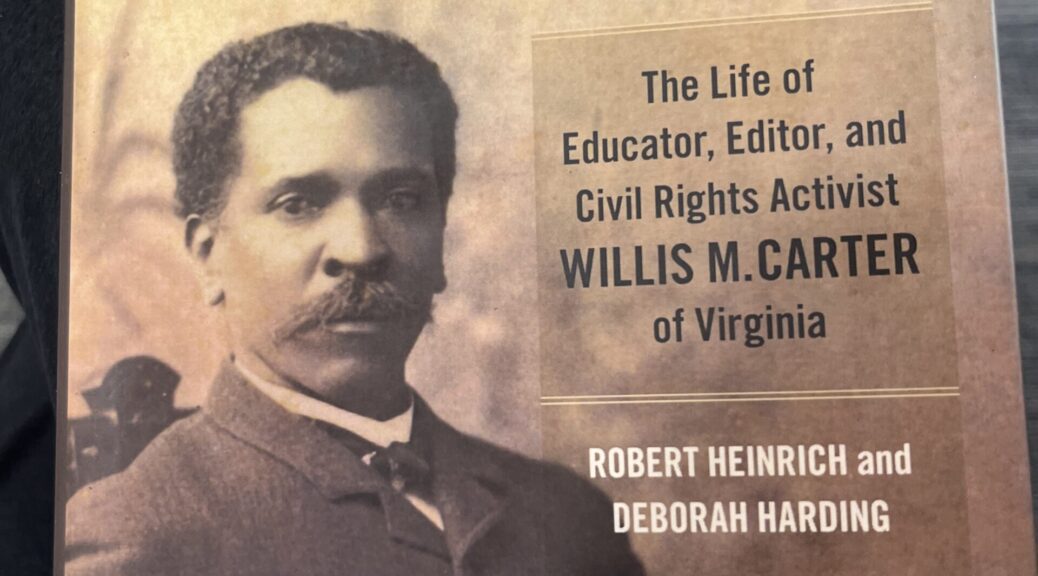
The little known life of Willis Carter – by Terry Howard

I could be wrong (and hope that I am) but the guess here is that those about to read this column are probably unfamiliar with the name Willis McGlascow Carter. (How about a show of hands by those who do and are anxious to prove me wrong.)

But for those who don’t, no worry since until recently, neither did I although he spent most of his life as a teacher, newspaper editor and activist in Staunton, Virginia, which happens to be my hometown.

Continue reading The little known life of Willis Carter – by Terry Howard