As a lifetime reader of Black newspapers – among them the Baltimore Afro-American, Chicago Defender, Pittsburgh Courier, New York Amsterdam News – I woke up to the headline, “The Richmond Free Press ceased publication,” a Black newspaper and held onto the fragile hope that someone had played cruel AI hoax on me. I wish I could sit here and say that was the case, but I can’t. Lord knows I can’t.
Life is never easy in Hong Kong. When I was a kid, the percentage of girls receiving proper education was low.Girls having higher education was much rarer. Boys were expected to do good at school and then at work.No such expectations for girls. Luck was always on my side. I passed all the examinations which I needed to pass to move on to the next level.My formal education ended being a graduate of the Chinese University of Hong Kong with a major in Sociology.I was having a free time at school and then free choice in my career.
In August, 2023, two of my friends — Sandra Fowler and Daniel Yalowitz — set out to make a difference.They envisioned a book on the field of interculturalism structured around individual professional autobiographies written by twelve people, mostly in their eighties, whom they deemed to be intercultural pioneers .I was one of the dozen selected, also the oldest at 91 when the book — Creating the Intercultural Field: Legacies from the Pioneers — was published in 2025.
Within diversityworld, the field of interculturalism is not all that prominent.It isn’t a widely-trumpeted diversity term like microaggressions or white fragility or critical race theory. It doesn’t make headlines like DEI.In fact, although its origins date back to the early twentieth century, interculturalism has operated effectively in the shadows without the widespread public recognition of hotter and more critically scrutinized fields like ethnic studies.
Having worked in the field nearly 33 years now and as President, CEO, of DTG fornearly 30 years, I have confronted these myths over and over and I am constantlydebunking them. I often distribute this document prior to a diversity and inclusion-related conversation, forum or training to undo the bias about an upcoming workshop onbias (what I call bias squared).
Hard to believe that a little over a year ago – April 25, 2025, to be exact – a white woman by the name of Mrs. Viola Liuzzo, if we were blessed to have had her still alive last year, would have been 100 years old.
So, on March 25, 2026, it will be sixty-one years since an assassin’s bullet in 1965 snuffed out her life on an Alabama highway; sixty-one years since, during the interim, the passage of the Voting Rights Act four months after her death; sixty-one years, during the interim, Dr. King was also felled by an assassin’s bullet; and sixty-one years since, during the interim, that the hard earned right to vote was instrumental in the election of the first African American president of the United States. One could make a compelling argument that Liuzzo’s assassination was a factor in the fight for civil rights.
Well, at least we as women have one of the longest commemorative months of the year. But equal pay and fair treatment would be preferable. That would be a measure of respect.
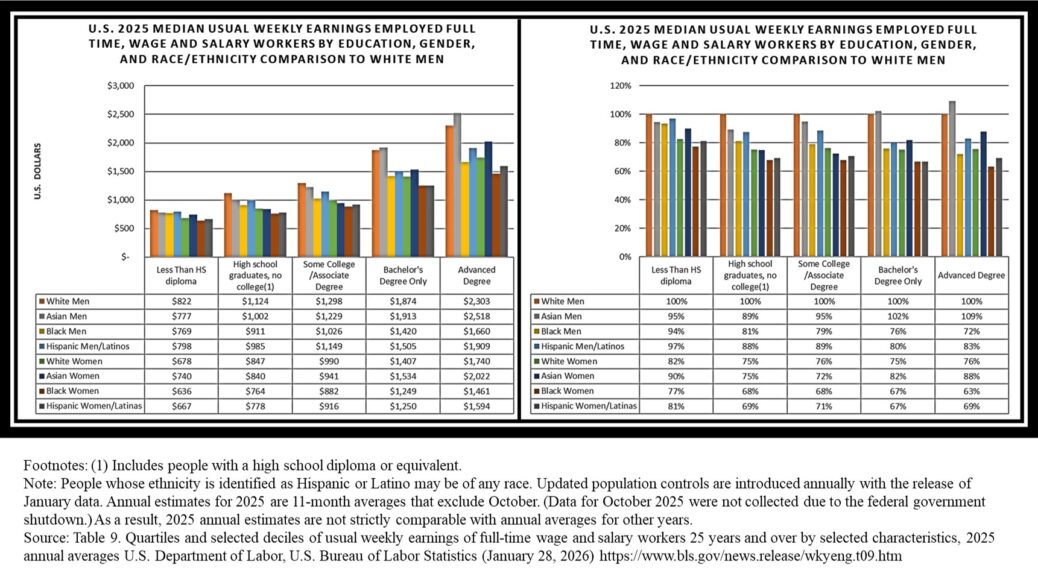
As of 2025, women earn less than men at all education levels, except that Asian women with a bachelor’s or advanced degree earn more than Black men with similar degrees. The gender pay gap is narrowest among individuals without a high school diploma. In essence, education only acts as an equalizer for those with the lowest level of schooling.
2025 Pay Inequality – See chart in headline
In 2003, serving on The Conference Board’s Tough Issues in Diversity panel, I showed that analyzing U.S. weekly median earnings requires considering gender, race or ethnicity, and education level. Over 20 years ago, gender had a greater effect on pay than race/ethnicity and that being a woman of color amplified the negative impact on pay. I found that higher education did not narrow the pay gap. Sadly, that remains true.
For woman of color the pay gap increases as they obtain higher levels of education. This remained true in 2014, when I analyzed the 2013 Bureau of Labor Statistics for the Harvard Business Review. Black women and Latinas vied for last place on the earning ladder for each level of education. By 2025, Black women were the biggest losers, earning less than any other group at each level of education, with the exception of Black women and Hispanic women/Latinas with bachelor’s degrees tying for last place in median weekly earnings.
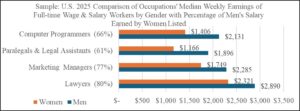
Yes, equitable pay would demonstrate that women’s work is respected as much as men’s. However, according to the U.S. Bureau of Labor Statistics, even when women are performing the same jobs, women are paid less than men. For example, female computer programmers earn 34% less than their male counterparts, while female marketing managers make 23% less than male marketing managers.
Addressing respect for women should be a no brainer, since women are approximately 50% of the global population. However, mainstream media allow talk show hosts, guests, and scriptwriters to use the B-word for women. If the importance of censorship is recognized to censor the N-word for people of African ancestry and censors the F-word for gay men, why are women’s psychological safety and psyche disregarded?
Why do mainstream media, cable, or streaming/podcasts, tend to refer to women by their first name? Men are routinely referenced by their surname. Why are women’s titles rarely mentioned? While serving as Secretary of State, Kissinger was often called Dr. Kissinger in news coverage, especially when his official title was not mentioned. Secretary of State Rice was often referenced as Condoleezza rather than Dr. Rice in similar circumstances.
Even when women ran for president of the United States, there was a distinction between how men were referenced than women. This may have been partially due to political strategists or political consultants, who tend to be men, wanting the women candidates to be perhaps more relatable and approachable. But think about it. When former Secretary of State Hillary Clinton and former Vice President Kamala Harris were running for president both in the primary and the general election, their campaign kept canvassing them as Hillary and Kamala. Former President Obama campaign did not promote him as Barack. Nor did President Trump campaign promote him as Donald.
While some may say that Hillary Clinton’s campaign focused on her first name because there had been a President Bill Clinton, George W. Bush campaigned as Bush even though President George H. W. Bush had been in office less than ten years, previously. He did not run as ‘George W’. Research has shown this name bias undermines creditability and authority. Surnames are indicative of a position of power and respect, first names are not, unless the first name is preceded by a royal title, à la, Queen Elizabeth!
Women’s History Month is a wonderful recognition of women’s achievement throughout history. Besides recognizing women for their contribution to society and culture, provide them respect and equitable pay. They earned it!
Okay, I’ll take my licks and apologize if anyone finds my headline repulsive; Sorry… Lo siento …Je suis désolé(e) …Es tut mir leid …or Entschuldigung …. 对不起. …..Now if I missed a sorry in another language, well here’s my blanket apology; I’m sorry about that too.
So, with that said and out of the way, how about we consider our “repulsiveness” in a historical context. Let’s talk about the lingering power of images that are burnt into our subconscious and remain buried there sometimes for a lifetime.
In 1816, 19-year-old Mary Wollstonecraft Godwin captivated her close friends with a story about a monster.Two years later, now married andknown as Mary Shelley, she stunned the reading world with her novel, Frankenstein, or, The Modern Prometheus (1818).
Frankenstein’s monster was a man.It remained so in most film renditions.Notable exceptions were the 1935 “The Bride of Frankenstein,” who was actually created by Dr. Victor Frankenstein as a partner for his original male version, and the 2026 “The Bride”.
Frankenstein’s monster was not totally evil.He was big, strong, and often unaware of his ability to create havoc because of his size and strength.In some versions, such as Guillermo del Toro’s 2025 film, the monster’s human sensitivities figure prominently.
Today we are dealing with a monstrous new creation, artificial intelligence (AI).To the best of our knowledge, AI doesn’t have feelings.However, we know something else.AI is male tilted, and some of our fellow human beings are responsible.
It’s March 2026. Women’s History Month has many people reflecting on progress. This year’s theme is “Leading the Change: Women Shaping a Sustainable Future.” When I hear “sustainable,” I think about trust. I also think about keeping your voice alive in business.
If leaders do not record what they know, who will? How will the next generation learn? Your experience is an asset. It should not disappear in a calendar archive.
For years, women heard “lean in” and “break glass ceilings.” In 2026, the bigger shift is communication itself. Credibility is earned in long-form conversations. Your thinking becomes visible. Your standards become trackable. That is not “content.” That is executive presence, documented.
Resilience did not begin with us. It did not start on social media. It did not arrive with modern movements. Women have been resilient for centuries. Quietly. Boldly. Without applause.
Across time, women have carried families, built communities, and sustained economies. Many did so without recognition or compensation. They endured wars, poverty, discrimination, and loss. Yet they rose each morning and kept moving.
Resilience is not loud. It is steady. It is the woman who shows up when her heart is tired. It is the mother who stretches meals and hope. It is the entrepreneur who rebuilds after rejection. It is the leader who holds firm when the room doubts her.