Category Archives: Inclusion

Diversity and Inclusion

A Thanksgiving to Remember – by Shayne Perry

A young boy, sat at a table full of people he didn’t know. A large family, all helping to make their thanksgiving dinner. Smells and laughter waft through the house. No television to distract from the face-to-face interaction. All the food is scratch made. The kitchen is littered with bits and pieces of dishes and ingredients, a messy labor of love. The smiles and plate passing keep the energy up. The boy is confused, there is no turkey, but a large plate of chitlins, and a ham. There aren’t any scalloped potatoes, but collard greens. As much as Thanksgiving is a universal experience, it differs house to house, culture to culture. This is a short story about how he came to know his neighbors.

Continue reading A Thanksgiving to Remember – by Shayne Perry
Cross-generational Adulting – by Tom Bissonette

A Boomer’s plea for unity

I was a bit put off when I first heard the term “adulting”, the traditional noun turned into a verb. It sounded like an excuse young people were using to buy themselves more time to step up to the demands of being a “grownup.” I grew tired of hearing how hard adulting is. I briefly had the same mindset as the other old guy who complained about the “Peter Pan Syndrome” of today’s youth in a TikTok video which set off the viral “OK Boomer” retort on Instagram and other social media. Since I was still somewhat indoctrinated in traditional views of human development, “adulthood” was a landing place after certain basic criteria were met. One’s chronological age plus official legal status as an adult was usually enough to claim it, maybe with a modicum of independence thrown in.

Continue reading Cross-generational Adulting – by Tom Bissonette

The Heartbreak in Hanger Sales – by Samantha Belcher

In early May of 2022, I noticed a couple of protestors yelling at the downtown traffic on my drive home. Ironically, I believe I was on my way home from grabbing boba with some friends to commemorate the end of our junior year of college. I was unable to make out what their signs or chants depicted nor did I have much interest. It wasn’t until a few hours later when my father texted me a link to a news story covering what would be known as the beginning of worldwide heartbreak: the leaked draft of the Supreme Court majority decision in Dobbs v. Jackson Women’s Health Organization (2022) that would explicitly overturn the 1973 Roe v. Wade ruling.

Continue reading The Heartbreak in Hanger Sales – by Samantha Belcher

From Conditional to Equitable Inclusion: Inclusivity for a Stronger Nation – by Carlos Cortés

Keynote Address for Unidos:
2022 National Hispanic Heritage Month Celebration of the U.S. Dept. of Energy

Thank you for inviting me to join you for Hispanic Heritage Month.  And thank you for providing me the opportunity to reflect upon a very important idea: inclusivity.
________________________

In 1999, Mayor Ronald Loveridge of my hometown — Riverside, California –- asked me to lead a new city initiative, the Mayor’s Multicultural Forum.  He also asked the Forum to begin by drawing up a position statement on diversity.  We called the document “Building a More Inclusive Riverside Community.”  The City Council adopted the document, making inclusivity a basic city principle.

That was more than two decades ago.  Today you constantly hear variations of that idea.  Take DEI: Diversity, Equity, and Inclusion.  As a diversity consultant, lecturer, and workshop presenter I often use those terms, sometimes without giving them much thought.  So when you asked me to speak on the topic of inclusivity, I had to make a decision.  Should I give a traditional Hispanic Heritage speech filled with the usual once-a-year truisms about Latino this and Latinx that?  Sort of a Hispanic Groundhog Day?  I decided no.  You deserve something more original.

Continue reading From Conditional to Equitable Inclusion: Inclusivity for a Stronger Nation – by Carlos Cortés

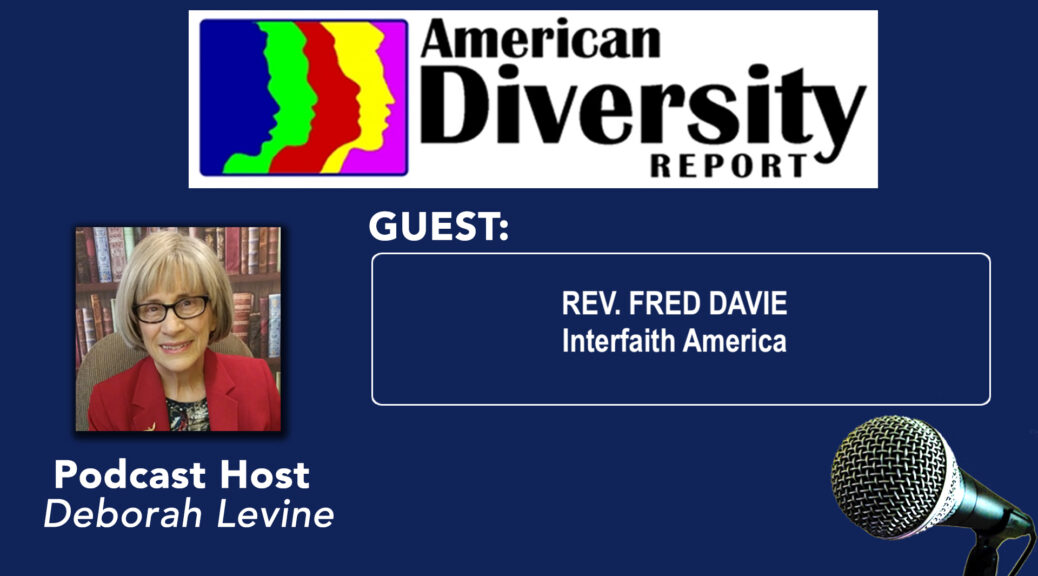
Rev. Fred Davie Podcast: Religious Diversity at Interfaith America

religious diversity Reverend Fred Davie is a Senior Advisor for Racial Equity at Interfaith America, where he executes programming with a primary focus on the intersection of race and religion. He is also a minister in the Presbytery of New York City, and recently served as the Executive Vice President at Union Theological Seminary.

Hear Rev. Davie address these vital questions:
  1. Why does Interfaith America consider religious diversity a foundational American strength?
  2. Why should religion be front and center in conversations about both diversity and social change?
  3. How does religious diversity help build better institutions and a better civil society?
You will be inspired to engage in ongoing discussions of …
  • The need for a positive conversation about religious pluralism.
  • How our diversity conversation should be more focused on highlighting the contributions that America’s varied communities bring to our potluck nation rather than continually centering tension and oppression.
  • How religion is a force that inspires many and is a bridge of cooperation between our diversity and the largest contributor to our civil society.

CLICK for podcast interview

Overhauling the Americans with Disabilities Act – by Lionel Wolberger

There has been a surge in federal civil rights lawsuits regarding the Americans with Disabilities Act (ADA) over the past decade. Lawsuits involving website accessibility under the ADA are also on the rise, growing 14% year-over-year in 2021. The major complication in all of this is that the ADA, passed by Congress in 1990, predates the earliest websites. Because the law does not explicitly discuss web accessibility, over the past three decades a legal landscape has developed that is both unpredictable and divisive.

For one, rules and regulations for web accessibility are beginning to vary from state to state. Members of Congress are penning letters to the Department of Justice (DOJ) urging them to establish clear accessibility rules for state and local websites. And there are a growing number of inconsistent rulings among that nation’s federal court districts on the subject. This article will explore the urgency of revamping the ADA to account for existing and emerging technology, and how uncertainty continues to grow on how and where the ADA applies.

Continue reading Overhauling the Americans with Disabilities Act – by Lionel Wolberger

Are Men Necessary? (Part 2) – by Terry Howard

I can’t keep up with bad behaviors by men nowadays – not all men before you lapse into cardiac arrest in anger at me – but those dudes who can’t seem to deal with their demons, fears, mental illnesses and hatreds in ways other than through the barrel of an AR-15.

So was it not men who flew planes into the World Trade Center, the field in Shanksville, Pennsylvania and the Pentagon on 9/11? Was it not the “Alt Right” men who marched in Charlottesville, Virginia in 2017 protesting the removal of the statue of Confederate general Robert E. Lee that led to at least one death and scores of injuries? 

Was it men who murdered nine church parishioners in Charleston, South Carolina in 2015 and who gunned down six Asian women in Atlanta two years ago? Weren’t the gut-wrenching shootings at Texas’s Uvalde’s Robb Elementary School and at the July 4th parade near Chicago committed by men?  Was it a demented man who killed 11 worshipers at a Pittsburg synagogue? And more recently, was men who killed six Muslims in Albuquerque, or a man who plunged a knife into the neck of author Salam Rushdie in New York?
Continue reading Are Men Necessary? (Part 2) – by Terry Howard

A Middle East Angle on Diversity Part 1: When is protection oppression? – by Dana Winner

Each time we convene a new JASSPr class in the city of Jahra, Kuwait, the girls sit at the back of the room while the boys take their place at the front of the room. The first time I saw this, I felt offended on behalf of the girls. I wondered who told them they must sit at the back of the class? Is it an explicit order or implicit habit? More important, what could I do about it? Should I do anything about it? Their culture is about protecting the girls. When is protection oppression?

Civil Rights Icon Diane Nash….What else don’t we know? – by Terry Howard

Nash
Photo: From left, Reverend John L. Edwards, Jr., Diane Nash, and John L. Edwards, III

When I got the news that President Biden recently awarded the Presidential Medal of Freedom to civil rights icon Diane Nash, I called an elated John Edwards, III, publisher of the Chattanooga News Chronicle having recalled a chat I had with him a while ago about his memories of and experiences with Nash.

Said Edwards, whose dad was an influential pastor and civil rights leader in Tennessee, and whose church was bombed by racists, “I was only 12 years old when I got the approval from my father to take part in the sit-ins. Dad dropped me off at the church early each morning where I sat on the front row and took my marching orders from John Lewis and Diane Nash. I was so enamored with those two Fisk University students and the courage they embodied.”
Continue reading Civil Rights Icon Diane Nash….What else don’t we know? – by Terry Howard

On rustic church pews – by Terry Howard

If ever there was an eye-catching picture, this one fits the bill.

You see, a fellow I grew up with in a small town in Virginia posted it on Facebook. I’m not sure of its source or time, but think that maybe it was sometime in the 40s or earlier. Who knows for sure?

Okay, I admit to having lost count of the number of times I’ve looked at it, and am doing so right now as Juneteenth is in the spotlight. However, to get other reactions I randomly shared it with several folks.