
Category Archives: Social Issues

Social causes, activism, and projects

U.S. Indian Boarding School Report – by Marc Brenman

In April 2022, the U.S. Department of the Interior issued the Federal Indian Boarding School Initiative Investigative Report. The report was probably prompted by several year’s ago Canadian report on First Peoples boarding schools, and by the appointment of the first Native American Secretary of the Interior. The Canadian report was issues by the National Centre for Truth and Reconciliation in 2015. 

The U.S. report has much interesting information on cultural eradication. Native American children were forced from their families and into schools that were little better than prisons, beginning in the early years of the American Republic. Esteemed Founding Fathers like Thomas Jefferson and Benjamin Franklin expressed anti-Indian beliefs. Interestingly, these sentiments were sometimes expressed in confidential memos to Congress, as if it was known even then that the actions were morally reprehensible. 

Continue reading U.S. Indian Boarding School Report – by Marc Brenman
Anti-abortion and the Descent into Fascism – by Marc Brenman

What can be said about the anticipated anti-abortion decision from the US Supreme Court that hasn’t been said already? From a civil rights and social justice perspective, the reasoning in Justice Alito’s draft opinion is dangerous. It presages and exemplifies anti-democratic tendencies already present and vigorous on the American right. There are many “rights” that are not mentioned explicitly in the Constitution. Even though Alito’s draft says the decision should not be used as precedent in restricting other rights, the effort is already underway to do so. These include privacy, LGBT rights, the rights of people with disabilities, and the education of non-citizen children in public schools. And of course, the rights of women, educational rights, and the right to housing, to eat, and to live in a clean environment.

Although we hear about it relatively little, the Equal Rights Amendment has never been added to the Constitution. However, there are many laws from Congress on protecting women, people with disabilities, and the environment. Women’s health advocates want Congress to pass similar laws protecting abortion. This is unlikely to occur, with the close division between the parties in the Senate, and the likely loss of Democratic House seats in the mid-term election. In addition, the Supreme Court can overturn acts of Congress if they believe the laws are not rooted in the Constitution. 

Continue reading Anti-abortion and the Descent into Fascism – by Marc Brenman

Diversity and Speech Part 30: The Strange Odyssey of Racial Sports Metaphors – by Carlos Cortés

Woke people don’t stereotype, right?  And, of course, white men can’t jump.  Hm.  Consider the following.

For relaxation, my wife Laurel and I attend a bi-weekly creative writing workshop.  For a recent assignment, our instructor Jo Scott-Coe asked us to write about chocolate.   Each of the other participants wrote about food.   Not me.  For whatever reason, Jo’s assignment triggered thoughts of former National Basketball Association guard Jason Williams.

Continue reading Diversity and Speech Part 30: The Strange Odyssey of Racial Sports Metaphors – by Carlos Cortés

Afflictions of American Health Care – by Eliana Teel

When I was seven years old, I had my first MRI, or Magnetic Resonance Imaging – a medical imaging machine that generates internal images of the body. The tubular machine was quite large in comparison to my petite body. I can still remember how scared I was as they placed headphones twice the size of my head over my ears and pushed me back into the small cylinder. Or how the nurse called the IV that shot cold, contrast dye throughout my bloodstream a “butterfly clip” to ease the nerves. The MRI was ordered to examine my neck and upper spine because I was experiencing a lot of unusual pain there for a child that young. What my family and I didn’t expect was to be in that room for two more hours as they caught a glimpse of something concerning in my lower back.

Continue reading Afflictions of American Health Care – by Eliana Teel

African American History Month: what else don’t we know? – by Terry Howard

This piece explores another African American bit of history. It is about John Lewis and James Zwerg.

Like many, I would love to have been a proverbial “fly on the wall,” listening intently to candid conversations between those two men. Of course, we –well, most of us anyway – know about the late congressman John Lewis. But James Zwerg?

Diversity in Tech Tips – by Pearl Kasirye

The tech industry is one of the fastest-growing industries in the world. We live in a digital era where technology has become an essential part of our daily lives and work processes. For this reason, we need tech companies that create software that improves our lives, cybersecurity agencies that protect our online data, and experts who develop new technologies annually.

There is a high demand for technology and people who specialize in this field. What strikes me the most is the lack of diversity in such an essential industry like tech. Are the most qualified people always white and male? Or are other groups of people intentionally underrepresented?

Continue reading Diversity in Tech Tips – by Pearl Kasirye

Challenges of Teaching about Diversity and Health Equity – by Carlos E. Cortés

A Difficult Conversation about Difficult Conversations forDeveloping Medical Educators of the 21st Century:
New Ideas and Skills
for Adaptable and Inclusive
Learning Environments Conference

February 4, 2022 (Revised, February 6, 2022)

 Let’s start with today’s ground rules.  None.  No rules; no powerpoints.

But three hopes.  That you speak honestly without obsessing about maybe saying the wrong thing, a bane to diversity discussions.  That you contemplate divergent ideas.  And that you reflect openly on your own perspectives by posting comments and questions in the chatbox as we go along.   

So let’s turn to our theme, difficult conversations about diversity and health equity.  Health equity conversations necessarily involve discomfort because they address the idea of group diversity, not just random individual differences.

Continue reading Challenges of Teaching about Diversity and Health Equity – by Carlos E. Cortés

MLK Day: Civil Rights Lessons for Millennials and Gen Z – by David Grinberg

On Monday the nation will pause to observe the annual holiday honoring the life and legacy of iconic civil rights leader, Dr. Martin Luther King, Jr. Yet too many Millennials and members of their younger cohort, Generation Z, consider civil rights history as ancient history at the dawn of a new millennium.

However, there are profound and poignant lessons which today’s young people need to learn. The most important lesson is how to make major changes in society through the type of peaceful means championed by the Rev. Dr. Martin Luther King Jr. and his fellow civil rights leaders of the time.

A term of significance for young people to comprehend is: “civil disobedience.” Continue reading MLK Day: Civil Rights Lessons for Millennials and Gen Z – by David Grinberg

The exam paper that stumped all – by Mona Bopanna

How will India respond in 2022 to this regressive stance towards women?

In December, 2021, millions of secondary school students in India appeared for their Class X (Grade 10) exams conducted by the Central Board of Secondary Education (CBSE).

Since its inception in the 1920s, the Board has gone through several changes and emerged as one of the largest such organisations in the world, with more than 25,000 school — based in India and other countries — affiliated to it. Each year, about 2 million students take the secondary board exams.

Continue reading The exam paper that stumped all – by Mona Bopanna

Algorithmic Biases & Economic Inequality – by Pearl Kasirye

America has a long history of racial segregation and systemic racism that made it difficult for ethnic minorities to achieve financial and economic stability. Well-researched academic studies have found that “even after decades of growing diversity…most Americans still live in racially segregated neighborhoods.”

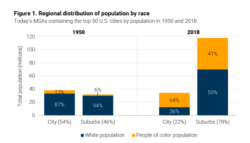
A study conducted by the University of Minnesota found that 64% of the urban city population are people of color while only 34% are white. Take a look at the graph below:

Equity


This data shows that in the 1950s, the suburbs were populated by a majority of white people (94%), and in 2018, they are still the majority (59%). While the cities have become even more populated by people of color in 2018 than in 1950.
Continue reading Algorithmic Biases & Economic Inequality – by Pearl Kasirye