Well, at least we as women have one of the longest commemorative months of the year. But equal pay and fair treatment would be preferable. That would be a measure of respect.
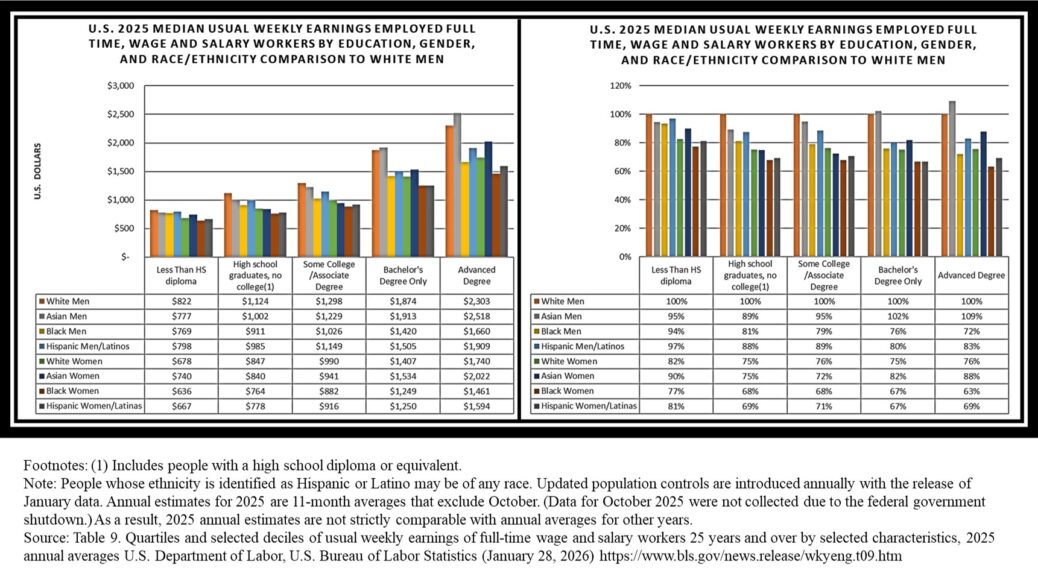
As of 2025, women earn less than men at all education levels, except that Asian women with a bachelor’s or advanced degree earn more than Black men with similar degrees. The gender pay gap is narrowest among individuals without a high school diploma. In essence, education only acts as an equalizer for those with the lowest level of schooling.
2025 Pay Inequality – See chart in headline
In 2003, serving on The Conference Board’s Tough Issues in Diversity panel, I showed that analyzing U.S. weekly median earnings requires considering gender, race or ethnicity, and education level. Over 20 years ago, gender had a greater effect on pay than race/ethnicity and that being a woman of color amplified the negative impact on pay. I found that higher education did not narrow the pay gap. Sadly, that remains true.
For woman of color the pay gap increases as they obtain higher levels of education. This remained true in 2014, when I analyzed the 2013 Bureau of Labor Statistics for the Harvard Business Review. Black women and Latinas vied for last place on the earning ladder for each level of education. By 2025, Black women were the biggest losers, earning less than any other group at each level of education, with the exception of Black women and Hispanic women/Latinas with bachelor’s degrees tying for last place in median weekly earnings.
Yes, equitable pay would demonstrate that women’s work is respected as much as men’s.
Addressing respect for women should be a no brainer, since women are approximately 50% of the global population. However, mainstream media allow talk show hosts, guests, and scriptwriters to use the B-word for women. If the importance of censorship is recognized to censor the N-word for people of African ancestry and censors the F-word for gay men, why are women’s psychological safety and psyche disregarded?
Why do mainstream media, cable, or streaming/podcasts, tend to refer to women by their first name? Men are routinely referenced by their surname. Why are women’s titles rarely mentioned? While serving as Secretary of State, Kissinger was often called Dr. Kissinger in news coverage, especially when his official title was not mentioned. Secretary of State Rice was often referenced as Condoleezza rather than Dr. Rice in similar circumstances.
Even when women ran for president of the United States, there was a distinction between how men were referenced than women. This may have been partially due to political strategists or political consultants, who tend to be men, wanting the women candidates to be perhaps more relatable and approachable. But think about it. When former Secretary of State Hillary Clinton and former Vice President Kamala Harris were running for president both in the primary and the general election, their campaign kept canvassing them as Hillary and Kamala. Former President Obama campaign did not promote him as Barack. Nor did President Trump campaign promote him as Donald.
While some may say that Hillary Clinton’s campaign focused on her first name because there had been a President Bill Clinton, George W. Bush campaigned as Bush even though President George H. W. Bush had been in office less than ten years, previously. He did not run as ‘George W’. Research has shown this name bias undermines creditability and authority. Surnames are indicative of a position of power and respect, first names are not, unless the first name is preceded by a royal title, à la, Queen Elizabeth!
Women’s History Month is a wonderful recognition of women’s achievement throughout history. Besides recognizing women for their contribution to society and culture, provide them respect and equitable pay. They earned it!
- R-E-S-P-E-C-TWomen’s History Month – by Deborah Ashton - March 12, 2026
- Defining the Role of Language, Culture, National Identity – by Deborah Ashton - January 8, 2026
- Political Violence & Inclusion– by Deborah Ashton - September 16, 2025