Category Archives: Of Women

About  Women

R-E-S-P-E-C-T Women’s History Month – by Deborah Ashton

Well, at least we as women have one of the longest commemorative months of the year. But equal pay and fair treatment would be preferable. That would be a measure of respect. 

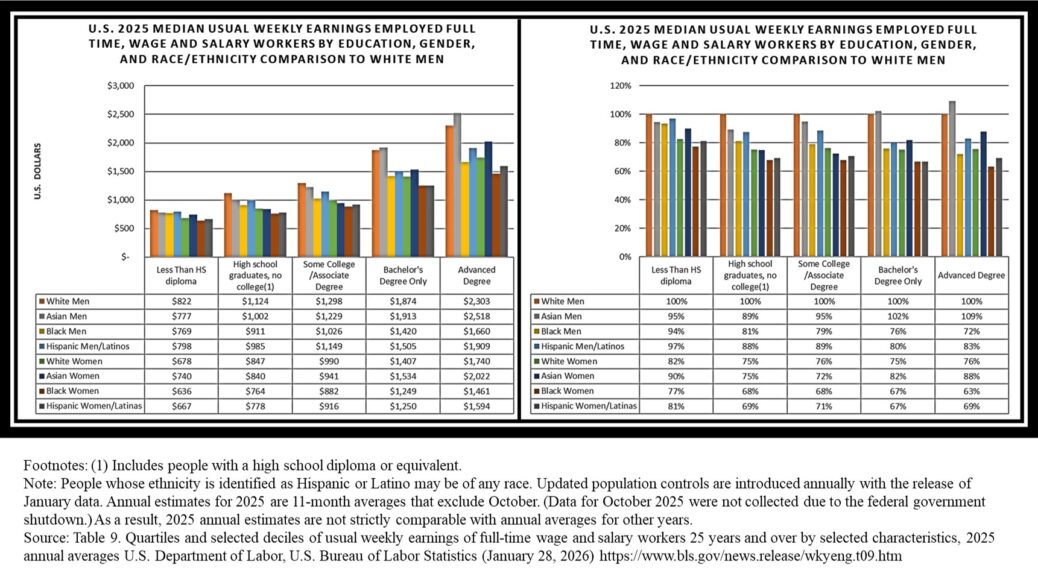
As of 2025, women earn less than men at all education levels, except that Asian women with a bachelor’s or advanced degree earn more than Black men with similar degrees. The gender pay gap is narrowest among individuals without a high school diploma. In essence, education only acts as an equalizer for those with the lowest level of schooling.

2025 Pay Inequality – See chart in headline

In 2003, serving on The Conference Board’s Tough Issues in Diversity panel, I showed that analyzing U.S. weekly median earnings requires considering gender, race or ethnicity, and education level. Over 20 years ago, gender had a greater effect on pay than race/ethnicity and that being a woman of color amplified the negative impact on pay. I found that higher education did not narrow the pay gap. Sadly, that remains true.

For woman of color the pay gap increases as they obtain higher levels of education. This remained true in 2014, when I analyzed the 2013 Bureau of Labor Statistics for the Harvard Business Review. Black women and Latinas vied for last place on the earning ladder for each level of education. By 2025, Black women were the biggest losers, earning less than any other group at each level of education, with the exception of Black women and Hispanic women/Latinas with bachelor’s degrees tying for last place in median weekly earnings.

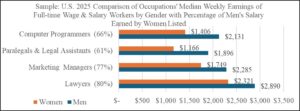
Yes, equitable pay would demonstrate that women’s work is respected as much as men’s. However, according to the U.S. Bureau of Labor Statistics, even when women are performing the same jobs, women are paid less than men. For example, female computer programmers earn 34% less than their male counterparts, while female marketing managers make 23% less than male marketing managers.
pay inequality

Addressing respect for women should be a no brainer, since women are approximately 50% of the global population. However, mainstream media allow talk show hosts, guests, and scriptwriters to use the B-word for women. If the importance of censorship is recognized to censor the N-word for people of African ancestry and censors the F-word for gay men, why are women’s psychological safety and psyche disregarded? 

Why do mainstream media, cable, or streaming/podcasts, tend to refer to women by their first name? Men are routinely referenced by their surname. Why are women’s titles rarely mentioned? While serving as Secretary of State, Kissinger was often called Dr. Kissinger in news coverage, especially when his official title was not mentioned. Secretary of State Rice was often referenced as Condoleezza rather than Dr. Rice in similar circumstances. 

Even when women ran for president of the United States, there was a distinction between how men were referenced than women. This may have been partially due to political strategists or political consultants, who tend to be men, wanting the women candidates to be perhaps more relatable and approachable. But think about it. When former Secretary of State Hillary Clinton and former Vice President Kamala Harris were running for president both in the primary and the general election, their campaign kept canvassing them as Hillary and Kamala. Former President Obama campaign did not promote him as Barack. Nor did President Trump campaign promote him as Donald. 

While some may say that Hillary Clinton’s campaign focused on her first name because there had been a President Bill Clinton, George W. Bush campaigned as Bush even though President George H. W. Bush had been in office less than ten years, previously. He did not run as ‘George W’. Research has shown this name bias undermines creditability and authority. Surnames are indicative of a position of power and respect, first names are not, unless the first name is preceded by a royal title, à la, Queen Elizabeth!  

Women’s History Month is a wonderful recognition of women’s achievement throughout history. Besides recognizing women for their contribution to society and culture, provide them respect and equitable pay. They earned it!


Renewing Diversity No. 14: Interrogating Gender Bias in Artificial Intelligence – by Carlos Cortés, Angela Antenore

In 1816, 19-year-old Mary Wollstonecraft Godwin captivated her close friends with a story about a monster.  Two years later, now married and  known as Mary Shelley, she stunned the reading world with her novel, Frankenstein, or, The Modern Prometheus (1818).  

Frankenstein’s monster was a man.  It remained so in most film renditions.  Notable exceptions were the 1935 “The Bride of Frankenstein,” who was actually created by Dr. Victor Frankenstein as a partner for his original male version, and the 2026 “The Bride”.

Frankenstein’s monster was not totally evil.  He was big, strong, and often unaware of his ability to create havoc because of his size and strength.  In some versions, such as Guillermo del Toro’s 2025 film, the monster’s human sensitivities figure prominently.  

Today we are dealing with a monstrous new creation, artificial intelligence (AI).  To the best of our knowledge, AI doesn’t have feelings.  However, we know something else.  AI is male tilted, and some of our fellow human beings are responsible.

Continue reading Renewing Diversity No. 14: Interrogating Gender Bias in Artificial Intelligence – by Carlos Cortés, Angela Antenore

Leading the Change for Trust – by Denise Reed

It’s March 2026. Women’s History Month has many people reflecting on progress. This year’s theme is “Leading the Change: Women Shaping a Sustainable Future.” When I hear “sustainable,” I think about trust. I also think about keeping your voice alive in business.

If leaders do not record what they know, who will? How will the next generation learn? Your experience is an asset. It should not disappear in a calendar archive.

For years, women heard “lean in” and “break glass ceilings.” In 2026, the bigger shift is communication itself. Credibility is earned in long-form conversations. Your thinking becomes visible. Your standards become trackable. That is not “content.” That is executive presence, documented.

Continue reading Leading the Change for Trust – by Denise Reed

Resilience Wears Heels – by Linda Murray Bullard

Resilience Is Not New

Resilience did not begin with us. It did not start on social media. It did not arrive with modern movements. Women have been resilient for centuries. Quietly. Boldly. Without applause.

Across time, women have carried families, built communities, and sustained economies. Many did so without recognition or compensation. They endured wars, poverty, discrimination, and loss. Yet they rose each morning and kept moving.

Resilience is not loud. It is steady. It is the woman who shows up when her heart is tired. It is the mother who stretches meals and hope. It is the entrepreneur who rebuilds after rejection. It is the leader who holds firm when the room doubts her.

Continue reading Resilience Wears Heels – by Linda Murray Bullard

An African American in Women’s History Month – by Terry Howard

To kick off March, Women’s History Month, I decided to write about Unita Blackwell and her place in both African American and women’s histories. Among so many great women of all backgrounds, among them Eleanor Roosevelt, Viola Liuzzo and Susan B. Anthony who advocated for civil and voting rights, I wish that Unita Blackwell was alive and with us today. More than ever, we need her out on the battlefield leading protests and knocking on doors extolling the urgency of exercising our right to vote. Lord knows we need her (and them).

Continue reading An African American in Women’s History Month – by Terry Howard

Strategic Business Advantage of Gender Equity – by Rose Joneson

Inclusive Leadership

Inclusive leadership is no longer a “nice-to-have” or a seasonal initiative highlighted once a year. It is a strategic lever for growth. Companies that treat gender equity as a core business priority — not a public relations effort — consistently build stronger leadership pipelines, make better decisions, and outperform competitors.

Despite progress, women remain underrepresented in executive leadership globally. According to McKinsey & Company’s, women hold roughly one in four C-suite positions, and progress at senior levels remains uneven. This gap is not only a representation issue; it directly impacts organizational effectiveness. Leadership teams lacking diversity often experience narrower strategic thinking and reduced innovation capacity.

Inclusive leadership changes that dynamic. It deliberately creates environments where talent rises based on capability, not access, bias, or outdated systems. Organizations that embrace gender equity as a business strategy unlock measurable advantages: higher employee engagement, stronger retention, broader market insight, and improved financial outcomes.

Here are five strategic pillars that turn gender equity into a true competitive advantage.

1. Establish Clear and Transparent Pathways to Leadership

You cannot expect equitable outcomes from unclear systems. Many organizations still operate with vague promotion criteria, informal sponsorship networks, and inconsistent leadership standards. These environments unintentionally reward visibility over performance and access over merit.

Inclusive organizations remove ambiguity. They define what leadership requires — specific competencies, measurable performance benchmarks, and realistic timelines. They create structured development programs instead of relying on informal networks that often exclude underrepresented groups.

When career progression becomes transparent, confidence increases. Employees are more likely to pursue advancement when they can clearly see the path forward. This isn’t about lowering expectations; it’s about ensuring expectations are clearly defined and consistently applied.

2. Design Flexible Work Structures That Support Long-Term Advancement

Flexible work policies are not perks anymore — they are strategic retention tools. While caregiving responsibilities can affect professionals of all genders, women often carry a disproportionate share. Without structural flexibility, many talented leaders exit the pipeline before reaching senior roles.

Organizations that embrace meaningful flexibility — remote work options, outcome-based performance metrics, adaptable scheduling — expand access to leadership. But flexibility must be authentic. If leadership roles quietly reward presenteeism or 24/7 availability, flexibility becomes performative.

Companies that integrate flexibility into leadership culture see measurable benefits: stronger retention, improved productivity, and broader leadership representation. The result is continuity in talent development rather than constant rebuilding.

3. Address Bias Through Systems, Not Just Workshops

Unconscious bias exists in every organization. The real question is whether systems are designed to minimize their impact.

Bias training is valuable, but training alone does not change outcomes. Inclusive leadership embeds safeguards directly into hiring, evaluation, and promotion processes. Structured interview scoring, diverse hiring panels, standardized performance reviews, and promotion audits reduce subjective decision-making.

When organizations regularly review representation data, compensation patterns, and advancement rates, they move from assumptions to evidence. Data creates accountability. It transforms inclusion from aspiration into an operational discipline.

The goal is not to assign blame. It is to build decision-making frameworks that ensure talent is evaluated fairly and consistently.

4. Strengthen Infrastructure with Strategic HR Guidance

Human resources plays a critical strategic role in advancing gender equity. Effective HR guidance ensures that inclusion is not siloed within one department but embedded across the organization.

Strategic HR frameworks shape recruiting pipelines, compensation structures, succession planning, and leadership development programs. They create guardrails that prevent inequities from emerging and address them quickly when they do.

This includes pay equity audits, transparent compensation bands, structured mentorship initiatives, and formal sponsorship programs that connect emerging female leaders with executive advocates. It also means tracking progress consistently — not once a year, but as an ongoing metric tied to leadership accountability.

When HR operates as a strategic partner rather than an administrative function, it becomes a driver of inclusive growth.

5. Engage Leadership Commitment and Active Allyship

Inclusive leadership requires visible commitment from the top. Cultural transformation accelerates when executives model inclusive behaviors and actively support gender equity initiatives.

Male leaders, in particular, often hold influential sponsorship positions. When they advocate for qualified women, challenge biased assumptions in meetings, and ensure equal access to high-visibility projects, momentum increases.

True allyship is proactive. It involves opening doors, sharing influence, and reinforcing equitable standards in decision-making rooms. When leadership accountability is tied to measurable inclusion goals, equity becomes part of performance expectations — not a side project.

The Compounding Business Impact

When these strategies operate together, the results compound.

Inclusive leadership improves decision quality by incorporating broader perspectives. It strengthens employer branding by signaling fairness and opportunity. It reduces turnover costs by retaining high-performing talent. It enhances resilience by building adaptable, psychologically safe teams.

Most importantly, it aligns leadership capability with the realities of diverse markets. Companies serve diverse customers. Leadership teams that reflect that diversity are better positioned to understand, anticipate, and meet evolving needs.

Gender equity is not about symbolic representation. It is about maximizing available talent. Organizations that overlook half the talent pool limit their own growth potential.

Moving from Initiative to Strategy

Inclusive leadership becomes a competitive advantage when it shifts from initiative to infrastructure. That means embedding equity into hiring criteria, performance reviews, compensation decisions, succession planning, and executive accountability metrics.

It requires consistent measurement. It demands transparency. And it calls for leaders willing to challenge legacy systems that no longer serve a modern workforce.

The organizations that treat gender equity as strategy — not sentiment — are building the leadership teams of the future. They understand that inclusion fuels innovation, equity strengthens engagement, and diverse leadership drives smarter business outcomes.

In today’s competitive environment, that is not optional. It is decisive.

Graphic: pexels-yankrukov-7793699

The Psychology of Displacement and Projection – by Olya K-Mehri

In professional and organisational settings, the word “aggressive” is often applied in response to tone rather than conduct. What is described as aggression in these moments seldom concerns hostility; instead, it reflects an emotional defence mechanism in which discomfort is projected onto the speaker. Through processes of displacement and projection, the listener redirects their unease rather than examining its source. subsequent labelling of their expression as “aggressive” functions less as an objective observation and more as a psychological strategy to preserve equilibrium and reaffirm dominant notions of professionalism.

Continue reading The Psychology of Displacement and Projection – by Olya K-Mehri

The Realities of Dark-Skinned Black Women – by Terry Howard

I begin this piece with a test on your ability to immediately recognize the names of the following  five prominent Black women in the United States. Any luck? 

Lisa Cook, Federal Reserve Board member
Latitia James Attorney General, New York
Ketanji Brown-Jackson, U.S. Supreme Court Justice
Stacey Abrams, former Georgia State Representative
Jasmine Crockett, Texas State Representative

Continue reading The Realities of Dark-Skinned Black Women – by Terry Howard

Prof. Anita Hill: Significance of Seat-taking – by Terry Howard

“Are you a scorned woman?” 

That was the “brilliant” question asked to Prof. Anita Hill by Senator Howell Heflin, a member of the Senate Judiciary Committee during the 1991 confirmation hearing (comprised entirely of graying white men) there to determine the fitness of Clarence Thomas for a seat on the U. S. Supreme Court.

After a three second – “are you kidding me” – pause and throat clearing, the good professor calmly answered, “no I’m not senator!”

Now let’s fast forward 35 years later to a recent Sunday night when Prof. Hill sat stoically across the desk from her interviewer, CNN’s Jake Tapper, to recap the experience and her life since then. On full display during that interview was the sempiternal nature of her professional demeanor that’s seemingly unchanged by time, a steadiness Prof. Hill exhibited during eight hours of blistering grilling by senators, some of whom had questionable backgrounds with respect to their treatment of women. Her poise and unflappability during her interview were textbook. 

Continue reading Prof. Anita Hill: Significance of Seat-taking – by Terry Howard

Celebrating WOMEN’s History MONTH – By Camm Ashford

Originally published in the Chattanooga News Chronicle

Deborah Levine:
A Woman of History Making History

Multi-dimensional. Purposed. Passionate. Resilient. These words and many more describe Deborah Levine – a woman of history making history as she lives.

A Chattanoogan by choice, the soft-spoken author gave the Chattanooga News Chronicle the honor of an interview for readers to be inspired during Women’s History Month, as well as know the hidden achievers who live in our very own community.

Deborah Levine’s biography features her accomplishments to include the roles of author, writing coach, editor-in-chief, script writer, journalist, and pioneer of cross-cultural leadership. Just as her roles are many so are her passions to learn, study, read, write, communicate, and convey to others tremendous insight and information.

Continue reading Celebrating WOMEN’s History MONTH – By Camm Ashford