I phoned the Los Angeles County Bureau of Adoptions. The switchboard operator asked me to please hold. Finally the director, Jessica Keebler, came on. “Yes, Mr. Barlin.”
“It’s been two years since we put in our application—”
“There are still no Jewish children available, Mr. Barlin.”
To achieve organizational cultural competence within the health care leadership and workforce, it is important to maximize diversity. This may be accomplished through:
• Establishing programs for minority health care leadership development and strengthening existing programs. The desired result is a core of professionals who may assume influential positions in academia, government, and private industry.
• Hiring and promoting minorities in the health care workforce.
• Involving community representatives in the health care organization’s planning and quality improvement meetings.
The complex constellation of skills required for global leadership is continually morphing. The basic leadership competencies are only an axis around which revolve the specifics of local culture and the
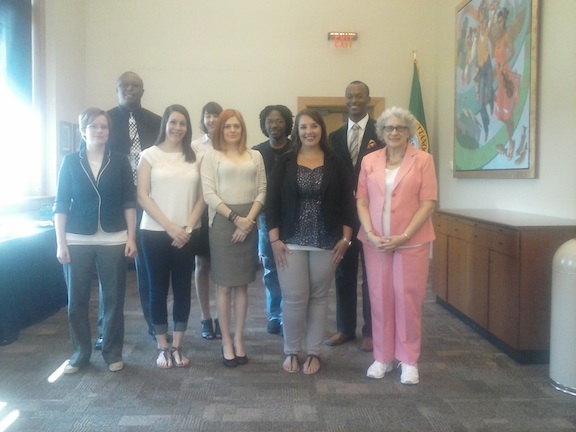
Office of Multicultural Affairs interns
analytics of the target culture globally. Therefore, not only does the knowledge management evolve, but so does the audience for global leadership development. At one time, the audience was primarily executives involved in international relocation. Over time, that group widened to include those who work with them: Human Resource departments, Supply Chain groups, and professionals with frequent contact, particularly in the STEM fields: Science, Technology, Engineering, and Math. Today, in order to stay competitive in this environment, virtually every nation on the face of the planet is extending their global leadership training into new arenas. A key area is our youth, brought up on the internet with its impersonal speed and no-holds-barred communication style. The question now becomes, how can we capture the imagination, thought processes, and commitment of potential leaders in an arena with few quick answers or short tweets.
We are constantly shuttling between local and global in our work today. Your markets may be in your home town one month, and across the country the next. Your consulting work can be on site around the corner, or across the country. Online night and day, we inform, coordinate, network, and market here at home and across the world. In the midst of massive information overload, the diverse team must have the expertise to cross cultures competently and the wisdom to make effective decisions quickly. In the future, the overload will only intensify. How will we master the global – local connection as it moves and morphs at lightening speed?
My kerfuffle with a department store floor ended with me lying on the floor. All that went through my mind was, “How will I get everything done for our Women’s History Storytelling celebration?” Part of me muttered, “We’re doomed!” But part of me said, “Ah, the Broken Bone Factor! This isn’t a disability – this is diversity at work! ”
This wasn’t my first experience with the Broken Bone Factor. Chicago 1990, I sat in my office, staring at the cast on my broken foot. I’d survived three years planning the National Workshop on Christian-Jewish relations, but oversee the actual 4-day conference was like running a marathon through the world’s hottest topics: Church-State issues, International wars, Life & Death. The convention center had just called yelling, “Extra security!” Sighing and muttering, “We’re doomed!” I hoped that maybe broken bones and breaking ground went together. Amazingly the planners produced the best religious diversity conference I’ve ever seen. Thank you, planning committee, always.
I have a passion for promoting standards formulation, standards adaptation, standards implementation, Indigenous development and working for a sustainable technological base in developing countries. It is due to this passion that I work with Pakistan Standards and Quality Control Authority, Pakistan Engineering council and other professional forums. My HRD project aims to empower deprived woman and their children in order to give better human beings to this world. I operate in Pakistan, but I plan to expand to other countries. Women in this part of the world are very deprived; they do not stand equal to men (male- dominated society).
Saturday, my husband followed our GPS to a conference center bordering the inner city of St. Louis. He drove our four door, sandy colored Chevy. I sat on the passenger side, gripping an imaginary safety handle to make me feel more secure. The day was dull, cold and cloudless. Slight rain began to bubble on our windshield. My cell phone rang. “Hello,” I said. It was my forecaster son, calling to warn me of the freezing rain ahead. “Be careful,” he said.
The good people of the First Waughtown Baptist Church were consumed by utter jubilation – it was Baptism Sunday. Wearing the best of their Sunday best they sang hymns as they proceeded to the banks of the Belview Creek not far from the Church and just beyond the old Belview School. The candidate for baptism was none other than my mother’s distant relation Brother Hines. Bro Hines hailed from a strong old Baptist family and his people were numbered amongst the founders of First Waughtown and it’s mother church First Baptist Winston and his father was a Baptist pastor of the family church in Davidson County.
A discussion of engineering careers for women was recently held at the office of the Interim Dean at the UTC College of Engineering and Computer Sciences/ University of Tennessee at Chattanooga. The dialogue highlighted issues of work-life balance, career choices and STEM education. Convened by Lulu Copeland, the diverse discussion group included the following participants from the Chattanooga and North Georgia area.
I’m aware that there are quite a number of groups and organisations that provide networking opportunities, support, training and work related opportunities for women. As a result when it became international news that over 200 hundred girls had been kidnapped in Northern Nigeria, I thought that there would be messages of concern and support added to our #BringBackOurGirls campaign from women’s groups across the world. When I mentioned this to a friend, she said that it probably didn’t happen because most groups focus primarily on women at the professional level.