Warning: call_user_func_array() expects parameter 1 to be a valid callback, function 'sadlysplitdirect' not found or invalid function name in /home/ufq9pf973nnd/public_html/wp-includes/class-wp-hook.php on line 341
Skip to content
America has a long history of racial segregation and systemic racism that made it difficult for ethnic minorities to achieve financial and economic stability. Well-researched academic studies have found that “even after decades of growing diversity…most Americans still live in racially segregated neighborhoods.”
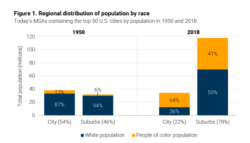
A study conducted by the University of Minnesota found that 64% of the urban city population are people of color while only 34% are white. Take a look at the graph below:
This data shows that in the 1950s, the suburbs were populated by a majority of white people (94%), and in 2018, they are still the majority (59%). While the cities have become even more populated by people of color in 2018 than in 1950. Continue reading Algorithmic Biases & Economic Inequality – by Pearl Kasirye→
Welcome to the Black-Jewish Dialogue, a virtual exchange of information and perspectives . The November dialogue “Black and Jewish” has been recorded. Scroll down for the link to the Dialogue recording.
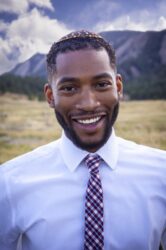
Bryant Heinzelman
Bryant is a veteran of the US Army, and a graduate of the Military Intelligence Cryptologic College of Corry Station, Pensacola. After a particularly difficult deployment to Iraq he shifted his focus from intelligence analysis to Jewish community building, interfaith outreach, and inclusion initiatives. Bryant is a Diversity, Equity and Inclusion consultant working primarily with North American Jewish organizations, a Jewish Educator, Teen Engagement Mentor, a 2018 Union for Reform Judaism Jew V’ Nation Fellow, and bluegrass hobbyist. Bryant is currently studying the “Intersections, Conflicts, and Alliances of the Black and Jewish Diasporas” at Western Washington University (in preparation for Rabbinic school), and resides in Bellingham, Washington.
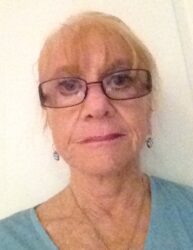
Dr. Barbara Weitz
Barbara is the former Director, Film Studies Certificate Program at Florida International University English Dept. She has done research for years with Dr. Tudor Parfitt and with the Kulanu Organization in identifying and supporting Isolated, Emerging and returning Jewish Communities around the world. She also has been on the steering committee of FCOS (Faith Communities Organizing for Sanctuary) and has spent time at our southern border trying to assist migrants seeking asylum in the U.S. She is currently heading up the organizing group preparing to help refugee Afghanis settle in the community. Through her research with Jews of Color, she has spoken at conferences and given webinars on the growing topic.
The topic of environmental justice (EJ) has become popular. We find it expressed in President Biden’s equity program, for example. I’ve been working with a group of advocates on the topic for about twelve years. Before that I helped write one of the first EJ programs for a federal agency while at the US Department of Transportation in the late 1980’s. At the time I knew nothing about the issue. I mentioned my ignorance to Bob Bullard, one of the fathers of the concept. He told me to read his books. Now I’ve become an expert, with books and essays, including one on the aftermath of Hurricane Katrina in New Orleans in 2005.
EJ has been overtaken by events, and today is sometimes called “environmental racism.” We now recognize the climate as a problem, and not as benign Mother Nature. EJ is the confluence of environmental issues with civil rights, resulting in health disparities for many people of color and low income people. They tend to live in lower marshy areas that are more subject to ocean level rise, flooding, and extreme storms. Even today, many lack air conditioning and are therefore more endangered by extreme heat. Many farmworkers live in rural towns in the West under extreme drought conditions. African-Americans own cars at the lowest level of any demographic group in the United States, and hence can’t escape in an evacuation order. Many African-Americans in Southern and Border states live near hog and chicken waste ponds and power stations and dumps that spew noxious fumes.
Years of research has shown that spending time in nature reduces cardiovascular disease, obesity, diabetes, asthma and mental illness. The last 18 months have underscored the immense benefits that our parks and public greenspaces provide. As the nation struggled through the COVID-19 pandemic, parks were outdoor oases that allowed millions of Americans a safe place to escape the confines of their homes. And parks in 98 of the nation’s 100 most populous cities doubled as venues for meal distribution, COVID testing and outdoor classrooms.
But parks and the benefits they provide are not evenly distributed in those cities. New research is demonstrating that the absence of these green spaces is disproportionately and negatively affecting our nation’s communities of color.
Not all Americans have the same experience when they try to access public services like healthcare, security, or even justice. That’s historically true, but when you take a closer look at the issues within the healthcare system, it’s clear that there’s more beneath the surface.
There are factors like socioeconomic status, education level, geographical location, racial and gender bias that can affect one’s experience with the healthcare system. In this article, we’ll look at those factors and briefly analyze what can be done to make healthcare more accessible and inclusive for all Americans.
Both my mother and brother had breast cancer that spread and was joined by other cancers. During Breast Cancer Month, I am compelled to write about the loss of these loved ones. I often stress the breast cancer that my brother Joe experienced, because too many of us think that breast cancer is a women-only disease. So, this is an ode to Joe. Not only do I write for men with breast cancer, but for all those experiencing the loss of loved ones to cancer, especially the siblings with whom we expect to experience old age together.
Diversity, Equity, Inclusion, and Belonging (DEIB) of the future
October 2021: American Diversity Report presented its 2nd annual Diversity Town Hall in partnership with the Gary W. Rollins College of Business at the University of Tennessee at Chattanooga (UTC). Speaking virtually, the panel of business leaders explored the relationship of business and community in creating the Diversity, Equity, Inclusion, and Belonging (DEIB) of the future.
MODERATOR
Dr. GAIL DAWSON Associate Professor of Management
Director of Diversity and Inclusion
Gary W. Rollins College of Business/UTC
PANELISTS
ERIC FULLER
President and Chief Executive Officer – U.S. Xpress
DEBORAH LEVINE Founder/Editor/Consultant – American Diversity Report
DAVID ORTIZ Corporate Diversity Officer, former board member – La Paz
LORNE STEEDLEY Vice President for Diversity and Inclusive Growth – Chattanooga Area Chamber of Commerce
NOTE: The Town Hall is also the October Black-Jewish Dialogue in partnership with: American Diversity Report, Chattanooga News Chronicle, Mizpah Congregation, Jewish Federation of Greater Chattanooga, Citizens Uprooting Racism in Bermuda (C.U.R.B. )
In July, 2020, the two of us met for the first time as inaugural co-directors of the University of California, Riverside, School of Medicine’s new Health Equity, Social Justice, and Anti-Racism (HESJAR) curricular initiative.The school handed us those six words.The rest was up to us.
We started by looking and listening.We looked at what other medical schools had done.While we found some useful ideas, this strategy had built-in limitations.No other medical school that we encountered had triangulated those three intersecting but disparate ideas: health equity; social justice; and anti-racism.We had to address all three and integrate them into a coherent curriculum. Continue reading Diversity and Speech Part 23: Health Equity – by Carlos E. Cortés and Adwoa Osei→
As the debate rages on the extent of equity and social justice for all, two perspectives are emerging. On the one hand, the traditional school of thought represents people who believe that things are going well and that the system operates well based on their conception of equity and social justice for all. These traditionalists assert that our system is fair and that it works as it is supposed to do. They further claim that the system’s operation aligns with the founding fathers’ statements in the 1776 Declaration of Independence. “We hold these truths to be self-evident, that all men are created equal, that their Creator endows them with certain unalienable Rights, that among these are Life, Liberty and the pursuit of Happiness.”
A year ago, who would have predicted that Critical Race Theory (CRT) would have become a 2021 national buzz word?A buzz word for those attacking it.A buzz word for those defending it.Probably with relatively few of those attackers and defenders actually having read much of it.
I have, but it’s not easy going.Lots of ideas.Lots of jargon.Lots of obscurantist legal analysis.But if you stick with it, CRT can be very thought-provoking.
CRT is based on a simple premise: the law is not neutral.As a result, institutions and systems that arise from the law will not be neutral. When Mark Twain asked a friend to explain his position on a controversial issue, the friend answered, “I’m neutral.”To which Twain responded, “Then whom are you neutral against?”

 Bryant Heinzelman
 Dr. Barbara Weitz
 Diversity, Equity, Inclusion, and Belonging (DEIB) of the future