
When an anniversary falls on Yom Kippur, the most solemn holy day of the Jewish calendar, thoughts of living and dying take on cosmic proportions. Fortunately, it’s rare for the two milestones to collide given the differences between the secular and Jewish calendars. Both are celebrations, but Yom Kippur which ends the New Year’s ten Days of Awe, is a sacred time when the celebration of life is combined with contemplation its finite nature. This year, I have a double dose of introspection and my mind sought the path separating living from dying and wandered from wonder and gratitude to mourning and humility.
Category Archives: Advisors
Advisory Council
Policies, Faith, and Calendars – by Deborah Levine
When the Jewish New Year arrived, I got many questions about faith and calendars from Human Resource departments. They wanted to know why the holiday occurs on a different day each year according to our secular calendar. And they asked about food associated with the holiday. Offering the traditional apples and honey for a sweet New Year was the easy part. Explaining the timing was the real challenge.
What should I write about religion and religious calendars in these contentious times? I know that many organizations and companies would prefer that the issue of religious diversity would disappear. But every year, thousands of religion-based lawsuits claiming a “hostile or offensive work environment” are registered with the EEOC (Equal Employment Opportunity Commission).
Continue reading Policies, Faith, and Calendars – by Deborah Levine
The Art of Perseverance & Endurance
 Hear Deborah Levine’s interview with Rabbi Tzvi and learn about the art of perseverance and endurance. She shares her personal stories that are captured in her memoir, The Magic Marble Tree. In this interview Deborah talks about her journey through pain and incapacitation and why she decided to write the book.
Click below to hear true stories that will inspire you to Never Give Up!
Nurturing and Humility in Leadership – by Deborah Levine
I have been puzzled by colleagues congratulating me on my humility. What are these folks talking about? People who knew me years ago would definitely be amused by that. At best, I was described as “Sweet but Stern.” At my boldest, I was told that I could terrorize entire cities. Community leaders had a white-knuckled grasp on their chairs when I tersely announce my intention to speak off-the-record. Not even a voice from the back of the room calling out, “Oh ho, this should be good!” slowed me down.
Continue reading Nurturing and Humility in Leadership – by Deborah Levine
The Challenge of Unconscious Bias – by Deborah Levine
Unconscious bias training is an admirable project but may often be ineffective. The fuzzy, vague term of unconscious bias is often applied indiscriminately, but unconscious bias isn’t a one-size-fits-all term amenable to a one afternoon of training. Yes, it can refer to the incident where the police were called to arrest two African-Americans waiting for a meeting at Starbucks. But it can also mean only smiling at customers that look like you, rejecting resumes from diverse applicants, and promoting the employees who resemble the current leadership team. If we want to address unconscious bias effectively, we need to first be aware of how the senses, emotions, and brain interact to create unconscious bias. Second, we must go beyond awareness of our biases to sensitivity to their impact. Lastly, we need to develop a system that internalizes wise decision making with ongoing reinforcement of that competence.
Continue reading The Challenge of Unconscious Bias – by Deborah Levine
National Welding Month: Challenge & Opportunity – by Deborah Levine
In April, I joined the Chattanooga Regional Manufacturers Association (CRMA) Alliance in Manufacturing Excellence (AIME) as Editor-in-Chief of the American Diversity Report. I was invited to be the official communications person by Lulu Copeland, the facilitator and committee chair of CRMA AIME. Copeland is also the founding member of the Society of Women Engineers (SWE) for whom I facilitated an inaugural panel years ago. My assignment at this event marking National Welding Month was to interview women in the welding profession.
Continue reading National Welding Month: Challenge & Opportunity – by Deborah Levine
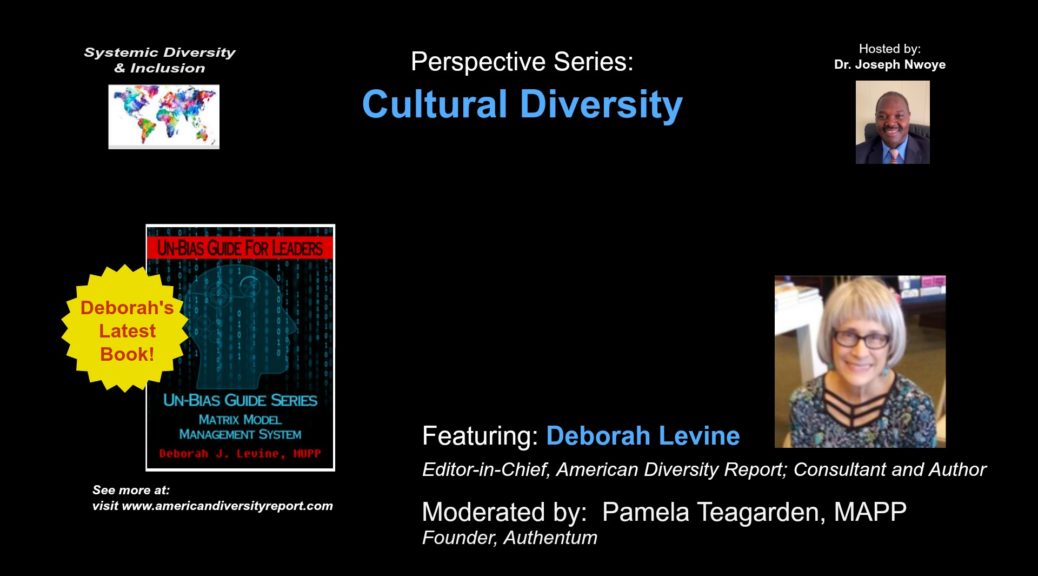
Deborah Levine: Cultural Systemic Diversity
The Systemic Diversity and Inclusive group gladly presents the recent interview with Deborah Levine, The Editor-in-Chief at the American Diversity Report and a member of the group. The interview was moderated by one of our own, Pamela Teagarden, a leader in her own right, and one of our own who has continuously provided unparalleled leadership to the group. Deborah is well endowed with a wealth of diversity and corporate experience. She is an expert in deciphering the framework for meaningful diversity and inclusion and inventor of a cognitive technology for dealing with unconscious bias. While making the case for infusion of competing perspectives, she can guide us to find common ground that fosters effective diversity and inclusion while advocating for the planning of strategic business priorities with emotional intelligence and smart decision making. Without further delay, please watch this remarkable lady and how she shared her work on systemic diversity…
Bermuda Jews Part 1: Returning for Passover – by Deborah Levine
(The Bermuda Jews History Series was originally published in The Bermudian Magazine. My family is the only Jewish family to have lived on the island for 4 generations and I am the sole remaining family member who grew up there. My grandfather is one of Bermuda’s Founding 400 and I want to ensure that the legacy of Jews is honored.)
 In the 1990s, I made my first trip to Bermuda in fifteen years. My family, once the mainstay of Bermuda Jews, were long gone from the island. The first whiff of salty sea air hasn’t changed but the airport is a jumble of construction. A short jog across the tarmac should end in a hushed wait for the appearance of a customs agent, sitting patiently on the dark wood furniture of the terminal’s old-fashioned waiting room. Today, official greeters wave us through a temporary cordoned maze to a terminal with a second story, a food court, and customs agents encased in glass booths. An electronically-enhanced steel band strikes an earnest rendition of “Island in the Sun” where a portrait of a young Queen Elizabeth once hung.
Continue reading Bermuda Jews Part 1: Returning for Passover – by Deborah Levine
Secretary of State Madeleine Albright – by Deborah Levine
 Reprinted in honor of Madeleine Albright R.I.P. 1937-2022
 Reprinted in honor of Madeleine Albright R.I.P. 1937-2022
Former Secretary of State Madeleine Albright is a petite woman who can fill large university auditorium with her presence. These days, Dr. Albright teaches, lectures and writes. She frequently speaks to university audiences land enjoys telling young people that they can be anything they want to be with hard work. Her audiences listen enthusiastically and a recent crowd at the University of Tennessee at Chattanooga was no exception. A packed house and 2 overflow rooms with video feeds were arranged for the presentation by our 64th Secretary of State. She was the highest ranking woman in government from 1997-2001 and the first female Secretary of State.
Continue reading Secretary of State Madeleine Albright – by Deborah Levine
Diversity vs. Free Speech: An Invented Conflict – by Carlos E. Cortés
“That’s against free speech.” “That’s censorship.”
“That’s unconstitutional.”
“That’s unconstitutional.”
Those are the kinds of responses diversity advocates are likely to receive when they challenge hate speech or other forms of demeaning and marginalizing expression. Unfortunately, diversity supporters often take the bait and respond by arguing for the importance of limiting free speech. But they shouldn’t go down that road. They don’t have to challenge free speech because free speech doesn’t actually exist. Let me explain.
Continue reading Diversity vs. Free Speech: An Invented Conflict – by Carlos E. Cortés