
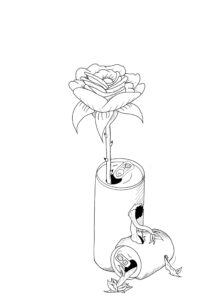
Moral fault lines are everywhere we look and serve as a muse for my writing. They are the underlying fissures that can fracture societal cohesion, fragment our understanding of what is right versus wrong, and threaten to break us under severe stress. In my novel, The Peccadilloes of Filamena Phipps, Filamena Phipps, née Ferayinskela, doesn’t ‘fit’ in North Chelsea, an affluent community which prizes homogeneity.
A clique consisting of Filamena’s neighbors drive informal, but ultimately rigid, community decisions such as where they shop, what they wear, with whom they socialize. Filamena tries to accommodate her neighbors but to them, she’s different; she’s a threat. They want her to conform, forget her own customs, dress and cook and raise her children like they do. Confronted by her neighbors’ bullying, she must decide how much bullying she should tolerate. What happens when she dissents? How can she dissent effectively and still remain a part of her community?
In my poetry, I further explore moral fault lines as I expose conflicting pressures that drive us to behaviors that separate us. As I reflect in my collection, Remember This Day, I consider the balance between predator and prey in my poem, “The Hunt.” In my poem, “Compassion,” the aging head of a goat herd is both the recognized alpha male while at the same time the weakened leader who has earned the lingering respect from fellow goats in the field. In my poem, “Promenade des Anglais,” I describe surviving a terror attack committed by a man driven by his own internal struggles; in its aftermath, my husband and I are left with learning how to prevent a second arrow of pain, post-traumatic stress, from piercing us. In “Focus,” a mother is drawn away from the attention her children crave by what she is reading on her phone.
There is no clear answer to the moral fault lines presented. Sometimes the answer may seem obvious, but it is left to the reader to make the decision.
I also focus on the struggle against erasure in my writing and is a theme long explored by writers. George Orwell understood the quiet ache of isolation on a human level and its connection with erasure to temper, weaken, even obviate a person’s identity by invalidating them. He explored emotional themes such as alienation, truth, and the struggle to connect authentically in an oppressively conformist world, such as in Animal Farm and in 1984. He wrote of the worst loneliness as being surrounded by people who cannot perceive who you are, have no conception of you, cannot begin to understand you. You feel yourself evaporate into thin air.
In my novel, Filamena fights to remain who she is, despite an attempt at coercion by her husband and neighbors to conform, to forget where she came from, to ignore the lessons she has learned in life, to forget her former self. She cannot do this and she is punished for it. She is shunned. But it is exactly because she stays true to who she is that she remains resilient; she embodies a mindful presence every moment as to who she is, both with respect to herself and with respect to the people and things around her. This is why animals, plants, and people outside the neighborhood clique are drawn to her, grow without restraint in her presence. Her spirit is open to accepting both herself the way she is and to them the way they are.
In my poetry, the fight against erasure takes on a more physical sense. “The Torment and the Tree” tells the story of a tree that fights the strong current of a raging river that ultimately will have its way and uproot the tree, but not until the tree struggles with all its might until the end for its survival. In “Hunt,” a herd of bison must fight off its predator, the wolves, and while at times some will lose this fight, the herd has learned what it must do to survive. In my poem, “Tempest,” my horse fights against the constraints of his stall, preferring instead to be free to experience the wind and the rain. In “Old Man,” my aging horse runs with the younger horses and insists on not being discounted simply because of his age, that “he’s still got it in him.” People have let me know they identify with a specific poem. For some, “The Torment and the Tree” may represent a nation battling for its survival; two women confided to me this poem helped them greatly while undergoing chemotherapy. One older gentleman told me he especially identified with “Old Man,” and others were drawn to the “pain from the second arrow” in “Promenade des Anglais.”
I wrote many of the poems in The Lighter Side of Horse Manure, such as “The Barn Manager Hates My Horse,” “Hooves,” “I Imagine Him Saying Thank You,” and several others as a response to a real situation where a barn manager insisted my horse, Vegas, no longer held any value because of his age and should be put down; in essence, his life should be erased. Vegas had every right to live his full life, had much more to express even as he grew old. He was also a beloved member of my family.
There is a gravity to my writing. Readers are increasingly seeking out titles that offer deep-lived experiences and philosophical immersion into the human condition. My body of work captures the resilience found in the emotional cost of survival and the retention of worth. At times, I incorporate humor as a tool. Humor provides a break in the emotional strain of the moment, and it enables the reader to see the silliness/absurdity of a scene immediately. Humor also enables the reader to pause, like a comma in a sentence; it gives them a moment to shake their heads in reaction to what a character says or does and ask themselves, wait, what? What just happened? It also acts like the white space between words—it doesn’t tell you what is funny. You read a twist and realize on your own the silliness of what was just said or done.

Both my poetry and my novel use humor to convey strong arguments, and I hope it enables the reader to easily swallow those arguments and assess their value.
- Moral Fault Lines as Muse – by Linda Drattell - May 1, 2026