
 My grandmother was Kurdish. She was from Van, in what is now eastern Turkey. What my family has told me is that her parents were killed in the Ottoman-era violence there. As a child, early in the 1900s, she walked from Van to Aleppo, with an uncle and her younger sister. My aunts say she was holding her sister’s hand. Somewhere along the way, her sister was lost and never found. In Aleppo, while she was still a child, her guardians married her off to a much older man.
Category Archives: Go Global
Living and Working in the Global Village
Strength With Restraint – by Muhammad Mohsin Iqbal
A nation’s military strength is measured not only by its manpower, weapons and capacity to defend territorial sovereignty, but also by the professionalism with which it fulfils its responsibilities. In an increasingly uncertain international environment, Pakistan’s armed forces occupy an important position, shaped by decades of operational experience, a demanding regional security environment and a longstanding contribution to United Nations peacekeeping. Their evolving role under Field Marshal Syed Asim Munir also reflects the growing importance of military diplomacy in regional affairs.
Continue reading Strength With Restraint – by Muhammad Mohsin Iqbal
Iqbal’s Spiritual Legacy and the Unity of the Muslim Ummah – by Muhammad Mohsin Iqbal
The history of humanity is, in essence, a continuous journey in search of divine guidance. From the creation of mankind, when Allah Almighty bestowed His guidance upon Prophet Adam (peace be upon him), this sacred mission continued through a succession of prophets until it reached its ultimate perfection with the advent of Prophet Muhammad (peace and blessings be upon him), the Seal of the Prophets. With his departure from this world, the institution of prophethood came to its completion, but the light of divine guidance did not diminish. It continued to illuminate human hearts through the teachings of the Holy Quran, the Sunnah and the lives of those chosen servants of Allah who devoted themselves to spiritual enlightenment, moral excellence and the awakening of humanity. Among such distinguished personalities, Allama Muhammad Iqbal occupies an exceptional place.
Partnerships Across Maritime Regions – by Muhammad Mohsin Iqbal
The oceans have never been merely geographical boundaries separating nations. They are arteries of international commerce, conduits of cultural exchange and, increasingly, arenas where the security and prosperity of distant societies intersect. Throughout history, maritime routes have connected civilisations, facilitated the movement of ideas and enabled nations to prosper through trade. Today, however, the same waters are exposed to geopolitical rivalries, security threats and competing strategic ambitions. Their future, therefore, depends not simply upon naval strength but upon the ability of nations to cultivate trust, cooperation and a shared commitment to peace.
The Holy Quran repeatedly draws attention to the seas, their resources and the benefits Allah Almighty has bestowed upon humanity through them. It invites mankind to reflect upon ships sailing across the waters, the sustenance obtained from the oceans and the countless signs of divine wisdom embodied in creation. These references carry a deeper message; the resources of nature are blessings entrusted to humanity, and their responsible use requires wisdom, gratitude and a sense of collective responsibility. The Quranic emphasis on consultation, justice, mutual understanding and peaceful coexistence offers an enduring framework for relations among nations. In a world increasingly troubled by confrontation, these principles deserve renewed attention, particularly in the maritime domain.
Continue reading Partnerships Across Maritime Regions – by Muhammad Mohsin Iqbal
The Growing Burden of Anxiety in Pakistan – by Muhammad Mohsin Iqbal
A child enters the world without an understanding of fear, uncertainty or responsibility. His days are governed by immediate needs, and tomorrow holds no particular threat. But as childhood gives way to adolescence and adulthood, the mind gradually becomes occupied with questions about education, employment, financial security, family responsibilities and social standing. What begins as a natural concern for the future can eventually become a persistent psychological burden. In a society where economic insecurity and social pressures are widespread, the ability to preserve mental well-being is becoming an increasingly difficult undertaking.
Continue reading The Growing Burden of Anxiety in Pakistan – by Muhammad Mohsin Iqbal
The Nuclear Shadow over Iran – by Muhammad Mohsin Iqbal
Could Electoral Defeat Trigger a Global Catastrophe?
The greatest danger in international politics arises when political ambition overshadows the responsibilities of statecraft. The possibility of the United States using nuclear weapons against Iran, particularly amid domestic political uncertainty surrounding President Donald Trump and the midterm elections, raises a disturbing question: could an administration facing electoral difficulties resort to an extraordinary military escalation to demonstrate its strength? Although no established evidence suggests that an electoral setback would lead Washington to contemplate a nuclear strike, the possibility warrants serious examination because its consequences would extend far beyond Iran.
Continue reading The Nuclear Shadow over Iran – by Muhammad Mohsin Iqbal
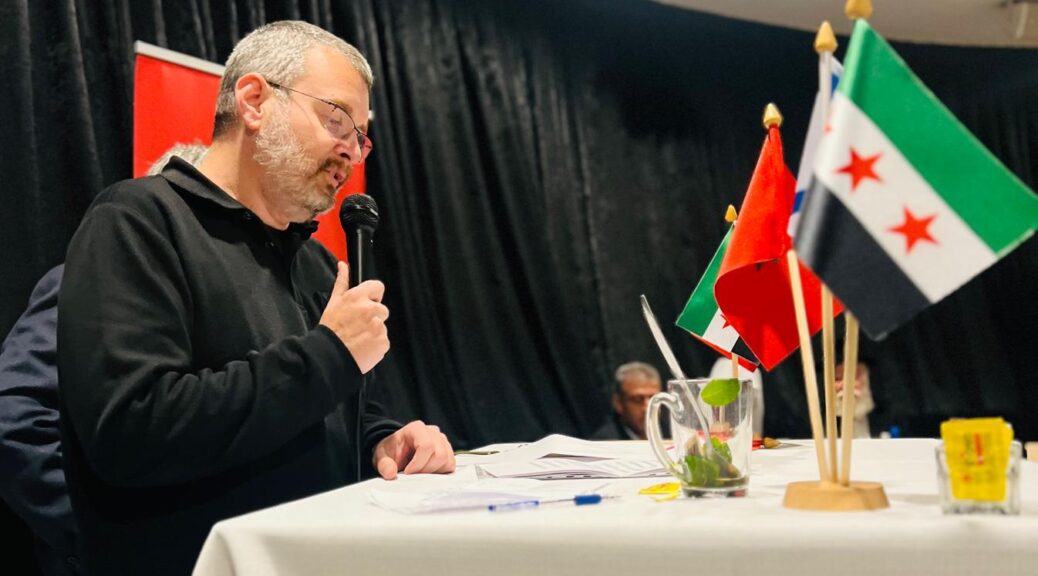
The Way Cousins Speak – by Tom Wegner
For decades, peace in our region has been negotiated between governments. What has been missing is a shared story between peoples. I learned this across divides that many Israelis never cross: in the IDF’s District Coordination and Liaison unit in Jericho, coordinating with the Palestinian Authority’s police, and later as a spokesperson for the Peres Center for Peace.
October 7, 2023 made one truth impossible to ignore: The way our region was living was not working for any of us. The massacre of the Yazidis and the civil wars in Iraq and Yemen made that clear long before that day. After it, I returned to those old relationships with one message: something had to change.
I did not believe that lines on a map, on their own, could resolve a conflict rooted in identity.
Muslim Unity and the Designs of Great Powers – by Muhammad Mohsin Iqbal
History is a stern teacher, but nations that refuse to learn from its lessons are condemned to repeat its tragedies. The Muslim world, blessed with immense natural wealth, strategic geography, a common faith and a civilisation that once illuminated the world with knowledge and wisdom, has too often found itself divided, weakened and exposed to the ambitions of powerful nations. The question that demands serious reflection is whether these calamities are merely the consequences of internal failures or whether external powers have repeatedly exploited Muslim divisions to advance their own strategic interests.
Continue reading Muslim Unity and the Designs of Great Powers – by Muhammad Mohsin Iqbal
Pakistan and the Gulf: Weathering the Oil Storm – by Muhammad Mohsin Iqbal
The history of the Gulf is marked by immense wealth, strategic rivalry and recurring conflict. Yet wars in this vital region have never remained confined to its shores. Whenever conflict threatens oil production or the security of shipping routes, its consequences spread across the world. Prices rise, supplies become uncertain and economies far from the battlefield are forced to absorb the shock.
Continue reading Pakistan and the Gulf: Weathering the Oil Storm – by Muhammad Mohsin Iqbal
The Gulf’s Conflicts and Their Cost to Pakistan – by Muhammad Mohsin Iqbal
Throughout the long and often turbulent history of the Gulf, the states of that vital region have repeatedly been plunged into the furnace of war, with consequences that have reverberated far beyond their shores and touched the lives of distant peoples dependent upon the free passage of oil. The Iran-Iraq conflict that erupted in nineteen-eighty, Iraq’s brazen invasion of Kuwait a decade later, the subsequent American-led campaign to liberate that small sheikhdom, the invasion of Iraq itself in two thousand and three, and the recurrent tensions between Iran on the one hand and Israel and the United States on the other, have each in their turn disrupted the free flow of petroleum upon which the modern world so heavily depends. Prices have soared, supplies have been interrupted at critical chokepoints such as the Strait of Hormuz, and the economic fabric of nations far removed from the battlefield has been strained almost to breaking point. Pakistan, though geographically distant from these contests, has never been wholly insulated from their effects, for her economy rests in no small measure upon the uninterrupted importation of crude oil and refined products, and upon the steady stream of remittances sent home by her sons labouring in the oil-rich states of the Gulf.
Continue reading The Gulf’s Conflicts and Their Cost to Pakistan – by Muhammad Mohsin Iqbal