For decades, peace in our region has been negotiated between governments. What has been missing is a shared story between peoples. I learned this across divides that many Israelis never cross: in the IDF’s District Coordination and Liaison unit in Jericho, coordinating with the Palestinian Authority’s police, and later as a spokesperson for the Peres Center for Peace.
October 7, 2023 made one truth impossible to ignore: The way our region was living was not working for any of us. The massacre of the Yazidis and the civil wars in Iraq and Yemen made that clear long before that day. After it, I returned to those old relationships with one message: something had to change.
I did not believe that lines on a map, on their own, could resolve a conflict rooted in identity.
From that conviction, and from those relationships, the Abrahamic Movement gained momentum: a volunteer-driven global grassroots initiative inspired by the Abraham Accords, built on the belief that the Accords are only the beginning. We promote dialogue and cooperation among Abrahamic faiths and peoples. We are neither a government body nor part of the Accords themselves.
A Family Argument
The world has largely missed one simple fact. Every group involved in this conflict tells the same origin story. Think of a secular Jew and an Orthodox Jew, a devout Muslim, a liberal Muslim and an ex-Muslim. Add a Christian Arab, a Druze and an Alawite. Every one of them agrees that we came from Abraham.
One idea guides my work: across our differences, Abraham remains a powerful point of connection. Jews, Muslims, and Christians understand that inheritance differently, but it offers a starting place for a shared regional story. I see this conflict, in part, as a conflict among cousins. Families can wound each other terribly, but they also have paths to reconciliation that strangers don’t.
People sometimes ask for our map. We do not have one. The Abrahamic Movement proposes no border plan or flag arrangement. Our work begins with how people see one another. We believe that changing those perceptions can help people find political answers together.
Europe can offer an imperfect but useful comparison. After generations of conflict and two world wars, a shared European identity developed alongside national and religious identities. Belonging to a larger story did not require everyone to become the same. In my book, The Abrahamic Revolution, I argue for a shared Abrahamic identity. An umbrella, not a replacement. No one is asked to change faith or surrender a prayer. People of no faith are welcome, too.
That umbrella must also make room for communities too often overlooked—including Middle Eastern Christians, Assyrians, Alawites, and Druze. A shared future cannot belong only to the largest groups.
Honor and Common Ground
In my experience, dignity and honor matter deeply in these conversations. An exchange that leaves someone feeling humiliated is unlikely to build trust.
I have watched heated debates cool when I respectfully quote the Quran. Its references to the Children of Israel can provide common ground that some Jewish participants have not considered.
Attacking another person’s faith closes that opening. We make more progress when we speak to our cousins as cousins: acknowledging what we share without pretending our differences have disappeared.
On common ground, neither person needs to surrender. Both can retain their identity and dignity.
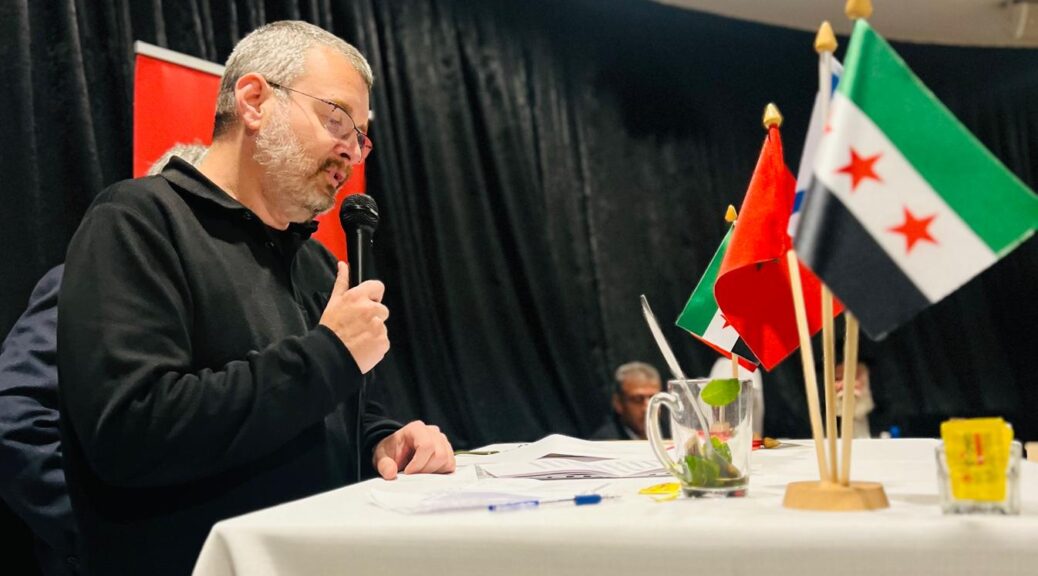
Our vision begins where people meet. In a Bedouin village in the Negev, elders, rabbis and educators sat together to explore what Islam and Judaism share, without ignoring the hard realities between them. As one participant from Beersheba put it: ‘What we need is to get to know one another, because encounter reduces fear of the other.’ This is the shared future we are building: a consciousness of common ground that grows village by village, until it reshapes how a whole region sees itself.
That consciousness grows one encounter at a time: 25 Jewish–Muslim encounters inside Israel so far, and more than 50 multilingual Zoom dialogues connecting people who cannot cross the borders between them.
What Some Partners Risk
A change of consciousness has a price, and not everyone pays it equally. I can speak openly. Many of our partners cannot.
In May 2022, Iraq’s parliament passed a law that sets penalties as severe as life imprisonment or death for a range of contacts with Israel or Israelis. When The Jerusalem Post profiled our members in September 2026, a Sunni scholar from Iraq spoke under an alias.
Khurram Ali Raza, chair of our Pakistan branch, made a different choice. Despite repeated warnings, he insisted that the newspaper use his real name.
He told the paper that Pakistani authorities had wrongly suspected him of working for Israel and that he spent four months in jail under conditions he described as “hell.”
It did not stop him.
“We are like brothers,” he said. “We are from one family and one home.”
Their courage shows that this vision is not naïve. People are already choosing to live as cousins, and it challenges the rest of us to ask what we are willing to do for the relationships we say we believe in.
Lessons for American Readers
What does this have to do with Americans?
Your country has long wrestled with bringing different faiths and backgrounds into a shared civic story. Antisemitism and Islamophobia test that promise, including on college campuses. The same shift in consciousness is needed there, which is why our North America chapter focuses on building bridges between communities.
Some lessons from our work travel well:
- Begin with what people share before approaching their most painful disagreement.
- Include smaller communities from the outset.
- Learn what your neighbor holds sacred and speak about it respectfully, even when you disagree.
- Keep meeting. One encounter may create goodwill; relationships require more.
The Abraham Accords opened a door between governments. Building the relationships that peace requires is work for people, wherever they live.
As Yousef al-Hawashla, who leads our work in the Negev’s Bedouin community, puts it, inside every person is a small light called peace. Our vision is a region where we help one another see it, and begin to kindle it.
- The Way Cousins Speak – by Tom Wegner - October 16, 2026