
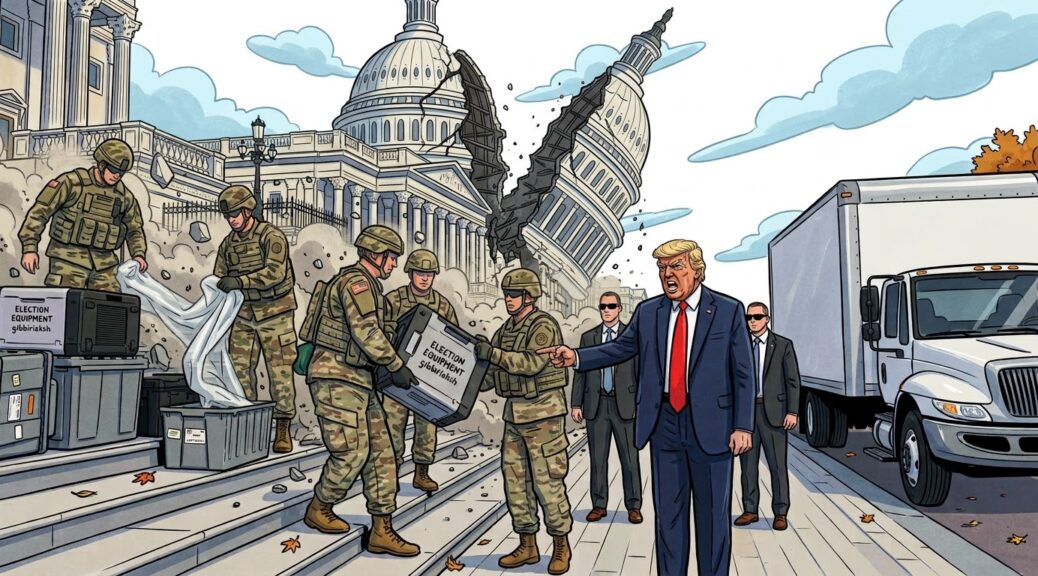
With the midterm elections fast approaching, we should expect President Trump to meddle with the results.
While Democrats are looking poised to regain majorities in Congress, Trump and Republicans are looking into the political abyss. Historical precedent shows that the party out of power typically gains 25 to 30 seats in midterm elections, as voters seek a check on the sitting president. A true wave election nets 40 to 60 seats, and a rare tsunami wave can shift 60 to 80 seats.
For context, Republicans gained 63 seats in the 2010 midterm elections under President Barack Obama. This time under Trump, the Republican Party is deeply underwater on overall job approval and major policy areas. On the closely watched generic congressional ballot, Democrats maintain a commanding lead.
As more congressional races shift to leaning blue, Democrats could retake the Senate and the House by sizable margins, complicating Trump’s claims of cheating and fraud.
Weaponizing Federal Agencies
By now, Trump’s political playbook is predictable. He’s a sore loser who can never admit defeat. That’s why Trump still stubbornly insists he won the 2020 presidential election, even though he’s lost nearly all the lawsuits he filed to the contrary.
“Trump and his allies filed more than 60 post-election lawsuits; nearly all failed, were dismissed, or were withdrawn, and many courts found the claims unsupported by law or evidence,” according to the nonpartisan organization, Politfact:
A stronger strategy for the 2026 midterms means Trump will once again try to nullify the election results. He will do so by ordering his handpicked (and unqualified) presidential appointees to do his dirty work.
Expect Trump to again make outlandish claims that the election outcome was “rigged” based on:
- Fake Mail-in ballots
- Noncitizens voting
- Votes cast by dead people
- Faulty and fixed voting machines
- Cheating by Democrats at the state and local levels
- Interference by foreign governments like Russia and China
- Other manufactured accusations
Trump will again fail to provide concrete evidence that can withstand objective scrutiny, especially in court.
More troubling than his words and litigation threats is Trump’s willingness to wield unchecked presidential power. He has no problem using the Department of Justice (DOJ), Department of Defense (DOD), Department of Homeland Security (DHS) and the FBI as his personal political weapons to validate his false assertions and carry out political vendettas.
Trump’s political dirty tricks were recently on full display in an unprecedented effort to hijack the U.S. Postal Service by enforcing restrictive regulations on ballot verification and delivery. But the Supreme Court swiftly intervened, blocking the proposed rules and keeping standard mail-in voting procedures intact. That’s a good sign.
A Lasting Stain on Democracy
If past is prologue, a desperate Trump will become a dangerous president.
During his first term, Trump tried to get a rubber stamp from the attorney general to present to Congress claiming the elections were fraudulent. He planned to stop Congress from certifying the results.
Trump’s desperate strategy failed after the 2020 presidential election because institutional guardrails at the DOJ and DOD prevented unconstitutional orders that also would have violated election laws. The unsuccessful result led Trump to orchestrate the January 6, 2001, attack on the U.S. Capitol by his rabid MAGA supporters.
The episode marked an ugly time in American history that left a lasting stain on democracy and the rule of law.
The Enablers
The problem today is more serious because Trump has installed weak political cronies at key federal agencies. These Republican keystone cops will most likely do whatever the president wants regardless of whether it’s illegal and unconstitutional.
The chief enablers are Attorney General Todd Blanche (Trump’s former criminal defense attorney), Defense Secretary Pete Hegseth (a former Fox News anchor), FBI Director Kash Patel (former MAGA podcast host), and Homeland Security Secretary Markwayne Mullin (who previously ran a family plumbing business and was a mixed martial arts fighter).
What’s dangerous and worrisome about these elections is that Trump appears to have put the pieces in place to bend or ignore the rule of law to steal the midterms with little or no pushback from Republicans in Congress. With that in mind, the worst outcome could easily become a reality. Here’s what it would look like:
- First, Trump orders the DHS secretary to have ICE stationed at select polling places to stoke fear and chaos by scaring away or intimidating voters, especially immigrant communities in blue states.
- Second, Trump orders the attorney general to fabricate an obscure legal framework that lets the president issue an executive order declaring a national emergency or invoking the Insurrection Act.
- Third, Trump orders the secretary of defense to deploy the military to seize voting machines in states, counties and cities with large populations of Democratic voters.
- Fourth: Trump, with the support of DOJ, orders a pause in the election certification to probe the voting machines for any purported irregularities and to recount the votes, allowing him to claim a false victory.
This would trigger a constitutional crisis of unprecedented proportions. No modern political or government playbook exists for a situation this dire.
To make matters even more surreal, the very legislative body tasked with checking the executive branch, the Congress, would be locked in a battle over its own legitimacy.
The Resistance
At least three fronts of resistance would emerge in a hypothetical constitutional crisis described above:
1. An Uneven, Partisan Response from Congress
Congress’s reaction would fundamentally depend on which lawmakers believe their seats were stolen. Winners facing invalidated results would fight aggressively, while those benefiting from the intervention would likely stay silent. This would create deep institutional gridlock unlike anything the nation has seen.
Still, Congress retains some critical leverage, at least technically:
- Power of the Purse: Lawmakers can cut funding for agencies carrying out the illegal directives.
- Subpoena Power: Committees can haul the heads of DOJ, DOD, DHS and the FBI to testify under oath.
- Statutory Checks: If domestic military forces are deployed, Congress can invoke the War Powers Resolution and the Posse Comitatus Act to order an immediate withdrawal.
- Impeachment: Congress could move to impeach both the President and his minions, although achieving a two-thirds Senate conviction remains a high bar.
2. The Courts: Fast to Rule, Slow to Enforce
Federal courts would try to move with lightning speed. State attorneys general, political parties and individual candidates would file for emergency injunctions within hours, having already prepared for this nightmare situation
Their legal argument would be airtight: under the Tenth Amendment and the Elections Clause of the Constitution, voting machines and election administration belong exclusively to the states and Congress, not the President. District courts would quickly issue temporary restraining orders.
However, judicial orders require enforcement. Courts do not command armies or police forces; they rely on executive compliance. If the executive branch actively ignores a Supreme Court ruling, a terrifying political vacuum emerges.
3. The Frontline Check: States & Ordinary Citizens
Because American elections are decentralized, the fastest and most effective pushback would come directly from state and local officials:
- Governors & State Police: Governors control the state National Guard unless federalized. A governor could deploy state law enforcement or National Guard units to physically protect county voting machines from federal seizure.
- Unlawful Orders Doctrine: Under military law, service members and federal agents are required to disobey unconstitutional and illegal orders.
- Civic Action: Mass public protests, emergency civil rights litigation and widespread refusal by local election workers to hand over equipment could present a formidable immediate barrier.
None of these three structural checks is guaranteed to work instantly or even effectively. A divided Congress is prone to partisan paralysis, and litigation is often protracted.
The Ultimate Stress Test
Until the midterm election results are officially counted and certified, Republicans would theoretically maintain control of Congress during the interim. This could take several months as lawsuits challenging Trump make their way to the Supreme Court for a final ruling.
Even then, as noted above, courts, including the Supreme Court, lack direct enforcement mechanisms. Moreover, political and public pushback cannot replace collapsing institutions.
This scenario poses the ultimate stress test for the American system of checks and balances and the rule of law. Can the three branches of government survive when the executive branch chooses to abandon the legislative and judicial branches entirely?
The prospect of an executive branch actively trying to invalidate a midterm election and seize voting machinery sounds like a plot from a political thriller, but the structural vulnerabilities are very real.
Trump’s track record shows that when he faces imminent political defeat, he attempts to burn down whatever institutional guardrails may still confront him. The riots at the U.S. Capitol on January 6, 2021, offer a prime example of how far a desperate Trump is willing to go.
On a more positive note, assuming the federal government is a monolith that will blindly execute unconstitutional executive actions overlooks the reality of American federalism.
Final Thoughts
Elections in the United States are deliberately decentralized.
Thousands of county clerks, local election boards and secretaries of state run them. A president cannot simply push a button in the Oval Office to freeze an election. Doing so requires thousands of civil servants, law enforcement officers and military personnel to directly breach their constitutional oath.
That is where the autocratic playbook breaks down in the American system.
If a crisis of this magnitude occurs, the ultimate defense of American democracy will not rest only with the federal judiciary and members of Congress. It will also rest with state governors, county officials, career civil servants and ordinary citizens who insist on enforcing the rule of law to prevent President Trump from stealing the midterm elections.
Yet the true test of American government institutions is not whether Trump will attempt to grossly abuse power, we know he will, but whether the rest of the nation retains the resolve to stop him.
Graphic: Google generated

- Can President Trump Steal the Midterm Elections? – by David Grinberg - October 19, 2026
- Pandering to Gerrymandering: Who Won the Redistricting War? – by David Grinberg - September 3, 2026
- Recognizing National Disability Employment Awareness Month – by David Grinberg - October 16, 2024