
Here’s the Score…
Examining the race to redraw congressional maps prior to the midterm elections.
What started as so-called “Trump-mandering” quickly became a national political battle between Republicans and Democrats to redraw as many congressional districts as possible before the critically important midterm elections on November 3, 2026.
When the smoke finally cleared, one party emerged victorious and will likely have up to a 10-seat advantage in the race to control the House of Representatives going into Election Day. That’s theoretical, of course, because even though a district map is redrawn to heavily favor one party, there’s no guarantee that an upset won’t occur, even if it remains a long shot.
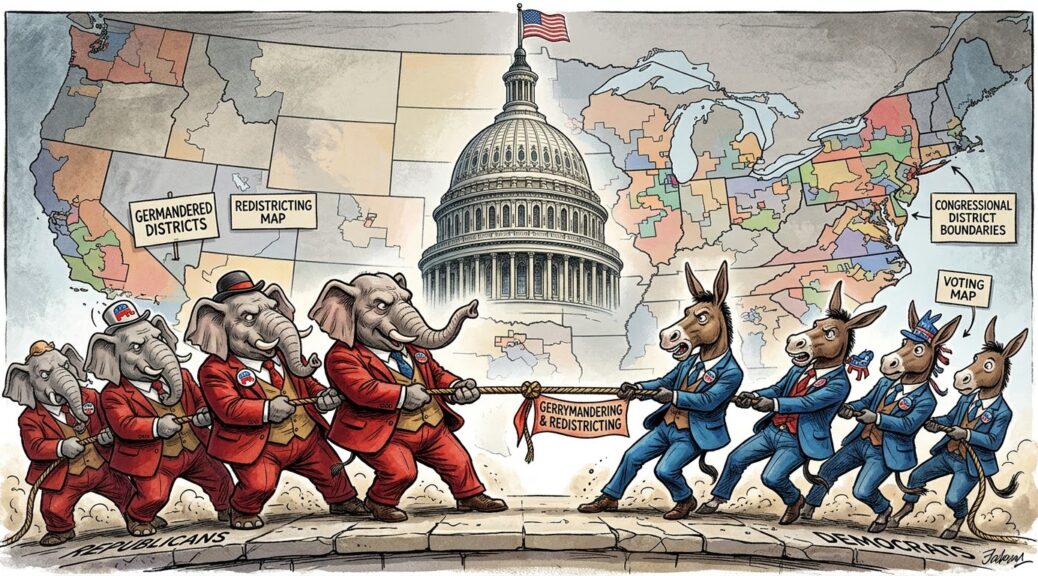
The political pandering is all about gerrymandering. That’s the term used to describe the partisan redrawing of congressional district boundaries to boost one party’s representation in Congress. The term was coined in 1812 following a contentious redistricting decision in Massachusetts (more on that below).
Republicans and Democrats have brawled politically to outdo one another in multiple states over the past year. Following is a scorecard and narrative recap of what you may have missed and how it could impact control of the House of Representatives when the new Congress convenes in January 2027.
Rare to Rampant
It’s relevant to review what the U.S. Constitution says about redistricting.
According to Article I of the Constitution, a nationwide census occurs every 10 years with reapportionment of congressional seats based on population changes. States handle redistricting within their own borders separately under the Elections Clause; it is traditionally managed at the state level rather than as a purely federal administrative process.
What makes this electoral cycle stand out is that mid-decade redistricting has gone from rare to rampant. The term “gerrymandering” dates to 1812, when Massachusetts Governor Elbridge Gerry signed off on a state senate district so contorted it was said to resemble a salamander. A newspaper cartoonist dubbed it a “Gerry-mander,” and the name stuck (Smithsonian).
The problem for citizens, in a practical sense, is that gerrymandering allows elected officials to choose their voters rather than voters choosing their elected officials.
Trump-Mandering
In the summer of 2025, President Trump launched a national political strategy to redraw congressional maps in Republican-controlled states ahead of the midterms. This was an effort to protect the Republicans’ slim majorities in Congress or, at minimum, soften potential losses. Democrats labeled the effort “Trump-mandering” to highlight the president’s direct involvement. While state legislatures hold the constitutional authority over election district boundaries, presidential pressure on state redistricting breaks long-standing political conventions.
The “Trump-mandering” moniker never fully took hold, in part because critics called it hypocritical given Democrats’ own history of aggressive gerrymandering. Nevertheless, the fight spread from Texas to roughly a dozen states, leaving voters to live with the fallout within their local congressional districts.
In the end, Republicans won the redistricting fight.
According to The Washington Post, “While the GOP has already drawn itself more favorable lines in 16 districts since last year, Democrats have only picked up an advantage in six more.”
While the exact net gain of seats attributed to redistricting won’t be known until the election results are announced, the GOP came out ahead. One year later, Trump’s strategy appears to have paid off, with Republicans gaining a net advantage of roughly 10 congressional districts.
The Playing Field
It’s worth pointing out that Republicans control the governorship and both legislative chambers (a state government “trifecta”) in 23 states, compared to 16 for Democrats, with 11 states operating under divided government (Ballotpedia trifecta tracker). Thus, Republicans held an inherent structural advantage at the starting line.
Republicans’ broader structural control of state governments gave them an advantage in redistricting compared to Democrats. Texas, Missouri, North Carolina, Ohio, Florida, Tennessee, Louisiana and Alabama all have GOP trifectas, meaning a governor’s signature was sufficient to enact new maps.
Democrats, by contrast, faced procedural hurdles, such as independent redistricting commissions and state constitutional constraints in several blue states. This necessitated a successful ballot measure in California and court-driven processes in other districts. Furthermore, Democrats faced a ceiling because many of their strongest trifecta states were already utilizing highly favorable maps drawn following the 2020 census (CalMatters).
Another legal shift occurred when the Supreme Court addressed the landmark Voting Rights Act (VRA) precedent in the case, Louisiana v. Callais. The April 2026 ruling gutted the VRA, impacting congressional district line drawing in states like Louisiana and Alabama (SCOTUSblog).
Meanwhile, a few Republican-led states resisted calls to redraw their maps mid-decade, including Indiana and South Carolina. Conversely, states such as Tennessee, Louisiana, Alabama and North Carolina successfully enacted more partisan red maps.
Riding a Blue Wave?
Will Democrats win the House majority by riding a “blue wave” to election victory? It’s certainly possible because midterm elections are usually a judgement on the president and his party.
Here is the metric that concerns Democratic strategists: redistricting alone has effectively raised Republicans’ structural floor in the House from their current 220-seat baseline up toward 230 seats.
The encouraging sign for Democrats is their polling edge on the congressional generic ballot question of which party you support more, which recent averages place at roughly six to eight points. A margin of that size could offset much of the 10-seat advantage Republicans gained through mid-cycle redistricting.
The average historical gain in midterm elections for the party out of power is about 26 seats since World War II. However, during wave elections, the opposition party has gained upwards of 50 to 60 House seats. Republicans, for example, won 64 House seats during the 2010 midterms during President Barack Obama first term.
Political Analysis
A year ago, the question was whether Republicans could gerrymander their way out of mid-term exposure. By and large, they achieved their objective through rapid legislative action rather than lengthier ballot initiatives or court battles.
Both parties attempted to optimize congressional maps; that strategy is not new. What is different in modern political history is the mid-decade scale. Democratic strategists in Maryland, New York and Illinois have already indicated plans to pursue redistricting adjustments when legal and political conditions permit, looking ahead to 2028.
With two months remaining before final ballots are cast, overall economic indicators and national voter turnout will play decisive roles. Moreover, the margins remain slim and highly sensitive to late-stage shifts in public opinion
Final Thoughts
Initial estimates a year ago projected Republicans could net between 12 and 17 seats through mid-cycle redistricting. The final outcome—a net gain of approximately 10 seats—remains a substantial structural advantage.
However, national conditions present headwinds for the ruling party. President Trump’s approval rating is at a record low. Additionally, many voters express ongoing concern over key policy areas such as inflation, the economy, immigration, tariffs and the war against Iran. At the same time, internal ideological debates within the Democratic coalition present challenges for candidate positioning in competitive suburban districts.
Financially, campaign committees and affiliated political action committees on both sides are pouring record resources into toss-up districts to counter or capitalize on the redrawn boundaries.
Retaking the House would allow Democrats to establish a legislative wall against executive actions, restoring divided government. This is an outcome that polling suggests many moderate voters favor. Moreover, Democrats may only need a modest swing in key suburban districts to flip the razor-thin House majority.
Therefore, even without a blue wave, Democrats can still win with a blue ripple.
Graphic: AI image generated via Google Gemini

- Pandering to Gerrymandering: Who Won the Redistricting War? – by David Grinberg - September 3, 2026
- Recognizing National Disability Employment Awareness Month – by David Grinberg - October 16, 2024
- Debunking 4 Major Myths of Assault Weapons Ban – by David Grinberg - September 17, 2024