A Single Verse, A Complete Moral Vision
In the book of Leviticus, a short commandment appears: “Do not place a stumbling block before the blind.”
On the surface, it is simple: don’t trip someone who cannot see. But Jewish legal tradition has understood this verse for centuries as something far larger — a comprehensive moral principle about knowledge, power, and responsibility.
The blind person in this verse is never the one at fault. He is the vulnerable party — the one who lacks information, lacks sight, lacks the ability to protect himself. The prohibition is directed entirely at the one who can see — and chooses nonetheless to place an obstacle in his path.
Three Kinds of Blindness
The Hebrew sages extended the concept of “blindness” well beyond the physical:
First — blindness to information. Someone who doesn’t know that the advice being given to him is harmful, that the product being sold to him is dangerous, that the path being offered will lead to destruction.
Second — blindness to consequences. Someone incapable of foreseeing where his actions will lead. The responsibility lies with the one who sees those consequences clearly — and says nothing.
Third — blindness to manipulation. Someone being pushed toward a destructive act — exploited at a moment of weakness, nudged toward something that will harm him and others.
“I Didn’t Know” Is Not Enough
Here is where the tradition parts ways with ordinary moral intuition.
The common Western assumption is that guilt follows intention. If you didn’t mean harm, you aren’t truly culpable. If you didn’t know, you cannot be held responsible.
The halakhic tradition draws a sharper line: if you could have known, you were obligated to know.
A weapons dealer who claims ignorance of how his weapons will be used is not absolved by that ignorance. His choice not to know is not a defense — it is itself part of the transgression.
Now Look at the World
As of this writing, the United States and Iran are in direct military confrontation. And here the principle of lifnei iver illuminates something important — not by drawing a false equivalence between the two sides, but by clarifying precisely who is placing stumbling blocks before whom.
Iran’s regime has for decades operated on a clear and stated doctrine: the destruction of Israel, the undermining of American power, and the expansion of its influence through proxy forces across Lebanon, Yemen, Iraq, Syria, and Gaza. This is not interpretation — it is declared policy, openly repeated by the Iranian leadership.
The stumbling blocks Iran has placed are literal: weapons supplied to groups whose explicit purpose is civilian terror. Funding for organizations that deliberately target the blind — those who have no army, no shelter, no say in the war being waged around them. The weakest, most vulnerable populations in the region have been made into instruments of a geopolitical strategy decided entirely without them.
This is lifnei iver as state policy — the systematic exploitation of the vulnerable, the deliberate placement of danger before those least able to protect themselves.
Iran as the Inverted Model of the Sanctity of Life
But there is an even deeper dimension here.
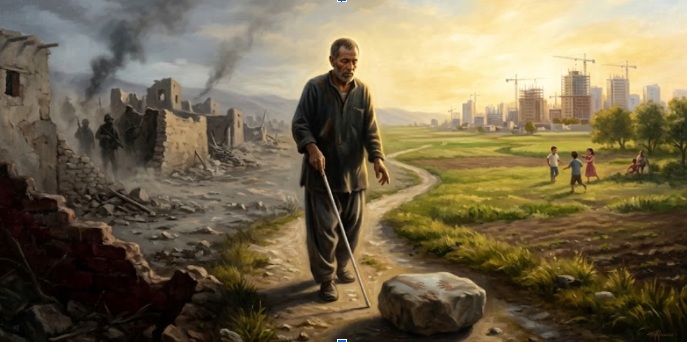
Iran does not merely place stumbling blocks before the blind — it deliberately manufactures the blindness itself.
The populations it recruits — in Lebanon, Yemen, Gaza, Iraq — are populations that have been systematically denied alternatives. People without infrastructure, without education, without economy, without horizon. Iran does not offer them construction — it offers them weapons. Not livelihood — but an ideology of destruction. It keeps them in poverty, in dependence, in darkness — and then deploys them as instruments of its own ambitions.
This is the stumbling block at a second degree: not only harming the blind — but engineering the blindness, and then exploiting it.
And Iran itself? Its natural resources are vast. Fertile land, oil, an ancient civilization, a gifted people. What has been done with all of it? Diverted — into terror infrastructure, proxy financing, a nuclear program whose stated purpose is annihilation, not flourishing.
The ancient principle asks a simple and devastating question: what would have become of those resources — and those people — had they been used to build rather than to destroy?
That is not a political question. It is a moral one. And it is precisely the question that “do not place a stumbling block before the blind” was always asking.
The Harder Question for the West
But the principle does not stop there. It also asks something uncomfortable of those who watched this doctrine develop over decades — and repeatedly chose not to see its implications clearly.
Agreements were signed with a regime whose foundational charter called for the annihilation of a neighboring country. Sanctions were lifted, funds were released, diplomatic legitimacy was extended — while proxy armies were being armed and trained. Officials and analysts who raised alarms were dismissed as alarmists.
This is not moral equivalence. America is not Iran. A democracy with imperfect policies is not comparable to a theocratic regime built on terror and annihilation.
But lifnei iver demands honesty even from the righteous: the choice not to see what was visible is itself a moral failure. Not the same moral failure — but a failure nonetheless.
The greater your knowledge, the greater your responsibility. Intelligence agencies knew. Diplomats knew. The question the ancient verse presses upon us is: what was done with that knowledge?
Sanctity of Life — For Everyone Except No One
The verse about the stumbling block appears inside a larger vision: “You shall be holy.”
Maimonides teaches that every person must see himself as a partner in the world’s balance — and understand that his actions tip the scales for everyone, not only for himself.
The sanctity of life, in this framework, is not a slogan. It is a demand: that those with power and knowledge use both to protect those without either.
Iran’s regime has built its power on the opposite principle — on the deliberate targeting of civilians, the arming of those who murder children at music festivals, and the funding of those who fire missiles into apartment buildings.
That is the stumbling block. That is the blind. And those who enabled it — whether through active support or deliberate not-seeing — bear a portion of what followed.
The Question the Verse Leaves Us With
“Do not place a stumbling block before the blind” is not merely a law against cruelty. It is a law against the abuse of knowledge — against using what you see to harm those who cannot see it.
In a world where one regime openly declares its intent to destroy, and arms others to carry out that destruction, the ancient principle is not ambiguous.
The stumbling blocks are real. The blind are real. And the obligation — to see clearly, to speak honestly, and to act accordingly — falls on everyone with the power to do so.
Especially those who have always had the power to see.Short summary:
The State That Turned “Do Not Place a Stumbling Block” Into National Policy
Iran does not act from poverty or desperation — it deliberately chooses to darken those it could have illuminated. It channels drugs into oppressed populations instead of infrastructure, weapons instead of education, and an ideology of destruction instead of any possibility of a dignified life. It systematically engineers the blindness of the poor — and then deploys them as soldiers in service of its own ambitions. Its vast natural resources, rather than being directed toward the flourishing of its own people and neighbors, are diverted entirely into terror infrastructure and regional devastation. In doing so, Iran does not merely place a stumbling block before the blind — it manufactures the blindness, sustains it, and wields it as a weapon. The people of Israel, by contrast, were commanded at their very core to do the opposite: to see the vulnerable, to protect them, and to transform knowledge into responsibility — never into exploitation. This is not a political disagreement — it is a collision between two fundamental visions of what a human being is worth: one that sees the weak as a tool, and one that sees them as a person.
Middle East Part 2 – Between the Illusion of Death and the Engineering of Life
Middle East Part 3: Why the American Chassis Doesnt Fit the Israeli Soul – by Chaim Goldberg
- Middle East Part 1: Ancient Wisdom for a World at War -by Chaim Goldberg - May 10, 2026
- Middle East Part 3: Why the American Chassis Doesn’t Fit the Israeli Soul – by Chaim Goldberg - May 10, 2026
- Middle East Part 2: Between the Illusion of Death and the Engineering of Life – by Chaim Goldberg - May 10, 2026