
Reflections from a Mahā Kumbh Discussion
(Seeking The Infinite: A Spiritual Journey through the *Maha Kumbh)
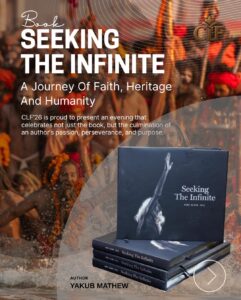 At the Gala Opening Event of the 2nd edition of Canada Literature Festival in Mississauga on 14th May, there was a discussion on USA-based Yakub Matthew’s newly published book Seeking the Infinite. It was convened by UK-based noted literary thinker Prabhu Guptara, where I found myself entering not merely a literary conversation, but a strangely layered inner journey. The subject itself, the infinite, already carries a destabilizing quality. It invites thought, yet resists containment within thought. And perhaps that was precisely what made the experience of the discussion both engaging and quietly unsettling.
Yakub’s book, deeply rooted in personal inquiry, had its Canadian launch on this occasion. It is not a rigid philosophical treatise, but a reflective journey through questions that exceed easy explanation. The infinite, in his writing, is not presented as an object to be mastered intellectually, but as something elusive, something repeatedly encountered at the edges of experience, spirituality, memory, and thought. The strength of the book lies precisely in this openness. It acknowledges that infinity may ultimately remain unexplained, not because of intellectual failure, but because the human mind itself may be structurally limited before it.
The panel consisted of Salman Chishty, a Sufi spiritual leader; Harminder Singh (Harry) Mann, a practicing lawyer; Lama Aria Drolma, a traditional Tibetan Buddhist; Rakesh K. Kaul, author; and Kalpesh Joshi, Vastu consultant and astrologer.
Prabhu Guptara’s questions to the panel reflected this depth and seriousness. They were carefully shaped, inviting philosophical engagement rather than superficial commentary. Yet many of these questions seemed to flatten as they entered the panel discussion itself, which gradually moved toward familiar territories of religion, ritual practice, and jyotish, partly influenced by the presence of an astrologer on the panel.
There is, of course, nothing inherently dismissible about ritual or astrology within Indian civilizational thought. They carry centuries of symbolic, psychological, and cultural meaning. But as the discussion unfolded, I began to sense an underlying assumption emerging repeatedly: that spirituality is primarily accessed through structured ritual pathways and inherited systems of practice. Is it?
It was at this point that my mind began to move elsewhere.
I found myself thinking first of Chapter 11 of the Shri Bhagavad Gita, where Arjuna witnesses the *Viraat Roop of Lord Krishna. The significance of this moment, for me, has never been merely theological. It is philosophical and existential. Arjuna is suddenly forced beyond the linear perception of time and movement. Time collapses. Past, present, and future coexist. Creation and destruction unfold simultaneously in a singularity. The vision dismantles ordinary categories through which the human mind organizes reality.
What struck me while listening to the discussion was that the Gita’s cosmic revelation does not ultimately point toward ritualistic enclosure. If anything, it explodes enclosure. The Viraat Roop destroys the illusion that truth can be safely contained within fixed mental or social structures. The infinite appears not as a system, but as a rupture of systems.
My question to the panel emerged from precisely this thought: how might Yakub’s idea of the “unexplained infinite” be reflected through the lens of Chapter 11? How does one reconcile the infinite as an uncontainable experience with spiritual structures that often seek containment through repetition, interpretation, and ritual continuity?
The question remained largely unanswered. Not rejected, simply untouched, as if it had arrived from a slightly different philosophical terrain.
And then, unexpectedly, my mind moved toward the famous Australian film Predestination, released in 2014, a film my daughter Tia had suggested to me some years ago because she found its ending deeply impactful. At first glance, it may seem strange that a discussion on Mahā Kumbh could lead one toward a science-fiction narrative. Yet internally, the movement felt completely natural.
Predestination revolves around circular time. Identity folds into itself. Cause becomes effect, effect becomes cause, endlessly. The protagonist is trapped inside a recursive structure from which there appears to be no exit. Awareness itself does not liberate him; it merely deepens the realization of entrapment.
Sitting in the discussion, I began to feel an unexpected parallel.
It seemed to me that spirituality, when reduced entirely to repetitive ritual structures without deeper existential awakening, risks becoming another form of circular entrapment. A closed loop. A movement that continues endlessly but never truly breaks through into transformed perception.
In my own reflection, this began to resemble the circular trap of Predestination.
The comparison may sound provocative, but it emerged not from dismissal of tradition, but from questioning its stagnation when ritual becomes self-contained rather than revelatory. If ritual only repeats inherited forms without opening consciousness toward a deeper encounter with reality, then it risks becoming recursive motion without transcendence.
The Gita, at least as I experience it, points elsewhere.
Krishna does not merely instruct Arjuna to perform ritual action. He destabilizes Arjuna’s entire framework of perception. The revelation of the infinite is not comforting repetition; it is existential upheaval. The self that enters the vision cannot remain the same self afterward.
This, perhaps, is where I felt a subtle disjunction during the discussion. The infinite was often being approached through systems designed to interpret it, whereas the deeper philosophical challenge of infinity may lie precisely in its refusal to remain fully interpretable.
Yakub’s book, interestingly, seems aware of this tension. Beneath its reflections runs an undercurrent of incompleteness, a recognition that the infinite cannot finally be domesticated by language, doctrine, or explanation. In that sense, the book appeared more philosophically restless than parts of the discussion surrounding it.
As the session progressed, I became increasingly aware that my own thoughts were no longer moving linearly. The conversation outside and the conversation inside had diverged. Scripture, cinema, philosophy, memory, ritual, existentialism—all began intersecting simultaneously. What I experienced was less a sequence of thoughts than a shifting field of associations, each attempting to approach the same elusive center.
Perhaps this is what the infinite actually does to the thought process when encountered seriously. It disrupts neat categories. It dissolves the safety of fixed intellectual positions. It pushes consciousness beyond familiar frames.
And perhaps this is also why truly meaningful discussions on infinity are so difficult to sustain. Because the infinite is not merely a topic. It is a pressure upon the mind itself. The moment it becomes too neatly explained, it ceases to feel infinite.
What remained with me after the discussion was therefore not disappointment alone, but a deeper reflection on how easily even spiritual discourse can become enclosed within conceptual and ritual repetition. The danger is not ritual itself; ritual can be symbolic, transformative, even profound. The danger lies in mistaking repetition for awakening.
The Bhagavad Gita’s Chapter 11 does not leave Arjuna inside a closed circle. It shatters the circle altogether.
That, perhaps, is the difference I kept sensing between the spiritual vision of the Bhagavad Gita and the recursive trap of Predestination. One points beyond circularity into expanded consciousness; the other reveals what happens when consciousness remains trapped inside the loop.
And somewhere between Mahā Kumbh, Yakub’s searching reflections, the unanswered question, and the strange inner journey from Krishna to science fiction, I realized that the most meaningful engagement with the infinite may begin not in certainty, but in the willingness to remain intellectually and spiritually unsettled before it.
Canada Literature Festival, Mississauga and Toronto, Canada, dated 13th to 18th May 2026
Canada Literature Festival
*The Viraat Roop, or Universal Form, is the supreme cosmic form of Lord Vishnu (as Shri Krishna) that encompasses the entire universe, past, present, and future – in one divine vision.
*The Maha Kumbh Mela 2025 in Prayagraj, India, is celebrated as a “once-in-144-years” phenomenon, marking a rare 12th cycle of the Purna Kumbh Mela (12 years × 12 cycles). This highly auspicious 44-day gathering at the Sangam (confluence of Ganga, Yamuna, and Saraswati) occurred from Jan. 13 to Feb. 26, 2025, attracting hundreds of millions.
- When the Infinite Becomes a Circle – by Meena Chopra - May 24, 2026
- Valuing Human Creativity in the Age of AI – By Meena Chopra - May 10, 2026
- Evolving Ethnic Literature – by Meena Chopra - July 8, 2014