
Category Archives: War

Middle East Part 1: Ancient Wisdom for a World at War -by Chaim Goldberg

A Single Verse, A Complete Moral Vision

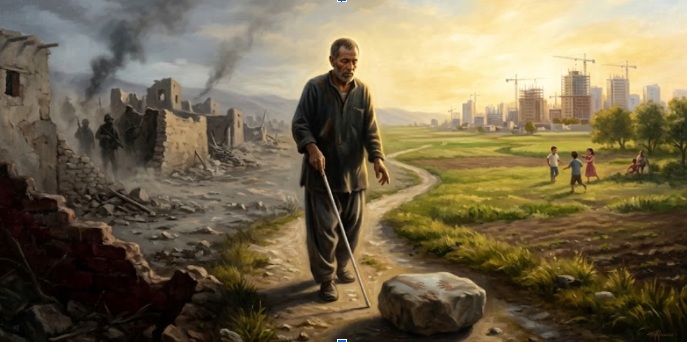
In the book of Leviticus, a short commandment appears: “Do not place a stumbling block before the blind.”

On the surface, it is simple: don’t trip someone who cannot see. But Jewish legal tradition has understood this verse for centuries as something far larger — a comprehensive moral principle about knowledge, power, and responsibility.

The blind person in this verse is never the one at fault. He is the vulnerable party — the one who lacks information, lacks sight, lacks the ability to protect himself. The prohibition is directed entirely at the one who can see — and chooses nonetheless to place an obstacle in his path.

Continue reading Middle East Part 1: Ancient Wisdom for a World at War -by Chaim Goldberg

Middle East Part 3: Why the American Chassis Doesn’t Fit the Israeli Soul – by Chaim Goldberg

A Meeting That Left Me With Questions

I did not expect the conversation to stay with me the way it did.

I sat with Jonathan Pollard in Jerusalem — a sharp, vital man, the kind you leave with more questions than you arrived with. The meeting was genuinely enriching. And at the same time, something in it placed before me a question I cannot put down:

Not a question about what he did, or what was done to him.

An architectural question.

What does it mean to live inside two states that are not the same kind of thing?

Because Pollard did not inhabit two countries. He inhabited two systems of reality — ones that sometimes use the same words and mean entirely different things. And under pressure, for one terrible moment, the structure cracked.

Continue reading Middle East Part 3: Why the American Chassis Doesn’t Fit the Israeli Soul – by Chaim Goldberg

Middle East Part 2: Between the Illusion of Death and the Engineering of Life – by Chaim Goldberg

I read the word three times before I understood it wasn’t a translation error.

“The subject demonstrated resistance… focused physical force was applied… she was later found without signs of life.”

The subject. That’s how she was described in the internal report of Iran’s Revolutionary Guards on Nika Shakarami, as exposed by BBC Persian. A sixteen-year-old girl who had gone out to protest the death of Mahsa Amini. A girl the same age as my granddaughter. The same age as the students who stood in front of me in the classroom for thirty years.

Continue reading Middle East Part 2: Between the Illusion of Death and the Engineering of Life – by Chaim Goldberg

Creative souls needed in war zones – by Deborah Levine

 ( based on column for The Chattanooga Times Free. Press)

When my hubby and I saw that Iran had bombed Bet Shemesh, a community outside of Jerusalem, we were horrified. That’s where our daughter Elana and 4 grandsons live. Photos of the decimated village and stories of nine dead in the bombing filled the news. It was 24 hours before we heard from Elana. You can imagine what a relief it was to see her post this on 

Facebook: “War has started again. Thank G-d we are all ok…” 

Continue reading Creative souls needed in war zones – by Deborah Levine

Wartime Part4: Why the West Fails to Defeat Regimes – by Chaim Goldberg

The Secret Pharaoh Hides from the Pentagon

A. The Biblical Question We Never Solved

How does the most sophisticated military force of the ancient world — the army of Egypt, the greatest empire on earth — march deliberately into a split sea and drown?

Think about what had just happened. Ten plagues had systematically dismantled Egyptian civilization. The Nile turned to blood. Crops were destroyed. Livestock died. And just days before that final march, death had visited every Egyptian household in a single night — the firstborn of every family, from Pharaoh’s palace to the lowest servant. Egypt was on its knees.

Yet — Pharaoh’s army charged into the parted waters. Willingly. With full force. Where was their free will? Where was the most basic human instinct — survival?

Continue reading Wartime Part4: Why the West Fails to Defeat Regimes – by Chaim Goldberg

Comparisons of Anti-Vietnam War Protests and Pro-Palestinian Protests – by Marc Brenman

Recently I was asked to compare and contrast the Anti-Vietnam War Protests of the mid to late 1960’s and early 1970’s with the current Pro-Palestinian, Pro-Gaza, and Anti-Israel protests, largely on college campuses. I was very active in activities against the War in Vietnam while in college and graduate school. I have some regrets at some of the stupid things I said and did. Therefore I try to understand the current demonstrators. I had a ox being gored—fear of being drafted. Thus, I had a personal stake in the actions. Today’s students have no such stake. It is especially notable that most of the groups opposing Israel’s stance in the Gaza War have no stake whatsoever in that part of the world. 

Continue reading Comparisons of Anti-Vietnam War Protests and Pro-Palestinian Protests – by Marc Brenman

Peacebuilding: Growing Strawberries on Coconut Trees – by Ashok Panikkar  

The Nature of Peace and Peacebuilding in a Collectivist and Illiberal World

This article was originally published in Beyond Intractability 

The only reasonable prediction we can make about the 21st century is that we don’t know what’s coming our way — except that it will be bad.

While triggered by the Israel/Palestine situation, this article is a critical reflection on the role of ‘peacebuilding’ (my umbrella term for all non-adversarial dispute resolution processes) in the 21st century.

To understand why the peacebuilding field has failed to live up to its lofty ambitions, we have to unpack the world we inhabit today. After the heady optimism at the end of the Cold War, the conflicts of the new century have forced Westerners to rethink their short-lived assumptions about abolishing war, making the world safe for democracy and capitalism, and world peace. Hence, I won’t give you a two-point off-ramp for Russia, a five-point plan for the Syrian embroglio, or a seven-point approach for the Israel-Palestine mess. Of course, we should try to make the world safer. However, our attempts should be rooted in hard-nosed realities, not skewered by wishful thinking.

Continue reading Peacebuilding: Growing Strawberries on Coconut Trees – by Ashok Panikkar  

Reimagining Indian Intervention in the Israel-Hamas Conflict – by Ainesh Dey and Diksha Gupta

India’s Non-Linear Engagement in the Region: 
Abstract

This article delves into the broader geo-strategic positioning of India against the backdrop of the brewing conflict between Israelis and Palestinians.

As the Israel-Hamas conflict rages on, India’s dehyphenation policy calls for valuing independent relationships with Israelis and Palestinians on their merit.

 As reflected in her latest statements in the UN Security Council, India unequivocally hit upon the need for the resumption of direct dialogue and the overall de-escalation of tensions.

Continue reading Reimagining Indian Intervention in the Israel-Hamas Conflict – by Ainesh Dey and Diksha Gupta

Israelis and Palestinians Part 2 – by Terry Howard

Why African Americans support Palestinians (in case you wondered)!

“Neal” wrote: “Terry, I liked your recent piece on the Israel-Hamas conflict. But as the saying goes, ‘there are two sides to every coin.’ So as a Black person, I hope you’ll balance that one with an African American perspective on Palestine. I suppose I shouldn’t hold my breath until you do, huh?” 

Duly noted Neal. And thanks for your, eh, “vote of confidence.” 

A few days after Neal’s email – while comfortably ensconced in my favorite chair – I scrolled my TV channels in search of an “Andy of Mayberry” episode I’d recently recorded, a search that was interrupted when I came across a heated interview with journalist Piers Morgan and a Palestinian guest, he too a journalist. 

The subject? Well, you guessed it – media coverage of the plight of Palestinians during the Israeli-Hamas war.  

Continue reading Israelis and Palestinians Part 2 – by Terry Howard