
All posts by c. Meissa Neu

C. Melissa Neu, DSL, is a global leadership strategist, intercultural communication consultant, and educator whose work is deeply shaped by her experience touring with Peace Child: The Musical. As founder of The Cultural Expedition Co., she partners with organizations to build global leadership capacity, strengthen communication, and foster cultural agility. She designs experiential, inclusive learning grounded in research, storytelling, and reflective practice. Dr. Neu is the creator of the Purpose-Built Leadership Program, holds multiple certifications in leadership and intercultural assessment, and serves as President-Elect of the SIETAR USA Board.

Peace Child: A Creative Response in a Divided World – by C. Melissa Neu

ABSTRACT

In an era marked by increasing social, political, and cultural polarization, intercultural communication practitioners are challenged to move beyond awareness-based approaches toward methods that actively foster dialogue and connection across differences. This article explores the Peace Child model, a youth-centered, theatre-based approach to peacebuilding, as a powerful framework for facilitating dialogic engagement in both global and local contexts. Drawing on its origins during the Cold War and its application in conflict regions around the world, the article examines how Peace Child integrates principles of dialogic theory, experiential learning, and co-creative storytelling to transform encounters with difference into opportunities for mutual understanding. Particular attention is given to the role of embodied, arts-based practices in disrupting entrenched narratives and cultivating generative dialogue. The article also addresses the relevance of this model in responding to contemporary polarization and offers practical strategies for intercultural practitioners seeking to design similar programs. By positioning creative collaboration as a catalyst for transformation, this work highlights the potential for theatre and dialogue to reimagine how individuals and communities engage across divides.

________________________________

At a time when polarization defines much of our public discourse, political, cultural, and ideological divides have continued to deepen globally. In this environment, dialogue can feel elusive, even fragile. Yet, decades before today’s heightened divisions, an innovative model emerged that offers both hope and practical direction. Known as Peace Child, this youth-centered, theater-based approach to intercultural engagement demonstrates how creative collaboration can transform conflict into dialogue and difference into shared understanding. 

     In Papua New Guinea, when warring tribes made peace, they exchanged a baby to seal the peace between them. The babies grew up in the others’ tribe, and if, in the future, conflict threatened, the elders of the tribe would send out each child to negotiate a new peace between them.
Such a child was called a ‘Peace Child.’
~Peace Child the Musical by David Wolcombe

Peace Child originated in the early 1980s as a creative response to the geopolitical tensions of the Cold War, when the threat of conflict between the United States and the Soviet Union loomed large. Founded in 1982 by David Gordon, David Woollcombe, and Bernard Benson, the initiative drew inspiration from Benson’s The Peace Book and a legend from Papua New Guinea in which warring tribes exchange children to sustain peace. The founders envisioned a youth-centered model that would use musical theatre as a platform for dialogue and understanding across ideological divides. Early productions brought together young people from opposing nations to collaboratively imagine and perform a future in which peace had already been achieved, with a landmark exchange in 1986 that introduced youth from the former Soviet bloc to audiences across the United States. What began as a theatrical experiment quickly evolved into a global movement, grounded in the belief that young people, when given voice, creativity, and purpose, can play a transformative role in shaping a more peaceful and interconnected world.

Theatre as a Site of Dialogue 

The theatre is one of the greatest catalysts for dialogic encounters.  Something magical happens when witnessing a slice of life from the audience that invokes powerful emotions and a need to discuss the new images that an audience member has been exposed to.  Since the time of Plato, dramatic theorists have argued over the moral responsibilities of the theatre. Should art be entertaining or life-altering?  Hopefully, it will be both.  To some theatre scholars, the discovery of how the aesthetic and political come together is a fundamental part of drama, because art touches human sensibility in a place that might not be easy to define, but that is recognizable (“What Do We Want to Achieve?” 2001).  In his essay, “The Stage as a Moral Institution,” Friedrick Schiller wrote that the stage “commands all human knowledge, exhausts all positions, illumines all hearts, unites all classes, and makes its way to the heart and understanding by the most popular channels” (Friedrick Schiller, 1895/2023).  Because of this, dramatic artists have the ability to change people by taking something that is political and making it so beautiful that people have to know that it is the truth (“What Do We Want to Achieve?” 2001). This is the essence of the Peace Child musical.  

Drawing on traditions of dialogic communication and critical pedagogy, the Peace Child model situates theatre as a living, relational space where participants encounter difference in real time. Rather than presenting fixed scripts, facilitators guide youth through the co-creation of narratives that reflect their lived experiences, conflicts, and hopes. This approach aligns with foundational theories in intercultural communication that emphasize dialogue as a transformative encounter with “otherness.” Meaningful dialogue requires more than exchanging viewpoints. It demands a suspension of certainty, an openness to being changed, and a willingness to engage perspectives that disrupt one’s assumptions. Participants do not merely discuss conflict. They perform it, interrogate it, and reimagine it together. The result is what can be described as generative dialogue, a process in which new meanings emerge that are not owned by any single participant but are collectively constructed. In this sense, the stage becomes more than a platform. It has become a site of intercultural transformation. 

From Cold War Tensions to Contemporary Polarization

Originally developed during the Cold War, Peace Child brought together youth from the United States and the Soviet Union to collaboratively imagine a future beyond ideological conflict. Performances began with a provocative premise: the world is already at peace. The story then unfolds as a reflection on how that peace was achieved. This narrative framing is particularly relevant in today’s polarized context. When individuals are entrenched in opposing worldviews, conversations often center on what is broken, who is to blame, and why change feels impossible. Peace Child disrupts this pattern by inviting participants and audiences alike to imagine a shared future first. 

This shift from problem-saturated narratives to possibility-oriented thinking is not naive. It is strategic. It creates psychological space for dialogue by reducing defensiveness and fostering collective visioning. In contemporary settings, where polarization often manifests along political, racial, cultural, and ideological lines, this approach offers a compelling alternative to debate-driven engagement. Rather than asking, “Who is right?” Peace Child asks, “What could we create together?”

A Model in Practice: Dialogue Across Deep Difference

One of the most powerful applications of the Peace Child model has been in regions marked by entrenched conflict. Programs that bring together youth from opposing cultural or political groups demonstrate how structured dialogue, combined with creative expression, can foster empathy and mutual recognition.  Participants engage in sustained interaction over time, moving through stages that include:

  • Exploring identity and cultural narratives 
  • Confronting stereotypes and assumptions 
  • Engaging in facilitated dialogue around conflict 
  • Co-creating artistic representations of shared and divergent experiences 

These processes are intentionally designed to move participants beyond surface-level interaction toward deeper engagement with difference. Importantly, facilitators do not impose solutions or dictate “correct” perspectives. Instead, they create conditions in which participants can encounter and respond to one another authentically.

David Bohm held that “The object of a dialogue is not to analyze things, or to win an argument, or to exchange opinions. Rather, it is to suspend your opinions and to look at the opinions—to listen to everybody’s opinions, to suspend them, and to see what all that means (Bohm & Nichol, 1996).” Peace Child aligns with the approach as it emphasizes the importance of encountering difference as a catalyst for transformation. It is through this encounter that taken-for-granted assumptions become visible, and new ways of understanding can emerge.

Opportunities for Intercultural Practitioners

For those working in intercultural training, leadership development, and organizational contexts, the Peace Child model provides a rich framework that can be adapted across settings. Its core strengths include: 

  1. Embodied Learning. Participants engage cognitively, emotionally, and physically, leading to deeper and more sustained learning outcomes. 
  2. Dialogic Engagement. The model prioritizes interaction over instruction, creating space for authentic exchange and mutual influence. 
  3. Co-Creation of Meaning. Rather than delivering pre-determined content, facilitators guide participants in generating shared narratives, increasing ownership and relevance. 
  4. Future-Oriented Thinking. By beginning with a vision of resolution, the model fosters hope and collective agency, which are essential in polarized environments. 
  5. Scalability Across Contexts. Whether in global peacebuilding initiatives or local community programs, the principles can be adapted to diverse audiences and settings.  

Reimagining Dialogue in a Divided World

The enduring relevance of the Peace Child model lies in its recognition that dialogue is not simply about exchanging ideas. It is about creating conditions in which people can encounter one another as human beings, capable of both holding differences and building connections. 

Since its creation, Peace Child: The Musical has achieved remarkable global reach and impact. The production has been staged in over 10,000 performances worldwide, engaging communities across diverse cultural and geopolitical contexts. These performances have extended across regions, including the United States, Russia, Central America, the Middle East, Ireland, Cyprus, South Africa, and urban communities in the U.S., among others (Peace Child the Musical |, n.d.). In each of these settings, the musical has served as both a creative and dialogic platform, using youth-led storytelling to “sow seeds of peace” in areas shaped by conflict, division, or social tension, demonstrating its enduring influence as a global intercultural and peacebuilding initiative.

In a polarized society, this kind of engagement is not easy. It requires courage, vulnerability, and a willingness to be changed by interaction. Yet, as Peace Child demonstrates, when individuals come together to create something meaningful, whether a performance, a story, or a shared vision, they begin to see one another not as adversaries but as collaborators in shaping a collective future.

For intercultural practitioners, the challenge and the opportunity are clear: to design experiences that move beyond conversation and into co-creation, where dialogue is not only spoken, but lived. In doing so, we may find that the path toward bridging our deepest divides begins not with agreement, but with the simple, profound act of creating together.

References 

Bohm, D., & Nichol, L. (Eds.). (1996). On dialogue. Routledge.

Friedrick Schiller. (2023). Aesthetical and Philosophical Essays | Project Gutenberg. Project Gutenberg. https://www.gutenberg.org/files/70669/70669-h/70669-h.htm#Page_339 (Original work published 1895, The Publishers Plate Renting Co.)

Peace Child the Musical |. (n.d.). Retrieved April 9, 2026, from https://www.peacechildthemusical.com/

What Do We Want to Achieve? (2001). Theater, 31(3), 153–159. https://doi.org/10.1215/01610775-31-3-153


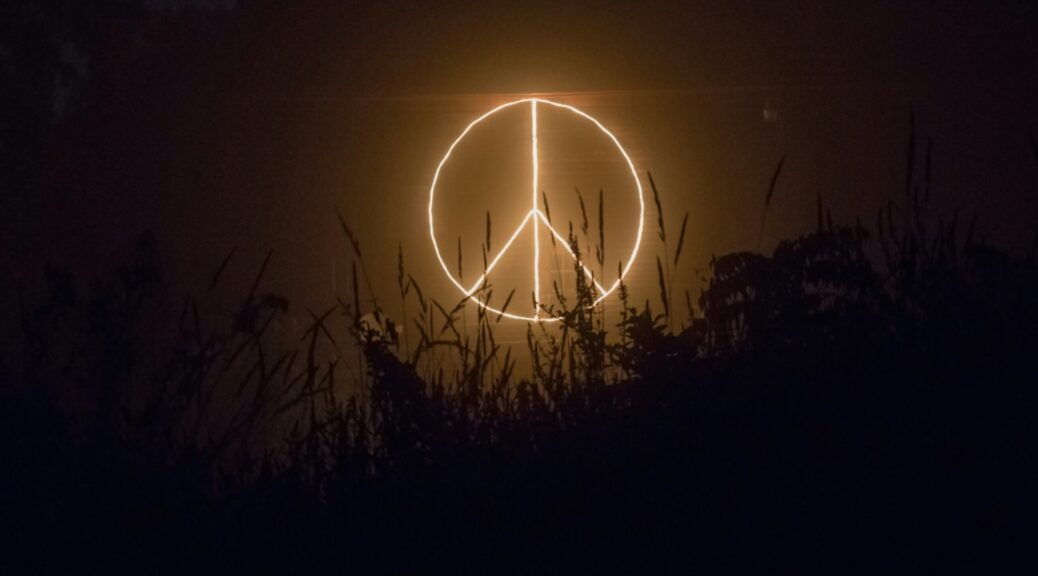
Photo by Candice Seplow on Unsplash