
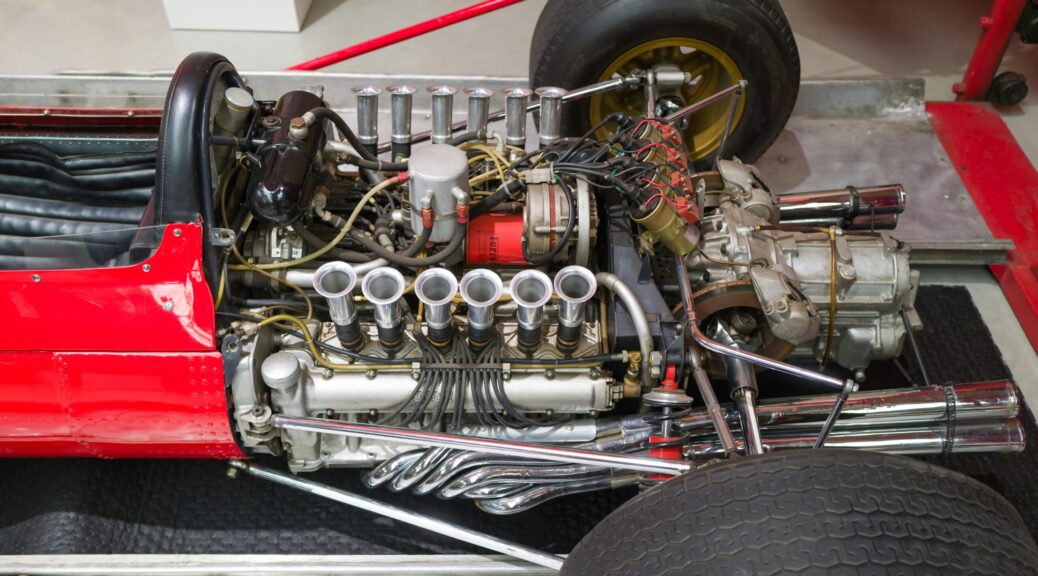
The Ferrari 2026 Paradox
Harvard research meets Biblical wisdom:
A roadmap for leaders drowning in output but starving for capacity.
Introduction: The Boy with the Ferrari Brain
In a world where the Machine can answer every “How” with infinite speed, the Human is losing the capacity to ask “Why.” This is the tragedy of the AI age: We have built a Ferrari engine for a bicycle chassis. To survive the acceleration, we must rebuild the only thing the machine cannot replicate: The three-dimensional architecture of the Human Soul.
Years ago, I served as the principal of a specialized high school dedicated to “gifted” teenagers diagnosed with severe ADHD. I remember vividly sitting in my office with a 14-year-old boy. Let’s call him David. David had an IQ that could frighten a university professor. His ability to process information, generate ideas, and see patterns was nothing short of breathtaking. But David was falling apart. He had been expelled from three schools in two years. He couldn’t maintain a friendship, he couldn’t organize his morning, and he was plagued by anxiety.
Looking at him, I realized the tragedy of his existence: David possessed a Ferrari engine—immense power, speed, and potential—but it was installed in a bicycle frame.
This was not just a metaphor for attention deficit; I now realize it is the fundamental gap between Artificial Intelligence and Human Consciousness. The Machine is a linear data processor. It has power, but no structure. But the Human Being is a complex architecture held together by three tensions: The relationship with Self, the relationship with Others, and the relationship with Purpose (Authority). The machine has no “Self” to discipline, no “Other” to bond with, and no “Purpose” to serve.
David’s tragedy was that he had the engine of a machine but lacked the architecture of a human. Every time he pressed the accelerator, the chassis didn’t just shake; it shattered.
For years, I thought this was a specific educational challenge. But as we approach 2026, I realize I was looking at a prophecy. Today, looking at the corporate world and the AI revolution, I see “David” everywhere.
Humanity has collectively become that student. We have acquired “Superpowers.” With Generative AI, our ability to produce, analyze, and create has become virtually unlimited. We have upgraded our engine to a level our ancestors couldn’t imagine. But we haven’t upgraded our chassis. We are vibrating apart because our Character—the integrity of those three relationships—cannot hold our Capacity.
Part 1: The Diagnosis – The Death of Judgment
To understand this crisis, we don’t need to look to Silicon Valley, but to Stockholm harbor in 1628.
On August 10th of that year, the Swedish Empire launched the Vasa. It was the most magnificent warship ever built, a symbol of absolute power. King Gustavus Adolphus ordered it to be equipped with 64 heavy bronze cannons and spectacular gold ornamentation. It was designed to rule the Baltic Sea.
Yet, the Vasa sailed less than 1,300 meters. A light gust of wind—not a storm, just a breeze—tipped the ship. Water rushed into the open gun ports, and within minutes, the engineering marvel sank before the eyes of a horrified crowd.
The inquiry revealed a painful conclusion: The ship was top-heavy. It had too much Power (Cannons) and too much Purpose (The King’s ambition), but it lacked the most basic element: Internal Ballast. It had no center of gravity to counter the weight of its own weaponry.
This is the “Vasa Syndrome” of the modern leader.
Recent research from Harvard Business School and MIT, particularly the work on “The Jagged Frontier” by scholars such as Jacqueline Lane and David Autor, points to a similar phenomenon in the AI era. AI has commoditized “Output.” It has solved the problem of creating value at speed. But as Lane’s research warns, while AI accelerates our Creative Output, it often degrades our Creative Capacity—our ability to judge, discern, and maintain strategic depth.
We are loading our decks with the heavy gold cannons of AI, automation, and data, but we are ignoring the ballast in the hold. And when the first breeze of a crisis hits—a market shift, an ethical dilemma, a team conflict—we capsize.
The solution is not to discard the cannons (we cannot return to a pre-AI world). The solution is to build a deeper hull and fill it with ballast. We need a new architecture.
To fix a structural flaw in the human soul, we cannot look to the engineers who built the engine. They deal with speed. We must look to the architects who designed the driver. We need a blueprint that predates the crisis.
Part 2: Decoding the “Vayishma”: The Art of Deep Listening
For centuries, management consultants have looked to the Bible, specifically Exodus Chapter 18, as the first case study in “Delegation.” They see Jethro, Moses’s father-in-law, observing Moses’s exhaustion and advising him to appoint “Captains of Thousands and Captains of Hundreds.”
It’s a great lesson in organizational efficiency. But it is an optical illusion.
If we read the text through the lens of ancient Hebrew wisdom—specifically the teachings of the great Kabbalist and philosopher Rabbi Yehuda Leon Ashkenazi (Manitou)—we discover that Jethro was not an efficiency consultant. He was an Architect of the Soul.
The text begins with the words “Vayishma Jethro”—”And Jethro Heard.” What did he hear? Why did he come?
He realized that “Freedom” (the Exodus) without “Structure” is simply Chaos. He understood that you cannot pour high spiritual content (“Torah” or, in our case, infinite AI knowledge) into an unstable human vessel.
Jethro’s advice was based on a three-layered internal transformation. He taught that before a leader can manage others (Output), he must stabilize himself (Capacity).
Let us explore these three layers as the blueprint for the AI era.
1. The Vasa Warning: When Gold Cannons Sink the Ship (The Choice of 2026)
The first thing Jethro heard about was the Exodus from Egypt. In Hebrew, Mitzrayim (Egypt) shares the root Meitzar—meaning “Constriction” or “Boundary.” The ancient world was deterministic. You were born a slave, you died a slave. Your “nature” was your destiny.
But this is not just ancient history; it is the fundamental human duality. Every human being is a hybrid. On one side, we have a biological body subject to fixed natural laws and instincts—this is our internal “Egypt,” our internal machine. On the other side, we possess a deep Inner Identity and a Sovereign Will capable of breaking those boundaries. That is our constant potential for “Exodus.”
The AI revolution challenges this duality because AI appeals directly to our “machine” side. AI models are probabilistic; they are trained on historical data. If we rely on them blindly, we surrender our Sovereign Will and become trapped in a feedback loop of yesterday’s data.
The Harvard study showed that when humans use AI for decision-making, they often fall asleep at the wheel. When the machine presents a convincing narrative, human judgment shuts down. We lose our agency.
The first layer of the Jethro architecture is Self-Government. It is the technical process of ensuring the “Human” governs the “Machine.” In the biblical story of Joseph, we see two ministers in prison: The Baker and the Butler. The Baker is passive (birds eat from the basket on his head). The Butler is active (he presses the grapes into the cup). The Baker dies; the Butler survives.
In 2026, the leader who lets the algorithm dictate the email, the strategy, or the vision is the Baker. The leader who acts as the Curator—using the AI as raw material while applying a rigid internal “Constitution” of values and judgment—is the Butler.
Here is the good news: Reclaiming this sovereignty is not a mystical event reserved for prophets. It is a technical, structural skill. It can be learned, practiced, and mastered remotely—even through a digital protocol—just as one trains a muscle. To survive the speed of the Ferrari engine, you must have the brakes of self-discipline. You must define who you are, separate from the machine.
2. Why AI Can’t Do “Face-to-Face”
The second thing Jethro heard about was the War with Amalek. Amalek represents the ultimate “Zero-Sum Game.” It is the philosophy of “Me OR You.” It is the archetype of the first murder in history: Cain killing Abel because he believed the world wasn’t big enough for two distinct successes.
In the corporate world, this is the “Scaling Ceiling.” Another notable insight from the Harvard research is that small teams using AI can generate substantial value (e.g., a startup of 3 people generating $1.5M in revenue), but they encounter a ceiling effect. Why? AI cannot replace the complex friction and trust required for human collaboration.
Jethro told Moses: “Nabol Tibol”—”You will surely wear away… for you are not able to perform it yourself.” He wasn’t just telling Moses to offload work. He was teaching him the Brotherhood Equation.
In a world where knowledge is a commodity, “being smart” is no longer a differentiator. Everyone has the same GPT-5. Therefore, technical brilliance is largely automated. The only friction that generates value is human friction. The new differentiator is Complementarity. Cain sees the other as a competitor. Abel sees the other as a partner.
The Jethro leader understands that while AI can replace tasks, it cannot replace the Covenant. The structure of “Captains of Thousands” isn’t about power; it’s about acknowledging that I am incomplete. I need the unique “Image of God” found in my colleague—that spark of intuition that no Large Language Model can replicate—to build something sustainable.
I must be candid with you: From my experience guiding leaders through the Jethro program, this is the earthquake moment. These high-Velocity Leaders are executives whose strategic vision and creative output significantly outpace their current structural capacity to execute. They are often marked by rapid ideation, high intensity, and a sense of constant urgency.”
This moment is when we leave the cold realm of automation and enter the living, breathing world. You can learn technical skills from a screen, but becoming “Abel”—learning to live in true resonance with another—requires a visceral, “Face-to-Face” transmission. It demands the inherent intensity of personal coaching because trust is not a concept you download; it is an energy you generate between souls. No amount of text on this page can describe the electricity of that shift. You have to experience it to believe it.
3. The Antinomy: How to Find Meaning in Randomness
The final and deepest layer is what Jethro heard last: The Giving of the Torah (Sinai). This addresses the crisis of Meaning.
The philosopher Immanuel Kant famously identified an “Antinomy” (a logical deadlock) regarding the creation of the world. Reason alone cannot prove if the world was created (has purpose) or if it is Eternal/Random (has no purpose).
This is not just an intellectual puzzle; it is the deepest existential struggle of the human condition. The decision we make here dictates our entire destiny. If the world is Random/Eternal, then I am merely a biological accident, driven by survival and statistics. If the world is created, then I am here for a specific purpose, carrying a unique frequency that the universe is awaiting.
AI is stuck in the “Eternal/Random” side. It operates Ex Misto—”Something from Something.” It takes existing data and rearranges it. It cannot create Ex Nihilo—”Something from Nothing.” It cannot agonize over purpose because it has no soul with which to agonize.
But the human being? We are created in the Image of the Creator. We have the capacity for true Novelty. Lane’s research explicitly highlights this: AI excels at making “Valuable” ideas (functional, practical), but humans still hold the edge in “Novelty” (ideas that break the paradigm).
The “Vasa” ship had power, but it sank because it lacked the “Why.” In 2026, a leader’s primary role is to be the Compass. To look at the “Chaos” of infinite data generated by AI and perform the act of Genesis: “And God divided the light from the darkness.” To distinguish between what is likely (AI prediction) and what is right (Human Vision).
And here lies the crux of the matter: You cannot resolve this Antinomy with a prompt. A machine can give you answers, but it cannot give you meaning. Decoding your unique destiny—deciding to live as a “Created” being with a specific purpose—requires deep, interpersonal resonance. It requires a mentor, a “Jethro,” who can look you in the eye and help you hear the call that is buried under the noise. This level of clarity arises only from the friction between two human souls. It is a biological and spiritual necessity that no software can replace.
Conclusion: The Return of the Driver
Let us return to David, my student with the Ferrari engine. We didn’t fix David by slowing him down. We fixed him by building his chassis—teaching him habits, boundaries, social connection, and a sense of purpose that was bigger than his impulses.
The corporate world is now facing the same curriculum. For decades, the goal of strategy was “Competitive Advantage”—how to beat the other guy. That is the logic of Cain. That is the logic of a world of scarcity.
But in an AI world of abundance, where “Output” is free, the goal shifts. We are moving from an era of Acquiring Knowledge to an era of Building Character.
The goal is no longer to be “better” than your neighbor (the AI will eventually be “better” than both of you at technical tasks). The goal is to reveal your Intrinsic Value—that unique frequency that only you can transmit.
Here lies the ancient Hebrew secret regarding the architecture of the human soul. For the average person, these three forces (Self, Others, God) are in constant conflict. The Hebrew tradition holds the secret of Integration (Peace). It teaches that a proper human “Chassis” acts as the foundation. Only when this foundation is combined with the insights of “Abel” (Brotherhood) and a deep, personal internal clarification regarding the nature of the universe, do we gain the capacity to weave these three parts into a single vector of Will.
We stand at a historic crossroad. Science is reaching breathtaking peaks with AI (building the ultimate “Engine”). Simultaneously, the return of the People of Israel to their land is a “replication” of the ancient Exodus, offering the opportunity to reconnect human Will with Divine Purpose in the world of action. This is an excellent opportunity for the coming year: To lead the peak of universal science with the depth of Israeli wisdom.
The question is: How ready are we to “hear” the shifting beat of the wings of history?
“The Jethro Principle” is not a management hack. It is the ancient engineering required to build the Ferrari and discover Man in his full power on the historical track toward a better future. It asks you to stop wrestling with the steering wheel and start building the vessel.
The engine is ready. It’s time to build the chassis.
 I leave you with this question: In a future where the machine can answer every “How” with perfect efficiency—do you possess an internal architecture strong enough to define the “Why,” or will you become the highly efficient administrator of your own irrelevance?
Here’s the question:
Are you running a Ferrari engine on a Bicycle chassis? [Take the 4-Minute Structural Audit Here] (https://bit.ly/Ferrari-Audit-
—
English Appendix: The Research Alignment
How the “Jethro Principle” architecture correlates with current academic findings (2024-2026).
| The Crisis (Research Diagnosis) | The Solution (Jethro Principle) | The Application |
| 1. The “Jagged Frontier” & Loss of Judgment
Harvard research (Lakhani et al.) shows that while AI boosts output, it causes humans to “fall asleep” and lose critical judgment, leading to a 19% drop in correctness on tasks outside the AI’s frontier [1]. |
Layer 1: Man vs. Self
The transition from “Baker” (passive) to “Butler” (active Curator). Establishing a “Constitutional Self” that judges the machine’s output. |
Building the “Ballast”
Protocols for human-in-the-loop verification and self-discipline. |
| 2. Hollowing Out of Middle Management
Gartner predicts that by 2026, 20% of organizations will flatten their hierarchies, eliminating middle management [2]. MIT’s David Autor warns of the devaluing of “common expertise” [3]. |
Layer 2: Man vs. Others
The “Brotherhood Equation.” Moving from “Competition” (Cain) to “Complementarity” (Abel). |
The “Crew” Structure
Focusing on interpersonal resonance and trust—skills that cannot be automated. |
| 3. The Crisis of Meaning
Cognitive Scientist John Vervaeke describes a “Meaning Crisis”—a loss of connection to reality and truth in an age of information overflow [4]. |
Layer 3: Man vs. God
Breaking the “Antinomy.” Moving from a Random/Eternal worldview to a Created/Purposeful one. |
The “Compass”
Defining the “Why.” Leadership becomes the act of distinguishing light from darkness (Vision). |
References & Further Reading:
- Harvard Business School: Navigating the Jagged Technological Frontier: Field Experimental Evidence of the Effects of AI. (Lakhani, Dell’Acqua et al., 2023). Read Study
- Gartner Research: Top Strategic Predictions for 2025 & 2026: The Hollowing of Middle Management. Read Report
- MIT Economics: The Work of the Future: Building Better Jobs in an Age of Intelligent Machines. (David Autor et al.). Read Article
- John Vervaeke: The Meaning Crisis: Wisdom, Purpose, and the Search for Coherence. Explore Concept
Photo by Georg Eiermann on Unsplash
- Why AI Will Break Us Before It Serves Us – by Chaim Goldberg - December 18, 2025