
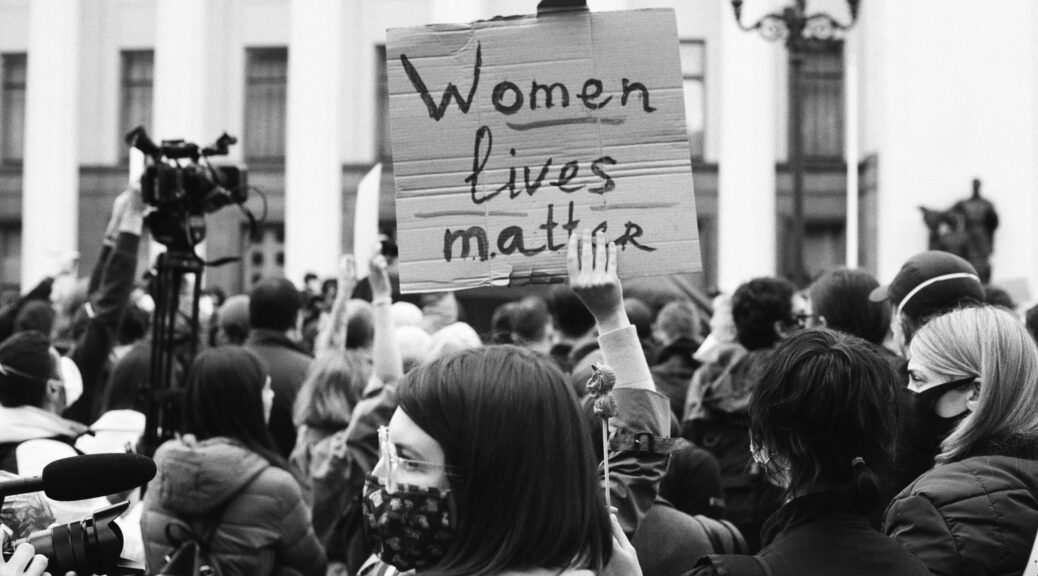
To kick off March, Women’s History Month, I decided to write about Unita Blackwell and her place in both African American and women’s histories. Among so many great women of all backgrounds, among them Eleanor Roosevelt, Viola Liuzzo and Susan B. Anthony who advocated for civil and voting rights, I wish that Unita Blackwell was alive and with us today. More than ever, we need her out on the battlefield leading protests and knocking on doors extolling the urgency of exercising our right to vote. Lord knows we need her (and them).
Of course the truth is that during African American History Month when we recognize well-known voter rights advocates from the past, chief among them Dr. King, Fannie Lou Hamer, Medgar Evers and many others who risked their lives and shed their blood for our right to vote, often many still just shrug off with flimsy excuses for not voting. Hey, as the saying goes, “if the shoe fits, wear it” (including one of the two you should be wearing to the nearest voting booth).
Well sorry history erasing proponents and “my one vote won’t make a difference,” excuse makers, but there’s no way I was going to sit quietly on the sidelines while February slips by while still another story disappears into the annals of oblivion or on some dopey banned books list. Uh, uh, sorry, no way. Which takes us to one Unita Blackwell.
Unita Zelma Blackwell (1933 – 2019) was an American civil rights activist who was the first African-American woman to be elected mayor in the state of Mississippi. She was a project director for the Student Nonviolent Coordinating Committee (SNCC) and helped organize voter drives for African Americans across Mississippi.
Now if her plate wasn’t already full, she also served as an advisor to six US presidents: Lyndon Johnson, Richard Nixon, Gerald Ford, Jimmy Carter, Ronald Reagan and Bill Clinton. Her autobiography, Barefootin’: Life Lessons from the Road to Freedom, (2006) covers her life and the sharecropper work she and her parents experienced, all of which drove her actions in the Civil Rights Movement.
Indicative of the brutality of life for African Americans in parts of the South back then, when she was three years old, Blackwell’s father left the plantation on which he worked and fled to Memphis, Tennessee, fearing for his life after he confronted his boss about speaking inappropriately to his wife. Prior to that her grandfather was murdered by a white landowner. Blackwell and her mother left the plantation to live with her father soon afterwards. After her parents separated, Blackwell and her mother went to West Helena, Arkansas so that she could have access to a better education.
Blackwell spent a majority of her early years chopping cotton for $3 a day in Mississippi, Arkansas and Tennessee and peeling tomatoes in Florida. She was 14 when she finished the eighth grade, the final year of school at Westside, a school in West Helena for Black children. She was 25 when she met Jeremiah Blackwell and a few years later they married.
Later Blackwell got involved in the Civil Rights Movement when activists from SNCC came to town and held meetings concerning the rights of African Americans to vote. The following week she and seven others went to the courthouse to take a voter registration test to vote. While outside the courthouse waiting to take the test, a group of white farmers from the area heard what was happening and tried to scare them off. Her group stayed there all day, but only two were able to take the test.
The racism that they experienced, Blackwell wrote in her autobiography, made that day “the turning point” of her life. Jeremiah and Unita lost their jobs the next day after their employer found out that they had been part of the group seeking to register to vote.
Blackwell attempted to pass the voter registration test three times over the next few months. In early fall she took the test successfully and became a registered voter. When the United States Commission on Civil Rights came to Mississippi in January 1965, Blackwell testified in front of them about her experiences with voter discrimination. As a result of Blackwell’s involvement with voter registration campaigns, she and other activists endured constant harassment.
After meeting Fannie Lou Hamer in the summer of 1964 and hearing about her experiences in the Civil Rights Movement, Blackwell decided to join the SNCC. As a project director for SNCC, she organized voter registration drives across Mississippi. Later that year, she became a member on the executive committee of the Mississippi Freedom Democratic Party (MFDP) which provided a party for voters that SNCC had been registering to vote.
In late August Blackwell and 67 other elected MFDP delegates traveled to the 1964 Democratic National Convention intending to get the MFDP seated as “the only democratically constituted delegation from Mississippi”. They were eventually offered two at-large seats but refused that compromise. The event, particularly Fannie Lou Hamer’s nationally televised famous “sick and tired of being sick and tired” testimony brought the party and the Mississippi Civil Rights movement into the public eye. During her time participating in the Civil Rights Movement, Unita Blackwell was jailed more than 70 times because of her role in civil rights protests.
Starting in 1973, Blackwell participated in 16 diplomatic trips to China, including a trip with actress Shirley MacLaine in 1973 to film The Other Half of the Sky. As part of her commitment to better relations between the United States and China, Blackwell served for six years as president of the US–China Peoples Friendship Association, an association dedicated to promoting cultural exchange between the United States and China.
She was elected mayor of Mayersville, Mississippi in 1976 making her the first female African-American mayor in Mississippi. As mayor, she oversaw the construction of several sets of public housing, the first time that federal housing had been built in Issaquena County. Blackwell obtained federal grant money that provided Mayersville with police and fire protection, a public water system, paved streets, housing accommodations for the elderly and disabled and other infrastructure. She gained national attention by traveling across the country to promote the construction of low-income housing.
Contuining her activism, Unita helped found Mississippi Action for Community Education, a community-development organization in Greenville, Mississippi. From 1990 to 1992, she was president of the National Conference of Black Mayors and in 1991, she co-founded the Black Women Mayors’ Conference as a corollary to the National Conference of Black Mayors and served as its first president.
Blackwell was awarded a $350,000 MacArthur Fellowship genius grant in 1992 for her part in creating the Deer River housing development among other creative solutions to housing and infrastructure problems in her state. Unita Blackwell died in Ocean Springs, Mississippi in 2019.
In closing, like the advice I ended a recent column with, insert Blackwell’s story into your three-ring binder so that by this time next year you will have a collection of relative unknown stories of icons from African American history.
Oh yes, lest I forget, make sure that you save space for stories about courageous American women of all backgrounds and cultures!
Photo by Rad Pozniakov on Unsplash
- Women’s History Month: Remember Viola Liuzzo – by Terry Howard - March 19, 2026
- Bombing innocent children – Terry Howard - March 11, 2026
- An African American in Women’s History Month – by Terry Howard - March 2, 2026