
Like millions, I was riveted to the breaking news about the passing of Civil Rights advocate Jesse Jackson and at 5:30 pm, during a commercial, I called Bill Willis to follow up on a conversation we’d had two days before.
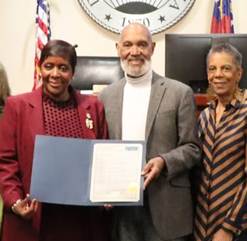
“Will I see you at this evening’s Board of Commissioners meeting (Douglas County, Georgia) during which I will accept their African American History Month proclamation? It starts at six and will be preceded by an art exhibition on the third floor.” I thanked him for the heads up and promised to get there as soon as I could.
Well as it typically is it is for Bill Willis, not only was he there with one of paintings, but the impeccably dressed Willis was there to accept the Commissioners proclamation.
Back to the purpose of my call to him at 5:30 and, as the saying goes, “be careful what you ask for.”
You see, acting on a combination of a hunch, hearsay and personal observations, I recently asked “Professor Bill” if he’d allow me to write a profile on him for African American History Month and, if so, would he mind sending me his curriculum vita. He agreed and did.
“Whoa,” was my response when I received his vita the next day. Well, if there’s a better adjective than “incredible” to describe Bill’s academic, professional, book authoring and artistic background I scratched my graying noggin to come up with one. And still can’t.
But in consideration of the limitations of space – and, eh, reader attention – I’ll provide highlights of his background and end with his answers questions I posed to him.
Bill Willis, Professor of Sociology Emeritus, served as Associate Dean of the Urban Studies Division, Assistant to the Academic Vice President, Dean of the College of Education, Chairman of the Department of Educational Leadership and as Interim Chair of the Department of Sociology at William Patterson College. He was the first African American to be elected to public office in West Orange, NJ when in 1999, he was elected to a three-year term on the Board of Education.
Willis earned his master’s and doctoral degrees from Harvard University and also served as a consultant to the Tufts New England Medical Center and the New Jersey Department of Education.
A dedicated social activist, Bill sat just a few yards from Dr. M. L. King on the steps of the Lincoln Memorial during King’s iconic “I Have a Dream” speech. He has traveled widely, studying educational systems in the United States, England, Israel, Tanzania and Togo. Locally, Bill served on the Board of Directors of the Douglasville/Douglas County Arts Council and the Douglas County Water and Sewer Authority and as its Chair was instrumental in reviving the Douglas County Democratic Party after it was de-certified by the state party.
A gifted artist, jazz enthusiast and aspiring novelist, Bill spends most of his free time studying and playing the tenor sax, painting, building model railroads, and researching his family history. A native of Griffin, Georgia, Willis and his lovely wife Mignon currently reside in Winston, Georgia.
Following are answers to questions I posed to him:
How did you end up in Georgia?
I was born in Griffin and my parents moved to Boston when I was four years old. Several years after I retired, one of my brothers moved here and encouraged me to come and look at a home he was having built in a nice subdivision. I was equally impressed with the chance to build a beautiful home on my own lot and was happy to trade the cold winters in the Northeast for the warmer climate in Georgia. One can have a vibrant life anywhere and I have continued to be an active participant in the social and political life of Douglas County and contribute in any way I can.
What book had the biggest influence on you over the years?
Even though I am an agnostic, I grew up in a religious household, so I guess the admonitions in the Bible to do good and treat others as I would like to be treated had the greatest influence on my life.
What helps you stay open to another person’s reality and understand them more fully as opposed to judging them from your own frame of reference?
Great question. As a sociologist, I embrace a concept known as “The Sociological Imagination,” which is just another way of saying try to evaluate every experience on the basis of the other person’s perspective. I’m always curious about what motivates other people and always want to know “why?” I try to be introspective and examine my own behavior and motives.
From all indications we’re amid an inexorable erosion of trust in institutions and leaders these days. How did we get here Bill?
I think that a part of the answer is that people are witnessing how evil doers are often enriched and find it difficult to maintain faith in the value of honor and integrity. The fact that many people in positions of power have simply used their positions to reinforce their power and enhance their own lives even if it meant trampling on the lives of others makes it difficult to trust our leaders and institutions. Unfortunately, diminishing levels of trust has permeated personal relationships and is lurking behind a lot of the divisions we’re seeing in the nation and world today.
Given that this is African American History Month 2026, it’s clear that there’s an organized effort to ignore, gloss over or totally erase our history. What are the implications and consequences of that and what should we do in response?
It sets the struggle back because we must spend time and energy that could be devoted to growth and development that counter efforts to erase true history. We should respond by continuing to apply as much pressure and resistance as possible against efforts to erase or diminish the African American history in society. In addition, we should actively participate in the electoral process by running for office and electing candidates who support our interests because we should understand now that elections have consequences.
Tell us one thing about Bill Willis that the reader may be surprised to know.
I don’t know if there are things that would shock anybody, but the fact is that I was jailed with other protestors for participating in a civil rights demonstration. Also, people might be surprised to know that I once dressed in a Paul Revere costume and rode a horse through Boston encouraging people to come out to participate in a rally. I led a parade on horseback, and it was carried by local TV stations, newspapers, and magazines. Time magazine carried the story with a photo. What else? Well, one of my greatest loves are playing the saxophone, painting, writing, building model railroads, playing pool, and the feeling of satisfaction from learning to do new things. I’m a do it yourself advocate and over the years have made many repairs and upgrades on my vehicles and homes. I also belong to a book club and have recently completed my first novel and have plans for two sequels and a memoir.
As you reflect on your decades of accomplishments in this, the 4th quarter of your life, do you have any regrets about something you did or didn’t do?
I have been married and divorced more than once and regret that I was unable to raise all my children in a stable two-parent home for their entire lives. I also regret that my parents allowed me to discontinue music lessons when I was a child. As humans, we all have regrets, but we should learn from rather than dwell on them.
In the end, in the same manner that we celebrate history icons of yore, let’s not lose sight of those history makes today who, like low hanging fruit, have important stories daring to be told.
- Random thoughts on No Kings Day protests – by Terry Howard - April 6, 2026
- Women’s History Month: Remember Viola Liuzzo – by Terry Howard - March 19, 2026
- Bombing innocent children – Terry Howard - March 11, 2026