“Sorry, but I don’t remember seeing many white faces during civil rights protests and marches in the sixties.
So, I’ll take a pass.”
That was one of the “no thanks” responses I got from “Fernando,” one of several Black folks I invited to attend the recent No Kings Day protest with me. Hold that for now because I want to leave with a full-throated response to “Fernando” in closing.
Now in case you didn’t know, cared to know, or reside on another planet (and much to the chagrin of “someone” who is obsessed with crowd size), in the largest single day of protest in American history, over 8,000,000 people took part in some 3,300 “No Kings” rallies recently spanning every continent on Earth while millions more participated remotely by watching coverage on television or online.


Georgia protesters Virginia protester
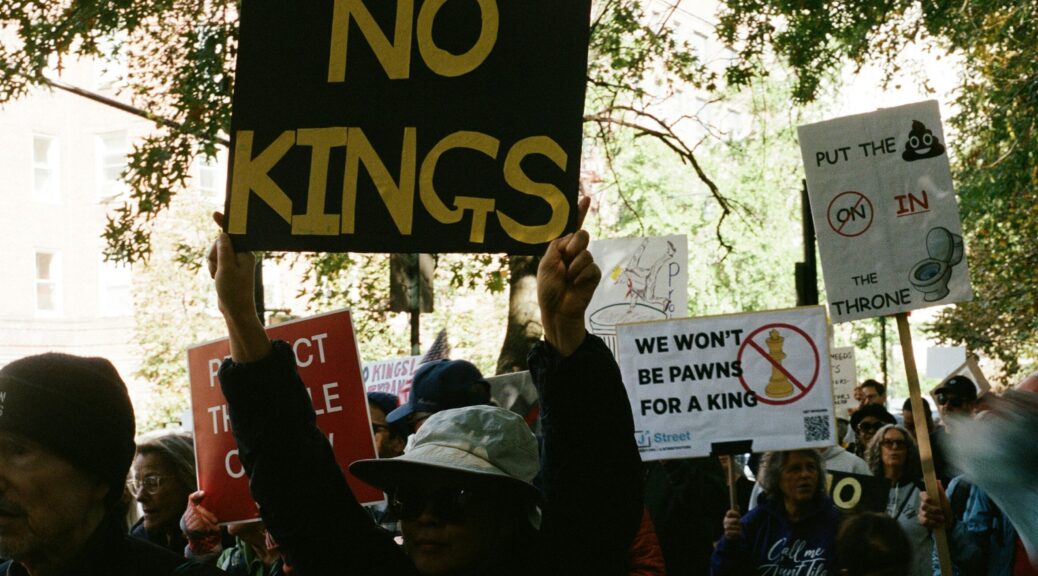
So, despite temperatures in the mid-forties, I made the short drive to a local No Kings Day protest. It seemed that the only difference between that protest compared to the one I attended last year was a much bigger turnout, more young people in attendance and more creative posters, some with graphic images and language way too inappropriate to include in this narrative. Plus, given that this an election year a few politicians were there deftly working the crowd. And from what I could glean from some conversations, many protesters were there not necessarily to protest for themselves but for generations to come.
This time my friend “Debbie” walked through the crowd plucking the strings on her guitar, in response to which one protester whispered to me that it reminded him of the hippy culture of the sixties.
Now the truth is that I had no plans to write about that experience until I read a piece by The Beautiful Mess author John Pavlovitz (I share excerpts from his piece shortly) who has written extensively about his anger and exhaustion with the havoc the current administration has wreaked on everyday Americans. Let’s begin with the following excerpts from how Pavlovitz responded to his participation in a No Kings Day protest in a town in North Carolina.
“When you lose elemental parts of yourself, they don’t all depart at once, and since you’re sustaining the daily woundings of this life from the inside, you may not be aware of the thousands of tiny cuts at the time. You may not notice the lifeblood slowly draining from your spirit. In fact, you might believe you’re who you’ve always been, until something reminds you of the you you used to be. No Kings Day reminded me.
Yesterday, as I stood shoulder to shoulder with hundreds of similarly exhausted, equally disheartened, but still not ready to call it a day with human beings lining the streets of our little North Carolina town, I found a few things I hadn’t even realized I’d lost. There is a silent toll that witnessing so much suffering takes on compassionate people, especially when you work so hard to remain awake and aware. Being reminded every day of just how many human beings are experiencing such wasteful brutality can gradually suffocate the spirit, rendering us joyless.
One of the first sounds I noticed as I found myself within the pulsating mass of humanity on that highway was the sound of laughter, and it was my own. I realized it had been a while since I’d heard it like this: easy, constant, booming. The joy was medicinal. It was infectious. This was not a dour, dismal acknowledgement of defeat, as much as it was a joyfully defiant dance party of pissed-off people who haven’t let a minority movement of misery make them incapable of restorative jubilation. One of the goals of authoritarian regimes is to extinguish the light from people; to inundate them with a legion of emergencies and nightmares that require so much energy to confront that they begin to lose the ability to see anything ahead worth pursuing. When optimism dries up, the future becomes a bleak foregone conclusion. I hadn’t realized I had been chronically emotionally dehydrated.
That is, until once surrounded by a swirling technicolor sea of activists, fighters, healers, helpers, and dreamers in the blazing North Carolina sun, I could feel hope returning within me: not a naive one that denies the gravity of the moment or the reality of the threats, but a hope that refuses to give this ugliness the last word. Yesterday won’t magically rewind the clock pre-election and let us have a do-over. It doesn’t suddenly erase the unprecedented damage to our systems and safeguards. It alone can’t bend the arc of the moral universe away from fascism. That will require a sustained and organized presence, political engagement leading into the midterms like we’ve never seen, and very likely, a general strike.
But No Kings Day was a glorious reminder of how vital joy, hope, diversity, and our collective efforts are in resisting this Renaissance of hatred. Our Republic is still in great peril, but we, its fierce caretakers who number in the tens of millions, are still not ready to consent to defeat.”
What must not be lost is the fact that No Kings Day protests represent a nationwide movement aiming to fight against authoritarianism and protect democratic values. For Black Americans, participating in them is seen as a way to engage in the resistance against potential tyranny, defend civil rights and build a truly multiracial democracy.
Now I have one last thing to say to “Fernando” about the visible presence – or lack thereof – of African American participation in No Kings Day protests. Yes, I respect your right to choose not to protest, although not for the reason you cited. But I remind you that white folks like Mrs. Viloa Liuzzo, Rev. James Reeb, Michael Schwerner, Andrew Goodman, William Lewis Moore, Jonathan Daniels, Rev Elijah Lovejoy were assassinated when participating in protests for civil and voting rights in the deep South. Not to be ignored were scores of people from other races who provided financial and in-kind support from behind the scenes.
Now I will make one last request of you “Fernando,” if you choose not to march in a No Kings Day protest, please do march to your local polling station during upcoming local and national elections because the stakes are just that high.
So, remember “Fernando,” (and all the Monas, Jerrys and Keishas out there) that although you may not have been alive or participated in them, the protests we see today started with “us” during the civil rights movement. We’ve been the leading force for all protests by others who followed our example. There’s truth in the axiom “out of sight, out of mind.” We must reclaim our political significance, make our presence known and let our friends, neighbors and opponents know that we still count. No excuses, just participation!
Oh, yes, one last memory jogger before I climb off my high horse “Fernando.”
Scores of courageous people – yes, the majority of them African American – withstood death threats, fire hoses, Billy clubs, police dogs and blistering summer heat while protesting for our civil and voting rights. Truth is that they never had to be begged, cajoled, or bullied to go to the polls as we do to many of us these days. My point being that even — no strike that, especially — through our weariness and disappointment from the past few years of persistent assaults and attempts turn back the clock on diversity, we have to protest, we have vote, we have to march alongside those who, although they may not look us, share our hope for a better world.
“My feets is tired but my soul is rested.” – Mother Pollard, 72-year-old activist during the1955 Montgomery Bus Boycott
Photo by Bradley Andrews on Unsplash
- Random thoughts on No Kings Day protests – by Terry Howard - April 6, 2026
- Women’s History Month: Remember Viola Liuzzo – by Terry Howard - March 19, 2026
- Bombing innocent children – Terry Howard - March 11, 2026