
World Soil Day – Dec. 5 , 2026. Never heard of it? Few people have. It is sponsored by the United Nation’s Food and Agriculture Organization (FAO) and the Global Soil Partnership (GSP).
It intends to illuminate the Global Soil Crisis. You probably haven’t heard about that either. The FAO has officially declared a Global Soil Crisis, with a grim forecast that deprives the earth of its critical soil resources within the next four decades. Put in plain language, the absence of productive soil resources predicts worldwide famine, with no recovery in sight.
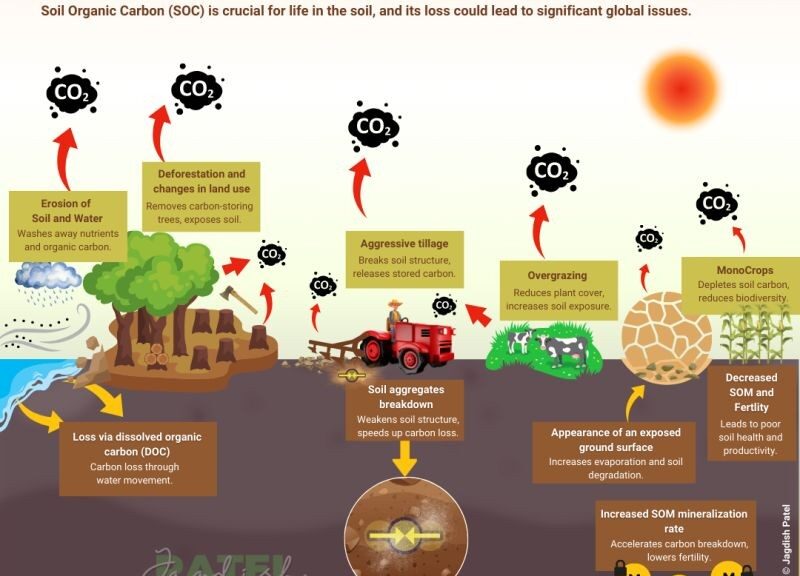
A critical factor that contributes to this dire prediction is monoculture, the practice of planting a single crop over a large area, that continues to be a potent negative influence on soil degradation. Vast acreage (or hectarage, if you prefer) of a high-volume crop like corn or soybeans cancels biodiversity. The absence of biodiversity impedes biological pest control and interferes with the dynamics of soil nutrition.
Ask a farmer – in Italy, Brazil, Ukraine, or the U.S. – why they plow up their fields every spring you’ll often get this typical response: “We always do it this way”. And “always” means for roughly the past 10,000 years. Annual plowing disturbs and disrupts soil biology and exposes soil to erosive influences. In the short-term, soil is imperceptibly degraded and eroded. Long term loss of soil is epic.
Continuous addition of industrial fertilizer and toxic chemicals to the soil are the core legacy of chemical agriculture. Established in the late 19th century, chemistry became the dominant guiding force in agriculture. By the early 21st century biological management methods have forged major inroads into agricultural practices, characterized by non-invasive results.
Inadequate prioritization of Soil Organic Matter (SOM) is an ongoing omission. Addition of organic matter on a constant basis is essential to maintaining healthy soil. SOM is typically managed casually or not at all. Cover crops, the planting of non-food vegetative crops alongside food crops adds precious organic matter to the soil and keeps the soil covered at all times, effectively protecting it from erosive influences. Animal manures must be applied where possible, preferably in composted form.
The Status of the World’s Soil Resources 2026 report by the FAO paints a dismal picture of non-compliance with these recommended measures. Soil erosion management was rated as poor or very poor in 81 percent of monitored regions. Biodiversity loss, due to heavy use of toxic pesticides and industrial fertilizers, has reached an alarming new peak. The report also affirms that merely ten percent of evaluated global soils showed improvement over the last ten years.
Remedies are available but global farming communities in general, are deaf to authentic soil therapies. Regenerative farming counsels agriculture to forego its destructive habit of universal annual plowing and favors planting by “drilling” seeds into the soil, a process that barely disturbs the soil. Regenerative, by its rejection of the plow and its promotion of cover crops short circuits the process of soil degradation. Organic farming has gained modest success over recent decades and has captured a growing share of mainstream agriculture. Organic’s ban of industrial toxins and fertilizers protects soil biology and prevents structural and nutritional contamination. Both of these practices in combination, can reverse the negative trend but neither has gained sufficient momentum to impact global soil conditions in a meaningful way.
Soil cannot be replaced overnight. Soil formation is a process involving mineral weathering, chemical reaction, and biological influences that can take up to a century to produce a single inch of useful soil. The Mississippi basin is estimated to have lost at least one foot of topsoil depth since the inception of modern agriculture. Roughly calculated, nature would need at least 1200 years to replace the soil that has already been squandered.
Soil is not just a pile of mineral dirt. It is earth’s most bio-diverse system, estimated to contain nearly 60% of our planet’s biodiversity. The vast majority of that diversity is microscopic and not visible to the naked eye and therefore goes unnoticed by most humans. It’s impact is profound and its benefits to life on earth are immeasurable.
The general public has been inundated with global crises. Climate change, plastic particle marine pollution, contamination of potable water sources, toxicity of agricultural products, excessive air pollution, reference but a few. We didn’t request another crisis, but it is here, and we are compelled to focus on it and respond. It’s not a choice; it’s our obligation and urgent responsibility.
World Soil Day | 5 December 2026

Why a World Soil Day?
We celebrate World Soil Day (WSD) annually on 5 December to raise global awareness about the role soils play in agricultural development, ecosystem functions and food security.
Endorsed by the Food and Agriculture Organization of the United Nations (FAO) and the United Nations (UN) General Assembly, WSD became an official international day in 2014 under the leadership of the Kingdom of Thailand. Since then, FAO has facilitated the implementation of WSD as a global platform for action and advocacy within the framework of the Global Soil Partnership (GSP)
