I was born in rural Texas well before the digital age of social networking. I am a Mexican American. For those of you familiar with the digital divide, you know it is not commonplace for an older Latina to carry a laptop, travel internationally, and blog at a major innovation conference. This is a story about the success of a Latina with blogging and social networking in Europe.
Stephen Zack is determined that the American Bar Association (ABA) does not give in to ‘diversity fatigue.’ Zack is the first Hispanic president of the American Bar Association in its 150 years. Not surprisingly, Zack has an ongoing passion for both the law and for the issue of diversity. Recent census numbers underscores Zack’s insistence that the U.S. legal profession to become more diverse. One in six Americans is now of Hispanic heritage; the Asian-American population has more than doubled in the last 10 years. But the increasingly multiracial American population is not yet accurately reflected in the U.S. legal system even though lawyers and judges should represent the community they serve. The ABA formed the first-ever Commission on Hispanic Legal Rights and Responsibilities to address the disparity.
Maria Tallchief, international ballet superstar, inspired the ballerina in those of my generation caught up in the Dance Fantasy. Like gambling fever, the Dance can be all-consuming, easily contracted and a life-long passion. I caught dancing fever at first sight, growing up in Bermuda. I stared, open-mouthed when the square dance caller yelled ‘allemande right’ and my older brother Joe and his friends flew around the circle formation. “Me, too!” begged my five-year-old self. “Can I, huh, Can I?” The caller looked pained when Mom asked permission. “Yeah, OK. But only if she can find someone who’ll dance with a kid that young.” The deck was stacked against me, but Joe paid a friend sixpence to dance with me. My love affair with dance was off and running.
A friend on Facebook is the brand new father of a baby girl. Simon Cohen, in awe of childbirth and fatherhood invited his friends to give him ideas for an upcoming British radio show asking, “Why aren’t women given more respect? It’s the 21st Century!”
(The Bermuda Jews History Series was originally published in The Bermudian Magazine)
I sat in a restaurant overlooking Hamilton harbor pondering my morning researching Bermuda Jews in the island’s Archives. I’d spent many hours reviewing Bermuda’s Jewish tourism prior to World War II. Yes, my family had mentioned ‘restricted’ places where no Jews were allowed. But mostly I remembered their stories of Bermuda’s war-time kindness to Jews. Recently, Dr. Hollis Hallett, the Archives founder, directed me to documents from the 1930s showing the impact of an increasingly global anti-Semitism on Bermuda tourism. What should I write about this ugly period?
Cross Cultural is now a common professional term. On a historical note, the term ‘cross cultural’ originated in 1970 for the professional world. This was in response to the age of globalization which produced a demand for cross-cultural awareness in various commercial & professional sectors.
“I am a Generation Y. ” This statement seems harmless enough, until you find yourself planted in a room full of baby boomers fed up with the millennials, the whiney, egocentric, group of fickle youngsters filing into the newly unstructured world of work. We are the facebookers, the job-hoppers, the demanders and questioners who want a raise NOW with a company car and a key to the executive washroom. Never mind that we’ve only been working for two months. True, the Y generation may be a bit spoiled and tend to expect rewards somewhat prematurely, but we do have a few good traits that could encourage you to work with generation differences.
I phoned the Los Angeles County Bureau of Adoptions. The switchboard operator asked me to please hold. Finally the director, Jessica Keebler, came on. “Yes, Mr. Barlin.”
“It’s been two years since we put in our application—”
“There are still no Jewish children available, Mr. Barlin.”
To achieve organizational cultural competence within the health care leadership and workforce, it is important to maximize diversity. This may be accomplished through:
• Establishing programs for minority health care leadership development and strengthening existing programs. The desired result is a core of professionals who may assume influential positions in academia, government, and private industry.
• Hiring and promoting minorities in the health care workforce.
• Involving community representatives in the health care organization’s planning and quality improvement meetings.
The complex constellation of skills required for global leadership is continually morphing. The basic leadership competencies are only an axis around which revolve the specifics of local culture and the
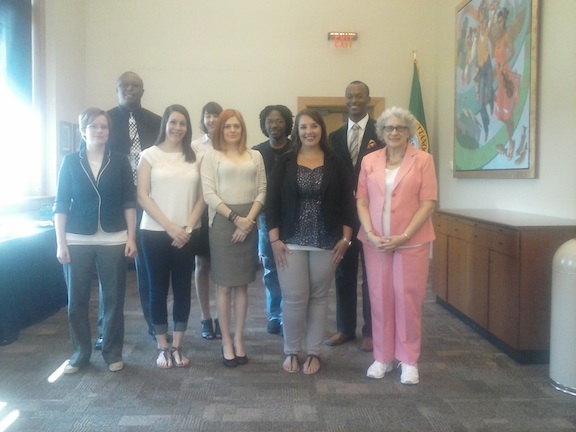
Office of Multicultural Affairs interns
analytics of the target culture globally. Therefore, not only does the knowledge management evolve, but so does the audience for global leadership development. At one time, the audience was primarily executives involved in international relocation. Over time, that group widened to include those who work with them: Human Resource departments, Supply Chain groups, and professionals with frequent contact, particularly in the STEM fields: Science, Technology, Engineering, and Math. Today, in order to stay competitive in this environment, virtually every nation on the face of the planet is extending their global leadership training into new arenas. A key area is our youth, brought up on the internet with its impersonal speed and no-holds-barred communication style. The question now becomes, how can we capture the imagination, thought processes, and commitment of potential leaders in an arena with few quick answers or short tweets.