All posts by Dr. Deborah Ashton

ADR Advisor, Dr. Deborah Ashton, President of Planet Perspective, is a HR strategist and executive with 30+ years of global and Fortune 500 experience. She led DEI at Medtronic, Darden Restaurants, Harley-Davidson, Argonne National Laboratory and Novant Health. She is the former Chief of Test Development and Validation for the Commonwealth of Massachusetts. Deborah served on the Advisory Board for the Mill Road Progressive Governance Fund, Mill Road Capital. She has published in the Harvard Business Review, the American Diversity Report, for American Hospital Association, etc. Deborah is an Inclusion Magazine’s 2021 D&I Hall of Fame inductee, one of Savoy Magazine’s 2014 Top Influential Women in Corporate America and recognized as a Health Equity Pioneer by American Hospital Association’s Institute for Diversity and Health Equity in 2023. She received Clarke University’s 2021 Distinguished Alumni Award. She has a Clarke College Doctor of Human Letters (honoris causa), Harvard University PhD and EdD, and Harvard Medical School postdoctoral fellowship. A licensed psychologist, she specializes in organizational and clinical psychology.

R-E-S-P-E-C-T Women’s History Month – by Deborah Ashton

Well, at least we as women have one of the longest commemorative months of the year. But equal pay and fair treatment would be preferable. That would be a measure of respect. 

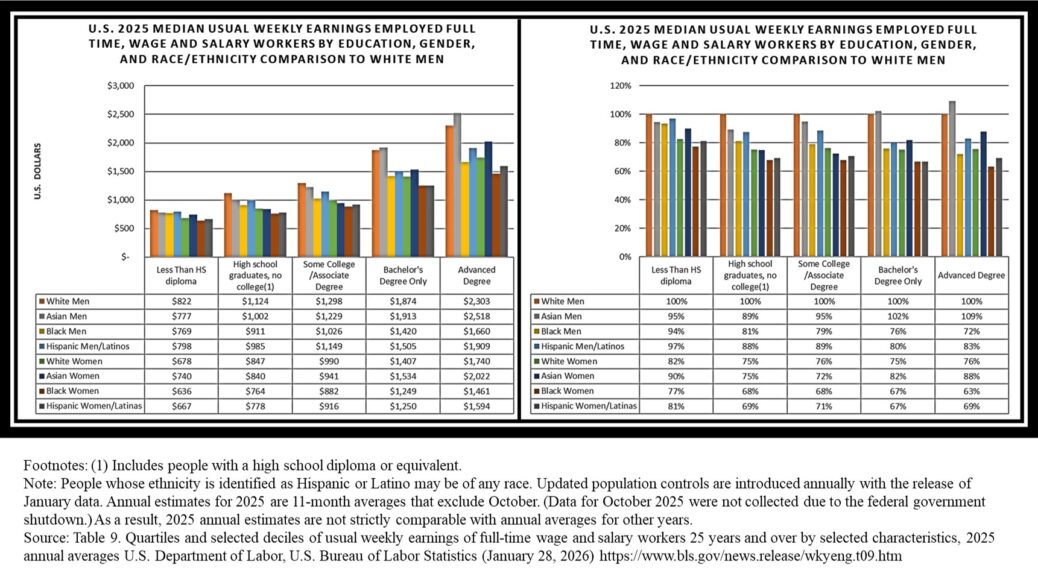
As of 2025, women earn less than men at all education levels, except that Asian women with a bachelor’s or advanced degree earn more than Black men with similar degrees. The gender pay gap is narrowest among individuals without a high school diploma. In essence, education only acts as an equalizer for those with the lowest level of schooling.

2025 Pay Inequality – See chart in headline

In 2003, serving on The Conference Board’s Tough Issues in Diversity panel, I showed that analyzing U.S. weekly median earnings requires considering gender, race or ethnicity, and education level. Over 20 years ago, gender had a greater effect on pay than race/ethnicity and that being a woman of color amplified the negative impact on pay. I found that higher education did not narrow the pay gap. Sadly, that remains true.

For woman of color the pay gap increases as they obtain higher levels of education. This remained true in 2014, when I analyzed the 2013 Bureau of Labor Statistics for the Harvard Business Review. Black women and Latinas vied for last place on the earning ladder for each level of education. By 2025, Black women were the biggest losers, earning less than any other group at each level of education, with the exception of Black women and Hispanic women/Latinas with bachelor’s degrees tying for last place in median weekly earnings.

Yes, equitable pay would demonstrate that women’s work is respected as much as men’s. However, according to the U.S. Bureau of Labor Statistics, even when women are performing the same jobs, women are paid less than men. For example, female computer programmers earn 34% less than their male counterparts, while female marketing managers make 23% less than male marketing managers.
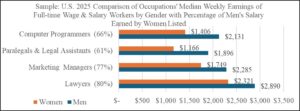
pay inequality

Addressing respect for women should be a no brainer, since women are approximately 50% of the global population. However, mainstream media allow talk show hosts, guests, and scriptwriters to use the B-word for women. If the importance of censorship is recognized to censor the N-word for people of African ancestry and censors the F-word for gay men, why are women’s psychological safety and psyche disregarded? 

Why do mainstream media, cable, or streaming/podcasts, tend to refer to women by their first name? Men are routinely referenced by their surname. Why are women’s titles rarely mentioned? While serving as Secretary of State, Kissinger was often called Dr. Kissinger in news coverage, especially when his official title was not mentioned. Secretary of State Rice was often referenced as Condoleezza rather than Dr. Rice in similar circumstances. 

Even when women ran for president of the United States, there was a distinction between how men were referenced than women. This may have been partially due to political strategists or political consultants, who tend to be men, wanting the women candidates to be perhaps more relatable and approachable. But think about it. When former Secretary of State Hillary Clinton and former Vice President Kamala Harris were running for president both in the primary and the general election, their campaign kept canvassing them as Hillary and Kamala. Former President Obama campaign did not promote him as Barack. Nor did President Trump campaign promote him as Donald. 

While some may say that Hillary Clinton’s campaign focused on her first name because there had been a President Bill Clinton, George W. Bush campaigned as Bush even though President George H. W. Bush had been in office less than ten years, previously. He did not run as ‘George W’. Research has shown this name bias undermines creditability and authority. Surnames are indicative of a position of power and respect, first names are not, unless the first name is preceded by a royal title, à la, Queen Elizabeth!  

Women’s History Month is a wonderful recognition of women’s achievement throughout history. Besides recognizing women for their contribution to society and culture, provide them respect and equitable pay. They earned it!

Defining the Role of Language, Culture, National Identity – by Deborah Ashton

Introduction

On December 21, 2025, The Harvard Crimson published an article reporting that the Harvard Salient’s board of directors suspended the conservative student magazine in October 2025 due to racist and anti-Semitic rhetoric. In addition, a Harvard Salient author claimed, “Germany belongs to the Germans, France to the French, Britain to the British, America to the Americans.” When confronted with evidence that this statement echoed Adolf Hitler’s 1939 speech, the author defended himself by citing ignorance. This incident showcases the use of patriotism as a veneer for alt-right nationalism, recalling Samuel Johnson’s 1775 assertion that “Patriotism is the last refuge of a scoundrel.” While this does not necessarily label the young writer as a scoundrel, the situation raises important questions about who defines national identity and underscores the need to differentiate nationalism from far-right or white nationalist movements.

Continue reading Defining the Role of Language, Culture, National Identity – by Deborah Ashton

Political Violence & Inclusion – by Deborah Ashton

Throughout history, political discourse in the United States has oscillated between civility and conflict. There were notable times when individuals from opposing perspectives engaged in constructive debate, exemplified by the 1965 exchange between author James Baldwin and conservative commentator William F. Buckley Jr., as well as the bipartisan relationships of leaders such as Ronald Reagan and Tip O’Neill during the 1980s. Yet, it is important to recognize that political violence is deeply rooted in the nation’s origins. The American Revolution itself was marked by actions that, had they failed, would have been deemed treasonous. As we complain about masks being worn to hide the perpetrator’s identity, colonists dressed up as Native Americans when they engaged in the Boston Tea Party. Hiding one’s identity is not new.

Continue reading Political Violence & Inclusion – by Deborah Ashton

The Difference Between Good and Nice – by Deborah Ashton

It is important to know the difference between being good and being nice. Good people are not always nice. And nice people are not always good. Being nice is easy and being good is fierce hard work. 

The question is, do you choose to be a good person or a nice person?  Pope Francis, who we lost on Easter Monday chose to be a good person he understood that which is preached in 1 John 3:18, good deeds make a difference, in the vernacular talk is cheap. We are what we do, and good people do good deeds.

Continue reading The Difference Between Good and Nice – by Deborah Ashton

Inclusion and DEI Trends 2025 – by Dr. Deborah Ashton

1,2,3 Analysis

1) 1 or 2 issues that are personally most vital to me in 2025.

I am personally invested in combatting the attack on DEI that is targeting policies and practices in academia and in the workplace—corporate America and government and the deliberate misrepresentation that DEI and meritocracy are dichotomous. When ENRON failed, the right was not blamed for the good old boy, tap on the shoulder, it’s not what you know but who you know selection process. But DEI is blame for a door that fell off a plane and the collapse of the Francis Scott Key Bridge.

My second issue is the voices on the far right and the far left drowning out the voices of the centrist and moderate on both the left and the right. Both the extremists talk at each other, not with each other. The far right refers to anything left of center as Marxist; and the far left refers to anything right of center as fascist.

Continue reading Inclusion and DEI Trends 2025 – by Dr. Deborah Ashton

Reflection on Women Groundbreakers Storytelling: Serving Diverse Communities – by Dr. Deborah Ashton

On March 7, 2024, women groundbreakers, who work locally and globally to serve diverse communities in their respective fields gathered in Chattanooga, Tennessee to share their stories with Deborah Levine, CEO of the American Diversity Report. The women groundbreakers were: 

  • LuLu Copeland – Director: Economic & Workforce Development Administration /Chattanooga State Community College, Exec. Director at TN-China Network, 
  • Dr. Gail Dawson – Associate Prof. of Management and Director of Diversity & Inclusion at the Rollins College of Business /U. of TN/ Chattanooga,
  • Vanessa Jackson – Program Specialist with the City of Chattanooga’s Office of Multicultural Affairs and one of Chattanooga’s first Neighborhood Relations Specialists,
  • Teletha McJunkin – For the past 8 years, she has led and coordinated international, multicultural, multi-lingual teams developing strategies in the areas of human and environmental rights.

Continue reading Reflection on Women Groundbreakers Storytelling: Serving Diverse Communities – by Dr. Deborah Ashton

DEI, Religion, and Hate Crimes – by Deborah Ashton, Ph.D.

Introduction

Deborah Levine requested that I join her group on Black and Jewish Dialogue in 2021. Given today’s atmosphere, dialogue is crucial. Levine is the editor-in-chief of the American Diversity Report (ADR). She is a Holocaust documentarian (Courter, 2023; Levine, Untold Stories of a World War II Liberator, 2023), whom I am sure when she launched ADR never anticipated that diversity and DEI would be equated with anti-Semitism. Yet the cry has been aimed at academia and business (Cohen, 2023; Notheis, 2024) I am baffled by the cry to silence and dismantle DEI. 

Through my DEI journey and practice since 1991 in corporate America, DEI has been inclusive and provides respect and dignity to all across religion, race, ethnicity, national origin, sexual orientation, gender, physical and mental ability, and other demographics. I will provide some examples later in the article.

Continue reading DEI, Religion, and Hate Crimes – by Deborah Ashton, Ph.D.

Two Iconic Women Who Inspire Me – by Dr. Deborah Ashton

As a Black woman, whose family moved up from the Chicago slums to ‘the projects’, I was navigating the intersectionality of race, gender, and poverty in the USA. A historical iconic woman that inspired me would be Harriet Tubman, born a slave. I admire her because not only did she believe in human dignity and rights, but she also acted on her beliefs and principles. 

Harriet Tubman understood that she and the others who were enslaved were human beings and not chattel. I had the honor to visit the Harriet Tubman House in Auburn, NY. Her modest home gives witness to her tremendous courage. She had seizures and narcolepsy, i.e., traumatic brain injury, from being hit in the head when an overseer threw a heavy metal weight at a slave.  Harriet Tubman could be recognized during Women’s History Month, Disability Pride and Heritage Month and Black History Month. 

Continue reading Two Iconic Women Who Inspire Me – by Dr. Deborah Ashton

EHLI: Inclusive or Elitism – by Dr. Deborah Ashton

 Stanford University’s Elimination of Harmful Language Initiative (EHLI)

Stanford University in December of 2022 issued the Elimination of Harmful Language Initiative (EHLI) to eliminate potentially harmful terms used in the United States within the technology community. Most of the recommendations are trying to avoid trivializing people’s experiences and avoid devaluing others. Other recommendations, from this reader’s experience, are a stretch and assume that we are not able to distinguish the context in which a word or phrase is used. 

The EHLI is a courageous and noble endeavor. I would also argue it is US-centric, Anglophilia, and elitist! And may or may not be transferrable to the larger society.

The following is a sampling of the terms/phrases in the EHLI’s thirteen pages of terms and my reaction to them. 

Continue reading EHLI: Inclusive or Elitism – by Dr. Deborah Ashton

DEI in the Boardroom – by Dr. Deborah Ashton

Equity Impacts Corporate Decisions

Why have diversity, equity, and inclusion (DEI) expertise in the Boardroom? Look at the controversy swirling around the Georgia’s voting law–the backlash, the boycott, and the backlash to the boycott. Georgia’s most vulnerable citizens lose from both the law and the boycott. I contend that if there had been DEI experts on the boards of the major corporations that traditionally lobbied in Georgia, this may have been averted. Corporations could have predicted how the passage and signing of the bill into law may have impacted their brand. While the bill was being crafted social justice concerns could have been addressed, along with concerns regarding voting integrity. When you are driving you slow down before you come to the hairpin curve rather than trying to correct for it afterward. I have always contended that we should resolve a problem before it begins.

Continue reading DEI in the Boardroom – by Dr. Deborah Ashton