
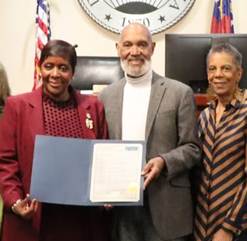
Like millions, I was riveted to the breaking news about the passing of Civil Rights advocate Jesse Jackson and at 5:30 pm, during a commercial, I called Bill Willis to follow up on a conversation we’d had two days before.
“Will I see you at this evening’s Board of Commissioners meeting (Douglas County, Georgia) during which I will accept their African American History Month proclamation? It starts at six and will be preceded by an art exhibition on the third floor.” I thanked him for the heads up and promised to get there as soon as I could.
Well as it typically is it is for Bill Willis, not only was he there with one of paintings, but the impeccably dressed Willis was there to accept the Commissioners proclamation.
Continue reading Introducing Professor Bill (“Paul Revere”) Willis – by Terry Howard




 Far from being abstract research on the dynamics of resilience, Deborah Levine has provided us with a life story, and highly relevant biography, an ethnography if you will, of the struggle for resilience lived out, day by day. It is filled with the challenges to resilience from health, work, environments, and relationships. Today we speak of the cost of intersectionality on oneself. The term is extremely relevant here, as Deborah herself is bundled into her white female identity, her Jewish ethnicity, the cultural marks of her places of upbringing, her immigrant status, her health vulnerability, and her religious belongings. Each of these shows up repeatedly both as a liability and an asset in her resilience narrative.