
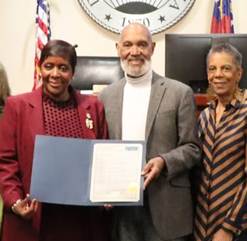
In February 1926, Carter G. Woodson initiated the celebration of Black History Week to honor the achievements and contributions of Black Americans, which had largely been overlooked in mainstream history. Woodson specifically chose February to coincide with the birthdays of Abraham Lincoln and Frederick Douglass, which fall on February 12th and 14th, respectively. Fifty years later, in 1976, the observance was officially expanded to cover the entire month of February. Subsequently, in 1986, Congress passed Public Law 99-244, formally designating February as National Black History Month.
I have always specialized in hostile or militant audiences but from time to time even I have to step back and pause for a second.Current events are always “fair game” in my workshops; it is what makes my sessions current, electric and never boring.Recent moments of truth in my sessions lead me to pen and update the original article I wrote many years ago.The rash of horrible racial injustices (some say pattern) of Ahmaud Arbery to Breonna Taylor to George Floyd to Amy Cooper to Jacob Blake had erupted into a national conversation about racial injustice, white privilege, inequity, diversity, inclusion, and more.
Comments like – “I don’t care about BLM – Black Lives Matter, I am trying to run a business” or “White Lives Matter” or worse “White Lives Matter More (WLMM)” when people mention “Black Lives Matter” have led many to the politicization and polarization of these horrible atrocities and these acts continue a horrible pattern of racial injustice.You have to go back to “Rodney King had it coming!” and “Trayvon Martin, who cares.”Today, you must be a “liberal” or a “conservative” – ouch!
In case you missed it, after a strong backlash from scores of others, including military brass and descendants of the Tuskegee Airmen, the United States Air Force quickly reversed its recent move to remove videos featuring the Airmen out of its training programs.
Okay, with that breaking news, I’m not gonna gloat – well, maybe I will. Just a little bit. I say that because here I am less than 24 hours after I received a message from “Lew,” a lifelong friend. But given that “Lew” is a 5th degree black belt in karate, I was relieved that his expletive-filled email to me wasn’t about anything I’d done or written. No, like scores of others I’d heard from once the news broke, his justifiable anger was ignited by a cockamamie decision to phase out the teaching of the contributions of the Tuskegee Airmen from the U. S. Air Force training curriculum.
“Keepin’ It Real: Essays on Race
in Contemporary America”
James Baldwin, the famous 20th century American intellectual, once observed:
“History is the present. We carry our history with us.
To think otherwise is criminal.”
This is an important point to ponder during the annual Black History Month observance during February in the United States. Baldwin was an iconic and outspoken figure of his time who was internationally recognized as a leading voice of the African American experience.
Thus, as Baldwin reminds us posthumously, we should not only focus on trailblazers of centuries past, but also consider more recent history when assessing the state of racial progress.
Patrick Donaldson is a church Elder, husband and father. He has worked in the financial services industry for over 20 years, focusing on retirement benefits and financial literacy. In addition to his Bachelor of Science degree, he has a Masters of Human Resources, holds a Tennessee insurance license and is a FINRA Securities Registered Representative with Primerica Financial Services. He has volunteered his expertise to the Chattanooga community with hands-on education workshops at numerous local churches and recreation centers, as well as actively working with the Citizen Safety Coalition.

Kimberly Rollins is the wife of Pastor Donald Rollins Sr. of Chattanooga’s Born Again Christian Church. She worked for 23 years for the City of Chattanooga, acquiring the leadership skills that she taught co-workers and the women of her church. Then 7 years ago, she expanded her calling to help others by working in finance, helping as many people possible to accomplish their goals and dreams with the knowledge that she’s acquired over the years.
. What Financial Concepts do you teach?
2. What is your passion & motivations?
3. What do you do for fun?
We don’t always have the time we think we have (I have a personal story) 2 Get your affairs together while you have time
Name 3 issues that the audience should continue to discuss. 1. Transparency about where they are emotionally, spiritually, and financially. 2. What small consistent changes are they willing to make to be better? 3. Take the time and care to prepare for the inevitable.
My three granddaughters are, respectively, age 12, 5 and 3. They are also Black and beautiful. I start with that as a link that to what I’m about to write about; something personal, very personal.
You see, I’m ticked off to report that we have still another addition to the umpteenth volume of our “You can’t make this stuff up folks” collection, our chronicles of the asinine. Our latest entry comes from Caldwell, New Jersey courtesy of some “racially nearsighted” dude by the name of Gordon Lawshe.
In 1926, Dr. Carter Godwin Woodson, an African-American historian, writer, and educator, created Negro History Week to honor the contributions of people of African descent in the U.S. He founded the Association for the Study of Negro (now African-American) Life and History in 1915 and the Journal of Negro History in 1916. Born in 1875 to former enslaved people in New Canton, Virginia, the Harvard-educated Woodson chose February for Negro History Week because the birthdays of abolitionist Frederick Douglass and President Abraham Lincoln fall then. He wrote, “What we need is not a history of selected races or nations, but the history of the world void of national bias, race, hate, and religious prejudice.” Dr. Woodson contributed to our understanding that a better knowledge of history is critical for people in the African diaspora to achieve greater pride, self-determination and collective progress.Negro History Week itself changed. About fifty years later, near the close of the Black Power period (early 1970s), the celebration was renamed Black History Week and later expanded to Black History Month in 1976.
Honoring Black History Month often comes with events that tell African American history through arts and culture, which resonate across cultural boundaries. For example: the National Center for Civil and Human Rights will display jazz music that “inspires movements, evokes revolution, and lightens troubled spirits.”
Corporate celebrations may elevate Black artists, creators, entrepreneurs through storytelling, content and products. But as memorable as these celebrations are, they may be considered once-a-year, check-the-box events.
African American History (AAH) Celebrations for decades have been designated to the month of February, mostly. I remember when invited the very few African American Educators’ staff members and our high school’s English Department Chairperson this was two years after I was hired in the state of Connecticut and after my college graduation.
We staff members were well aware that no knowledge or acknowledgement of African American History lessons were being incorporated or extra-curriculum programs into our school’s educational classroom goals and activities.
Hey readers, with African American history top of mind, does the name “Barbara Johns” ring a familiar bell with you? If not don’t feel bad, you’re not alone. You see, when African American history comes up there are two realities; first, it gets compressed into February (or recently Juneteenth) and, second, it typically cites the well-deserved names as its founder Carter G. Woodson, Dr. Charles Drew, Rosa Parks, George Washington Carver, W. E. B. DuBois Dr. King and others. So, I figured that perhaps the Barbara Johns’ story of profound unprecedented courage, the focus of this narrative, may pique your interest.
But first for context, consider the following imaginary scenario.