Category Archives: Advisors

Advisory Council

Diversity and Speech Part 34: Revisiting Privilege – by Carlos E. Cortés

Diversity language seems to wander through a series of predictable phases.  First, someone comes up with a new term like micro-aggressions, or retrofits an old dictionary word like violence.  A few terms catch on and become diversity specialist standard fare, then enter public lingo, sometimes celebrated, sometimes mocked.  Finally, after the heat dies down and new verbal fads replace them, those formerly-hot terms settle in for the long (or short) haul, during which people tend to mouth them in a relatively mindless, sometimes authoritarian fashion.  

Unfortunately, such has been the trajectory of the term privilege.  Beginning with its entrance into diversity world in the 1980’s, privilege has passed through several stages, ultimately becoming corrupted into little more than a simplistic, polarizing accusation.  This is a real loss, because as formulated by Peggy McIntosh, privilege provides a valuable lens for examining the world around us.  It does so by calling upon people to recognize and reflect on the unearned advantages that have been handed to them.    

Continue reading Diversity and Speech Part 34: Revisiting Privilege – by Carlos E. Cortés
Bridging the Choice Chasm – by Dr. Shalini Nag and Surya Guduru

A path to a sustainable future

As we get look ahead to 2023, sustainability takes center stage, yet again. Can we really achieve a sustainable future? Today, we posit that we can, if we are able to apply the equity and inclusion lens to the problem and bridge the Choice Chasm – the seemingly unbridgeable gap between the haves and the have-nots, between developed and developing nations, between incumbent practices and emerging norms.

Aftershocks from the Covid19 pandemic exacerbated by Russia’s invasion of Ukraine, combined with climate chaos made 2022 a chronicle of global challenges. These include the intermittent resurgence of Covid variants, the mental health epidemic, continued supply chain disruptions, internal displacement in Ukraine, worsening food crisis in the world’s most vulnerable regions, and a global energy crisis. By October 2022, weather disasters alone cost nearly 20,000 lives and 30 billion dollars, refocusing governments and organizations alike on sustainability. 

Continue reading Bridging the Choice Chasm – by Dr. Shalini Nag and Surya Guduru

Embracing Diversity, Equity and Inclusion – Dr. Nagwan Zahary

A Business Perspective

Promoting diversity, equity, and inclusion (DE&I) becomes a business necessity rather than a choice. Organizations – including businesses, non-profit organizations, colleges and universities  have to reconsider that U.S. is projected to become a majority-minority nation for the first time in 2043 and by 2060, 57 percent of the U.S. population will consist of racially ethnic minorities.1 This change towards a more diverse population will have substantial impact on the workforce and how organizations rethink its processes to manage opportunities and challenges related to DE&I. 

In fact, there is no shortage of suggestions to create inclusive environments. However, it is crucial to think about the role and positioning of DE&I within an organization’s structure. The question here is whether organizations consider DE&I a HR policy, a management-led initiative, an objective, a trend—or a mixture of all four? Some organizations still struggle to properly define DE&I, which impact the development of appropriate DE&I initiatives to empower and engage underrepresented groups. Making progress on that front requires a deep understanding of the concerns, experiences, and perspectives of people with different ethnicities, nationalities, educational backgrounds, sexual orientation, religion, and gender.

Continue reading Embracing Diversity, Equity and Inclusion – Dr. Nagwan Zahary

Technology Trends and Diversity – by Sridhar Rangaswamy

Technology is a dynamic and an ever-changing arena. There are always changes taking place in the field of technology due to new inventions and discoveries and to keep up with the expanding demands of the consumers.

In the earlier days we just had the landlines.  The first cellular was discovered in April, 1973 by Martin Cooper, a Motorola Engineer, while walking and thinking about contacting someone on the streets of New York.

Continue reading Technology Trends and Diversity – by Sridhar Rangaswamy

EHLI: Inclusive or Elitism – by Dr. Deborah Ashton

 Stanford University’s Elimination of Harmful Language Initiative (EHLI)

Stanford University in December of 2022 issued the Elimination of Harmful Language Initiative (EHLI) to eliminate potentially harmful terms used in the United States within the technology community. Most of the recommendations are trying to avoid trivializing people’s experiences and avoid devaluing others. Other recommendations, from this reader’s experience, are a stretch and assume that we are not able to distinguish the context in which a word or phrase is used. 

The EHLI is a courageous and noble endeavor. I would also argue it is US-centric, Anglophilia, and elitist! And may or may not be transferrable to the larger society.

The following is a sampling of the terms/phrases in the EHLI’s thirteen pages of terms and my reaction to them. 

Continue reading EHLI: Inclusive or Elitism – by Dr. Deborah Ashton

Threats to Affirmative Action and DEIA – by Marc Brenman

There is much confusion today between affirmative action, which is under threat by lawsuits in the U.S. Supreme Court, and Diversity, Equity Inclusion and Accessibility (DEIA), which is under no such threat, as long as practitioners stay away from race-based quotas and preferences. How can we educate the field about this?

The Supreme Court cases involve allegations by some Asian-American groups that their applicants should be admitted to prestigious colleges like Harvard at a higher rate because other applicants like African-Americans are given a preference. One should bear in mind that Asian-American students are already enrolled in such colleges at a rate far exceeding their presence in the American population, so these cases are not about proportional representation, or a “student body that looks like America.” In some cases, such as the University of California at Berkeley, the undergraduate enrollment is about 48% Asian-American. So these cases involve an extreme form of a desire for merit-based judgments by gate holders.

Continue reading Threats to Affirmative Action and DEIA – by Marc Brenman

Hey Nancy, got a sec? – by Terry Howard

Here’s my question to the men who are about to read this piece: 

Based on what you know for sure, or have been fed by the media about her, if you were to find yourself seated next to Nancy Pelosi on a five-hour cross country plane ride and initiated the conversation, what would you talk about, avoid talking about and why?

So how about I give you, say, one minute to absorb and craft your answer to that question. Go ahead. No, wait, on second thought hold off on your answer until the end of this narrative.

Continue reading Hey Nancy, got a sec? – by Terry Howard

Hate enablers should not prevail – by Deborah Levine

Originally published in The Chattanooga Times Free Press

Have you heard that Kanye West might buy the self-styled free speech platform called Parler? Supposedly “conservative”, the app was used to organize and recruit for the Capitol siege. Parler continually enables hate with accounts that use swastikas as their profile pictures along with posts with Holocaust denial, antisemitism, and racism. Proud Boys, QAnon conspiracy theorists, anti-government extremists and white supremacists have all promoted their views on Parler.

Continue reading Hate enablers should not prevail – by Deborah Levine

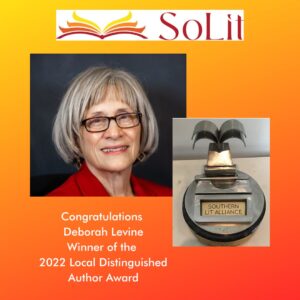
SoLit Award Acceptance Speech – by Deborah Levine

SoLitLocal Distinguished Author Award 2022

I’m deeply honored by this award from the prestigious SoLit Alliance. Literature is my passion and growing up in Bermuda’s 24 square miles, I explored the vast world through reading. You should have seen me with a pad of paper and a number 2 pencil while still in diapers. I published my first story at age 16 and wrote grants and newsletters for decades. But not until coming to Chattanooga did I blossom as a writer, and thought of myself as one.  

Continue reading SoLit Award Acceptance Speech – by Deborah Levine

Counteracting the “Heil Hitler” phenomenon – by Deborah Levine

 originally published in The Chattanooga Times Free Press

On the morning before the Jewish New Year, I walked into a neighborhood grocery store and was greeted by a customer with “Heil Hitler!” and a Nazi salute. My stunned silence prompted the man to shout “Heil Hitler” even louder.  He eagerly came closer to me, repeating the Sieg Heil salute, which was adopted in the 1930s to signal national obedience to Adolf Hitler. The crowd waiting in line for the cashier giggled. I gagged, and hoped it was all just a bad joke.

But it wasn’t. He turned to the crowd and explained why they should join him. “Hitler could rally the crowd, inspire everyone to join him. So follow me, Heil Hitler, then we’ll all say a prayer.” Hearing this linking of  Hitler to faith and prayer, the cashier turned green. I turned purple. 

Continue reading Counteracting the “Heil Hitler” phenomenon – by Deborah Levine