
My Holocaust research started with SW Germany, where my relatives were rounded up. My great-aunt, Hedwig Schwarz, was the only Jew to escape deportation in Horb/Rexingen. She was handicapped before the Holocaust, fell off the transport car, and was rescued by a nameless person who took her to Marienhopital in Stuttgart, where the nuns cared for her. My sister, daughter and I visited the hospital to thank the current generation of sisters for taking care of Hedwig. They told us that Hedwig was the only Jew in the hospital, though there were some Resistance members; and they treated her with silence, because they thought that was the best medicine. Can you imagine!
Here’s a poem I wrote about echoes in Horb and a photo of Hedwig in her hospital bed, surrounded by photos of all the others who were taken. The poem was first published in Prism: An Interdisciplinary Journal for Holocaust Educators, and in Packing Light: New and Selected Poems, Black Widow Press. 2009.
Mezuzah
In Memory, Hedwig Schwarz
In the doorpost of her house, a hollow
where the mezuzah used to hang.
I press my hand against the indentation,
my way of speaking to the past.
Touch the hollow where the mezuzah
used to hang. In Horb, Nazis renamed her street
Hitlerstrasse. My way of speaking to the past
is to listen, press the old men for answers.
1941, Jews were packed into Hitlerstrasse.
Now it’s a winding picture postcard road,
Jew-free, pleasant as it seemed
before Nazis pressed my family into Judenhausen.
I press my hand against the indentation.
Over Horb, a hundred doorposts echo, hollow.
Continue reading For International Holocaust Remembrance Day – by Marilyn Kallet
 Loss, trauma, memory, and the impenetrable ties of family are the elements that weave together Sharon Hart-Green’s panoramic debut novel Come Back for Me (New Jewish Press). Set in the aftermath of World War II, it is a gripping story about the redemptive power of love and self-understanding.
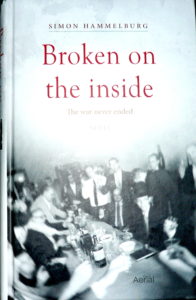 Broken on the inside – The War Never Ended by Dutch author and journalist Simon Hammelburg is based on 1200 interviews with Holocaust survivors and their children. The book reads like a novel but is based on facts, some of which have never been revealed before, disclosing insights of the psychological aftermath of survivors as well as the post-war generations and the traumas that are passed on for over six generations.
 It took me decades to write my historical memoir,