In 2021, the Associated Press Sports Editors (APSE) received an overall grade of a C on their racial and gender report card, an upgrade from the D-minus they received on the same report card just a few years prior. The curious thing about their C grade, however, is that they received a fairly strong B-plus in the race category, also an improvement on their race grades from years past. If the APSE is making such strides in their racial diversity by hiring a much more racially diverse group of employees, how is their grade still below average?
While television has included characters with disabilities, they haven’t steered away from showing them in a stereotypical light. Popular shows medical dramas like Grey’s Anatomy and Chicago Med aren’t excluded in this. In fact, after watching both of these shows, I believe they were two of the most stereotypical displays of people with disabilities. What makes these displays even worse is they are about the same across television, creating a constant image of a person with a disability needing help or playing a victimized character for the viewers. This constant image can lead to a downward spiral of how a person views someone with a disability, leading to bullying and mental health issues for the victim—in some cases even suicide. While research is limited, adults with disabilities are roughly three times more likely to commit suicide.
Clothing is a major way people express themselves, making it important that clothing brands make clothing that is welcoming for everyone. Brands such as Brandy Melville offer only one size clothing, but the clothing is only for some. Their sizes say they are for everyone, but realistically they fit an extra-small to a medium. One-size clothing is not a true statement because everyone has a different body type, meaning a one-size shirt will not fit everyone the same. Brandy Melville markets towards short and small people. The shirts and shorts are extremely short, small, and cropped making it impossible for curvy or tall people to fit into. However, they sell sweatshirts that are one size but are labeled as “oversized”. This is highly offensive to people because their oversized fit is just a normal fit. What kind of message is Brandy Melville trying to portray? That the “normal” size of women should be an extra small to a medium? These are questions that need to be answered and not suppressed just because “smaller” people like their clothing.
Gender diversity in advertising has become a prevalent issue in today’s fight for gender equality. For many years women have been fighting within the marketing and advertising industry for equal representation in commercials and even landing jobs working behind the scenes. A lot of progress has been made with integrating more representation of women into advertising, however there is still more work to be done. There are, on average, twice as many men shown in an advertisement than women and men have about three times the amount of speaking time than women. While women are underrepresented within the advertising world, they are also stereotypically sexualized for the work that they are chosen for. It’s no secret that sex appeal is one of the largest selling aspects in today’s marketing world, and while this is also true for men, it is more predominant among women displayed in advertisements.
My professor clicks the next slide of his presentation, a Secret Deodorant commercial from 2013. My classmates and I sit in silence as the YouTube player begin, and a woman’s fast, quivering voice booms from the speakers.
Stress sweat. It’s different from ordinary sweat – it smells worse and it can happen anytime to anyone. Like when I fell asleep at movie night with all my coworkers and totally dream snorted myself awake. I actually popped my head back so fast I’m pretty sure I have whiplash.
The LGBTQ+ community continues to be facing diversity, as a new law was passed recently in Tennessee that restricts adult cabaret performances in public or in the presence of children, and bans them from occurring within 1000 feet of schools, public parks, or places of worship.” This law strictly prohibits people in this community from expressing themselves in a country that is supposed to be known for their freedom. My uncle is a member of the LGBTQ+ community and has done drag before. He was simply devastated by the news, as many others in this community were and he even called my Father and angrily ranted to him how awful this new law is.
When I first met my partner, I could not grasp their pronouns for the life of me. In all honesty, I had never made acquaintances with a non-binary person until I met Koy in college. On the way to visit them, I would repeat “they, them, they, them, they, them” out loud behind the steering wheel. Of course, Koy and their friends would politely correct me each time I slipped up. Hey, we all have to learn at some point. Because the fact of the matter is: not everyone is comfortable with the gender that was assigned to them at birth. With the rapid discourse on gender expression changing every day, it’s imperative that we learn. I learned, and so can you.
Okay readers, ready yourselves for another entry into the You Can’t Make This Stuff Up – Chronicles of the Asinine. Have an extra strength Excedrin or shot of Bourbon within reach. You may need it.
You see, before the ink was dry on recent news about the Silicon Valley Bank collapse, nitpickers from the peanut gallery began pointing blame to the latest boogey man…. “Woke.”“Woke” flooded the news recently, drowning out coverage of NCAAP basketball tourneys, Ukraine and pending indictments.
At the end of the corporate Pride rainbow lies a darker story to be told
Since 1999 when President Bill Clinton designated June as Pride month in the United States, the surface level social climate has grown to be more widely accepting of the LGBTQIA+ community. Corporations have been quick to pick up on this, adjusting their marketing angle during June to reflect consumers ideals. Similar to the social climate though, this effort appears to be performative when viewed through a narrower lens. At the end of the corporate rainbow is a money trail of donations to politicians who support anti-LGBTQIA+ legislation. Continue reading The Corporate Rainbow – by Jules Jackson, McKenzie Malone, Anna Truss→
This story was originally published in the Forward. Click here to get the Forward’s free email newsletters delivered to your inbox.
I stood in front of the Holocaust education elective class handing out index cards and speaking loudly over the chatting high school students, asking them to write down why they’d chosen this elective.
I called on one particularly talkative student to share her answer: “I wanted to hear both sides of the story,” My eyes widened. She added that she’d read online that the Holocaust is just propaganda and didn’t really happen.
I looked down at the letters in my hand from my father, who had written them during his World War II service, when he’d been a spy and interrogated Nazi prisoners of war. My rabbi had asked me to speak about the letters to her son’s class in Chattanooga, Tennessee.
My father had witnessed the liberation of a concentration camp and the dissolution of the Nazi regime, but for 50 years, he told no one, not wanting his family exposed to the horrors that he’d seen in Germany, France and Belgium. Now, I was sharing his letters with the next generation of high school students, in a time where nearly two-thirds of their age group does not know 6 million Jews died in the Holocaust. I hoped to address this profound lack of awareness and prevent the perpetuation of antisemitism through a direct engagement with history.
I didn’t learn that my father had interrogated Nazis until I began interviewing Holocaust survivors for a documentary, Classroom Holocaust Stories. I decided to make the film after the Oklahoma City bombing in 1995. I needed to understand the appeal of American neo-Naziism, and learn how to re-educate its followers away from hate.
Dad grew increasingly nervous about my documentary subject matter, but the last straw was in 1997, when I went undercover to a meeting of several dozen neo-Nazis organized by international Holocaust denier David Irving as part of my documentary research. I’d moved to Tulsa to make the film, and Dad took the next plane there to check on me. That’s when he revealed for the first time his wartime activities, bringing over 100 letters he had written.
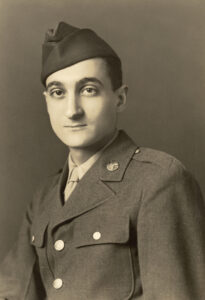
Dad was a “Ritchie Boy,” a famous group of predominantly Jewish soldiers trained at a secret U.S. military intelligence camp, Fort Ritchie, in Maryland, in frontlines interrogation, counter-intelligence and battlefield intelligence. Most Ritchie boys were spies before becoming interrogators closer to the end of the war, and many of them were German-born Jews, selected for their fluency in multiple languages.
My dad had hidden the hundreds of letters he’d written to my mother in his closet. When we began reading them together, I better understood his fear and his previous silence. Who would want to discuss liberating the Nordhausen extermination camp in central Germany with their kids? In one later from 1945, he wrote: “Nordhausen was a wreck and also the scene of concentration camp leftovers — we saw 2,000 bodies in one place — the sight and smell are still with me.” Dad needed me, and the high school students in front of me, to understand that we were now seeing echoes of a time when Germany, once known as a cultural and scientific hub, fell “prey to the evil of Naziism.”
The class became still as I projected on the classroom wall a photo of my father proudly wearing his military uniform, just four or five years older than the students themselves. Phones dropped into pockets for good when I projected a photo of one of his handwritten letters and read his description of required classes for Ritchie Boys: “Order of Battle, interrogation, and interpretation techniques, photo interpretations and plenty of field work: pigeons, radio and telegraph. There were lectures on military information and a tough two-day field exercise problem which I managed to survive.”
I recruited a student to read aloud one of Dad’s letters that I’d wrapped in protective plastic. In May 1945, he wrote: “A large part of the population never belonged to the Nazi Party, but 99.9% blame Hitler only for losing the war and seem to suffer no pangs of conscience over the origins of the war or the ideology of the Party … They have no questions over the misery they brought to millions of French and English, Poles and Russians.” The student paused, clearing his throat. “The Germans didn’t consider them as humans.” He looked up at me questioningly.
“Yes, this is all true,’ I nodded. “And we need to hear this.” When I asked for another volunteer to read a letter, the students looked scared.
Finally, one student raised his hand tentatively and read the next letter. “The stories of German cruelty and oppression are not just stories — they are the real thing. And much of this was done by what we call ordinary people — not just the party members, but a vast number of common citizens who fell easy prey to the baloney of national socialism. People who were jealous, griped, depraved, and plain scared.” He handed the letter back to me, his hands shaking.
Seeing a classroom of anxious faces, I read aloud from one of the index cards I’d asked them to fill out at the beginning of the class — the one that said: “I chose to take this class because of all the conflicting information I’ve gotten about the Holocaust. I just want to know what really happened. Besides, the Holocaust isn’t talked about much in any of the history classes I’ve taken so far.”
The student whose card I’d read smiled, and volunteered to read another letter. “I have talked to enough Germans to fill a good-sized section of Milwaukee — and all types — army generals and storm troopers, miners and artists, professors, businessmen and farmers. Confront them with the truth and they cannot believe it.” She paused, then whispered the rest: “We can remove the Nazis, but re-education is vital, and we had better be successful.”
I ended by asking the students to write down on fresh cards what had stuck most in their minds from the class. I read their responses when I got home and was deeply impressed by our session’s impact. One card said: “One of the things that had the largest impact on me was the amount of people that were murdered during the Holocaust, but also the many people who refused to do anything. There were homes right next to the camps and I know they could smell the burning flesh, but they went on with their lives like nothing was going on. Then, when it came to do something about it, they claimed ignorance of what was going on.”
Speaking to these high school students underscored for me how dire the state of Holocaust awareness is among young Americans. We need a broader, more effective reach for Holocaust education given the U.S. Millennial Holocaust Knowledge & Awareness Survey, conducted for the Claims Conference in 2020. The study polled 11,000 millennials and Gen-Z Americans (ages 18-39). Tennessee ranked 32nd in states with Holocaust education but was not alone in the lack of knowledge. About 63% of those polled didn’t know that 6 million Jews were killed, with 11% claiming that Jews had caused the Holocaust and 45% reporting that they had seen Holocaust denial or distortion online.
Thirty-one states have rejected requirements for Holocaust education in their curriculums. We need a federal mandate funding Holocaust education. If we don’t, the next generation will be shaped by online misinformation, fueling Holocaust denial and distortion. The wartime letters from my father were pivotal in shaping the understanding of one Tennessee classroom.
As my Ritchie Boy father said, “we had better succeed” at educating our youth about the horrors of the past. Otherwise, we will be doomed to repeat it.
Deborah Levine is an award-winning author, founder & editor of the American Diversity Report, and was named a Forbes Magazine Diversity & Inclusion Trailblazer. She is also a Holocaust educator, religious diversity speaker and creator of the documentary Untold: Stories of a World War II Liberator.
The views and opinions expressed in this article are the author’s own and do not necessarily reflect those of the Forward. Discover more perspective in Opinion.
This article was originally published on the Forward.

 My professor clicks the next slide of his presentation, a Secret Deodorant commercial from 2013. My classmates and I sit in silence as the YouTube player begin, and a woman’s fast, quivering voice booms from the speakers.