
 The Reverend Janet M. Cooper Nelson is Chaplain, Director of the Office of Chaplains and Religious Life, and faculty member at Brown University where she leads a multi-faith team of 4 Associate Chaplains and 40 Religious Life Affiliates, responsibilities she assumed in 1990 after appointments at Vassar, Mount Holyoke, and The Church of Christ at Dartmouth College.
She is ordained in United Church of Christ and holds degrees from Wellesley College, Tufts University, and Harvard Divinity School where she was awarded the Billings Prize for Preaching, the Rabbi Martin Katzenstein Distinguished Alumni award, and The Peter J. Gomes Memorial Award.
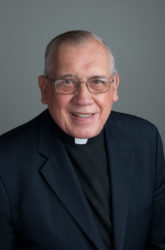 The Rev. Dr. John T. Pawlikowski was a Servite Friar priest, Professor Emeritus of Social Ethics, and Former Director of the Catholic-Jewish Studies Program, part of The Bernardin Center for Theology and Ministry, at Chicago’s Catholic Theological Union (CTU). Pawlikowski was appointed to the United States Holocaust Memorial Council by several presidents, chaired the council’s Subcommittee on Church Relations, served on its executive committee, the Committee on Conscience, and academic committee. He also served as president of the International Council of Christians and Jews (ICCJ) and its Abrahamic Forum and currently holds the title of Honorary Life President. Pawlikowski is a member 3 key committees of the Parliament of the World’s Religions (Global Ethic, Peace and Justice, and Climate Action Task Force). He authored/edited 15 books on Christian-Jewish Relations as well as on social issues such as economic justice, war and peace, and ecological sustainability. He was the former editor of New Theology Review and a member of the editorial board of the Journal for Ecumenical Studies.