This Teaching Guide accompanies the documentary: Untold, Stories of a Word War II Liberator. The Guide includes excerpts from the documentary’s letters as well as discussion questions for students and additional resources. It also includes section on the Nuremberg Trials and on newspaper journalists accounts of Holocaust death camps.
“Untold: Stories of a World War II Liberator proves that there are always new truths to learn and new heroes to celebrate when studying the horrors of the Holocaust. This work is arriving at a critical time; as the voices of survivors and liberators pass, those who teach history are confronted with increasingly loud cries of distortion and denial. A resource such as Untold allows students to both learn about and humanize the Holocaust.” ~ Dr. Rich Quinlan: Director, Holocaust and Genocide Education Center Chair, History Dept./Saint Elizabeth University
“Deborah Levine’s work continues to be of utmost importance for students of all ages. The specific story of ‘UNTOLD’ must be told today and forever, so that the words ‘Never Again’ never lose their meaning!” ~ Avi Hoffman: CEO, Yiddishkayt Initiative, Inc.
“Many liberators such as Levine’s father kept their experience largely secret So the publication is an important resource for Holocaust education and research…and a very readable introduction to the journey of the Jewish community over the past century” ~ The Rev. Dr. John T.Pawlikowski: Founding member of the US Holocaust Center, Prof of Social Ethics/Catholic Theological Union
Note: Also available are Deborah Levine’s memoirs:The Liberator’s Daughterand The Magic Marble Tree, upon which the documentary is based. They include the wartime letters with eye witness accounts.
The goal of this manual is to design new ways to discuss Israel, focusing on basic religious themes. The Middle East is often seen as a confusing array of political, economic, military strategy, and religion. Amidst this confusion, religious themes are an important element in shaping American attitudes toward Israel, and this volume helps prepare leadership to engage in an interreligious dialogue about Israel and the Middle East.
This manual attempts to move the process along with an “on-the-job-training“ approach to aid leadership in developing a personal approach to Israel dialogue that emphasizes religious themes.
This story was originally published in the Forward. Click here to get the Forward’s free email newsletters delivered to your inbox.
I stood in front of the Holocaust education elective class handing out index cards and speaking loudly over the chatting high school students, asking them to write down why they’d chosen this elective.
I called on one particularly talkative student to share her answer: “I wanted to hear both sides of the story,” My eyes widened. She added that she’d read online that the Holocaust is just propaganda and didn’t really happen.
I looked down at the letters in my hand from my father, who had written them during his World War II service, when he’d been a spy and interrogated Nazi prisoners of war. My rabbi had asked me to speak about the letters to her son’s class in Chattanooga, Tennessee.
My father had witnessed the liberation of a concentration camp and the dissolution of the Nazi regime, but for 50 years, he told no one, not wanting his family exposed to the horrors that he’d seen in Germany, France and Belgium. Now, I was sharing his letters with the next generation of high school students, in a time where nearly two-thirds of their age group does not know 6 million Jews died in the Holocaust. I hoped to address this profound lack of awareness and prevent the perpetuation of antisemitism through a direct engagement with history.
I didn’t learn that my father had interrogated Nazis until I began interviewing Holocaust survivors for a documentary, Classroom Holocaust Stories. I decided to make the film after the Oklahoma City bombing in 1995. I needed to understand the appeal of American neo-Naziism, and learn how to re-educate its followers away from hate.
Dad grew increasingly nervous about my documentary subject matter, but the last straw was in 1997, when I went undercover to a meeting of several dozen neo-Nazis organized by international Holocaust denier David Irving as part of my documentary research. I’d moved to Tulsa to make the film, and Dad took the next plane there to check on me. That’s when he revealed for the first time his wartime activities, bringing over 100 letters he had written.
Dad was a “Ritchie Boy,” a famous group of predominantly Jewish soldiers trained at a secret U.S. military intelligence camp, Fort Ritchie, in Maryland, in frontlines interrogation, counter-intelligence and battlefield intelligence. Most Ritchie boys were spies before becoming interrogators closer to the end of the war, and many of them were German-born Jews, selected for their fluency in multiple languages.
My dad had hidden the hundreds of letters he’d written to my mother in his closet. When we began reading them together, I better understood his fear and his previous silence. Who would want to discuss liberating the Nordhausen extermination camp in central Germany with their kids? In one later from 1945, he wrote: “Nordhausen was a wreck and also the scene of concentration camp leftovers — we saw 2,000 bodies in one place — the sight and smell are still with me.” Dad needed me, and the high school students in front of me, to understand that we were now seeing echoes of a time when Germany, once known as a cultural and scientific hub, fell “prey to the evil of Naziism.”
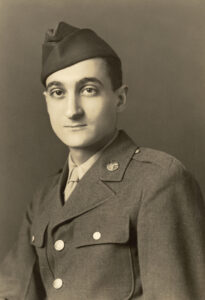
The class became still as I projected on the classroom wall a photo of my father proudly wearing his military uniform, just four or five years older than the students themselves. Phones dropped into pockets for good when I projected a photo of one of his handwritten letters and read his description of required classes for Ritchie Boys: “Order of Battle, interrogation, and interpretation techniques, photo interpretations and plenty of field work: pigeons, radio and telegraph. There were lectures on military information and a tough two-day field exercise problem which I managed to survive.”
I recruited a student to read aloud one of Dad’s letters that I’d wrapped in protective plastic. In May 1945, he wrote: “A large part of the population never belonged to the Nazi Party, but 99.9% blame Hitler only for losing the war and seem to suffer no pangs of conscience over the origins of the war or the ideology of the Party … They have no questions over the misery they brought to millions of French and English, Poles and Russians.” The student paused, clearing his throat. “The Germans didn’t consider them as humans.” He looked up at me questioningly.
“Yes, this is all true,’ I nodded. “And we need to hear this.” When I asked for another volunteer to read a letter, the students looked scared.
Finally, one student raised his hand tentatively and read the next letter. “The stories of German cruelty and oppression are not just stories — they are the real thing. And much of this was done by what we call ordinary people — not just the party members, but a vast number of common citizens who fell easy prey to the baloney of national socialism. People who were jealous, griped, depraved, and plain scared.” He handed the letter back to me, his hands shaking.
Seeing a classroom of anxious faces, I read aloud from one of the index cards I’d asked them to fill out at the beginning of the class — the one that said: “I chose to take this class because of all the conflicting information I’ve gotten about the Holocaust. I just want to know what really happened. Besides, the Holocaust isn’t talked about much in any of the history classes I’ve taken so far.”
The student whose card I’d read smiled, and volunteered to read another letter. “I have talked to enough Germans to fill a good-sized section of Milwaukee — and all types — army generals and storm troopers, miners and artists, professors, businessmen and farmers. Confront them with the truth and they cannot believe it.” She paused, then whispered the rest: “We can remove the Nazis, but re-education is vital, and we had better be successful.”
I ended by asking the students to write down on fresh cards what had stuck most in their minds from the class. I read their responses when I got home and was deeply impressed by our session’s impact. One card said: “One of the things that had the largest impact on me was the amount of people that were murdered during the Holocaust, but also the many people who refused to do anything. There were homes right next to the camps and I know they could smell the burning flesh, but they went on with their lives like nothing was going on. Then, when it came to do something about it, they claimed ignorance of what was going on.”
Speaking to these high school students underscored for me how dire the state of Holocaust awareness is among young Americans. We need a broader, more effective reach for Holocaust education given the U.S. Millennial Holocaust Knowledge & Awareness Survey, conducted for the Claims Conference in 2020. The study polled 11,000 millennials and Gen-Z Americans (ages 18-39). Tennessee ranked 32nd in states with Holocaust education but was not alone in the lack of knowledge. About 63% of those polled didn’t know that 6 million Jews were killed, with 11% claiming that Jews had caused the Holocaust and 45% reporting that they had seen Holocaust denial or distortion online.
Thirty-one states have rejected requirements for Holocaust education in their curriculums. We need a federal mandate funding Holocaust education. If we don’t, the next generation will be shaped by online misinformation, fueling Holocaust denial and distortion. The wartime letters from my father were pivotal in shaping the understanding of one Tennessee classroom.
As my Ritchie Boy father said, “we had better succeed” at educating our youth about the horrors of the past. Otherwise, we will be doomed to repeat it.
Deborah Levine is an award-winning author, founder & editor of the American Diversity Report, and was named a Forbes Magazine Diversity & Inclusion Trailblazer. She is also a Holocaust educator, religious diversity speaker and creator of the documentary Untold: Stories of a World War II Liberator.
The views and opinions expressed in this article are the author’s own and do not necessarily reflect those of the Forward. Discover more perspective in Opinion.
This article was originally published on the Forward.
How do they hate us? Let me count the ways. There’s Holocaust denial, Nazi memes, attacks by Supremacists, far-right conspiracies,and victimization appropriations. Ironically, Russia which was the source of a favorite Nazi propaganda, The Protocols of the Elders of Zion, recently joined that list. Russia’s Foreign Minister, furious with their isolation and Ukraine support, compared Western leaders to Hitler who “wanted a ‘final solution’ to the Jewish question.”
I have furnished Rabbis, educators, and Holocaust commissions and libraries with a life time of readings, sermons, essays and poems which hopefully will be used for generations to come.
As my radio theater play, UNTOLD: Stories of a World War II Liberator, is in preparation for broadcast, I am reminded of the 1st time that I agreed to serve on the local Holocaust Remembrance Day Committee was painful, even after almost seventy years since the end of World War II. I agreed to assist in promoting the event beyond our Jewish community and I agreed to participate in the reading of the names of the victims. And I resigned myself to being an usher at the event, not my favorite thing. What I didn’t bargain for was a seat on the stage when I offhandedly shared that I was helping in memory of my father who was a U. S. military intelligence officer during World War II. Aaron Levine was an army translator of German and French. And by the way, he was a liberator of a labor camp.
Antisemitism goes back long before the term wascoined by a German historian in 1781. Violent attacks and expulsions of Jewish communities span centuries. The Babylonians exiled Jews from Zion, the earliest use of the term, into Middle Eastern and Mediterranean regions. The Romans forced Jews into Europe. Blamed for causing the Black Plague, Jews were driven out of England, France, Germany, and Italy. They fled to Eastern Europe but experienced violent pogroms and isolation into The Pale. Throughout it all, the elements of antisemitism rarely changed.
For example, the Blood Libel dates as far back as the Temple in Jerusalem with claims that Jews sacrificed Greeks. It reappeared in the Middle Ages when an English cult announced that Passover Seder wine was actually Christian blood. Centuries later, a mob destroyed a synagogue in Damascus for this blood libel. As recently as 1928 in New York, Jews were accused of kidnapping and ritually killing a young girl.
Perhaps the past Century will not be known for the World Wars, for the atom bomb, for the rapid growth of scientific technology leading to IT, nor for even the Holocaust and a new awareness of crimes against humanity. In the long eye of history, perhaps the past Century will be known for fatherlessness. As such it will also be known for “Atyahiány”, Our Father’s absence, a most bitter and embittering fatherlessness: For Hitler was fatherless, Stalin was fatherless, Sceuicescu, the tyrant of Romania, was a bastard, Sadam Hussein of Iraq had no father, the ruler of Libya, Khadaffi was fatherless, Castro was a bastard.
When I was a sophomore in high school, my history teacher showed us a film during Hitler’s reign. The graphic film gave me nightmares for over a week. In great detail the atrocities of the Jewish people were in front of my eyes. Bodies of loved ones were dumped into a pile as the families were forced to watch in the cold, emaciated and near death themselves. The scene of women standing naked outside, holding their hands over their private areas was appalling. Not long ago I read that some women would cut their skin and use the blood to give them coloring. That was what Hitler had done. It didn’t matter that some were German, his own people, it mattered that they were Jewish. I can’t fathom a person having done such harm. In an article it said that he loathed the Jewish population because they took away jobs. We’ll never fully understand or know what was behind his madness.
In one of the most memorable forewarnings in social history, Dr. Martin Luther King, Jr. once said, “Injustice anywhere is a threat to justice everywhere!”
Hold that premonition in the front of your mind now and in the days, weeks and months ahead. If you remember nothing else about this narrative, I urge you to remember that line.
“Donna” is a writer. She’s also Jewish, does podcasts and publishes a newspaper column. She takes risks with the topics she takes on which has, on an occasion, drawn the ire of hate groups in the US and from abroad. Yet “Donna” just keeps on writing.

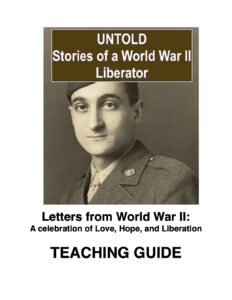 This Teaching Guide accompanies the documentary: Untold, Stories of a Word War II Liberator. The Guide includes excerpts from the documentary’s letters as well as discussion questions for students and additional resources. It also includes section on the Nuremberg Trials and on newspaper journalists accounts of Holocaust death camps.
 The goal of this manual is to design new ways to discuss Israel, focusing on basic religious themes. The Middle East is often seen as a confusing array of political, economic, military strategy, and religion. Amidst this confusion, religious themes are an important element in shaping American attitudes toward Israel, and this volume helps prepare leadership to engage in an interreligious dialogue about Israel and the Middle East.