Category Archives: Advisors

R-E-S-P-E-C-T Women’s History Month – by Deborah Ashton

Well, at least we as women have one of the longest commemorative months of the year. But equal pay and fair treatment would be preferable. That would be a measure of respect. 

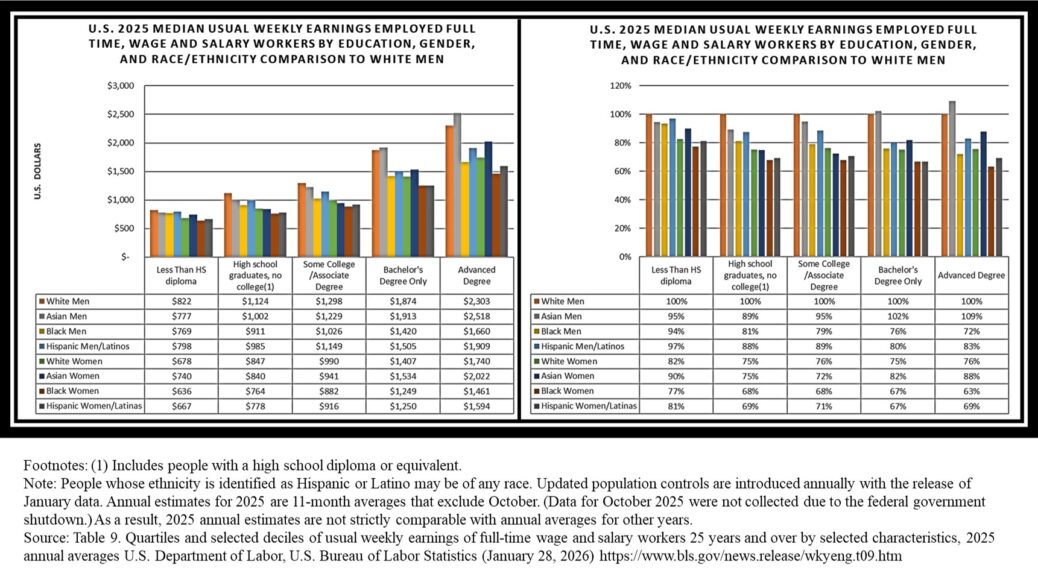
As of 2025, women earn less than men at all education levels, except that Asian women with a bachelor’s or advanced degree earn more than Black men with similar degrees. The gender pay gap is narrowest among individuals without a high school diploma. In essence, education only acts as an equalizer for those with the lowest level of schooling.

2025 Pay Inequality – See chart in headline

In 2003, serving on The Conference Board’s Tough Issues in Diversity panel, I showed that analyzing U.S. weekly median earnings requires considering gender, race or ethnicity, and education level. Over 20 years ago, gender had a greater effect on pay than race/ethnicity and that being a woman of color amplified the negative impact on pay. I found that higher education did not narrow the pay gap. Sadly, that remains true.

For woman of color the pay gap increases as they obtain higher levels of education. This remained true in 2014, when I analyzed the 2013 Bureau of Labor Statistics for the Harvard Business Review. Black women and Latinas vied for last place on the earning ladder for each level of education. By 2025, Black women were the biggest losers, earning less than any other group at each level of education, with the exception of Black women and Hispanic women/Latinas with bachelor’s degrees tying for last place in median weekly earnings.

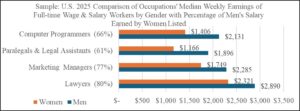
Yes, equitable pay would demonstrate that women’s work is respected as much as men’s. However, according to the U.S. Bureau of Labor Statistics, even when women are performing the same jobs, women are paid less than men. For example, female computer programmers earn 34% less than their male counterparts, while female marketing managers make 23% less than male marketing managers.
pay inequality

Addressing respect for women should be a no brainer, since women are approximately 50% of the global population. However, mainstream media allow talk show hosts, guests, and scriptwriters to use the B-word for women. If the importance of censorship is recognized to censor the N-word for people of African ancestry and censors the F-word for gay men, why are women’s psychological safety and psyche disregarded? 

Why do mainstream media, cable, or streaming/podcasts, tend to refer to women by their first name? Men are routinely referenced by their surname. Why are women’s titles rarely mentioned? While serving as Secretary of State, Kissinger was often called Dr. Kissinger in news coverage, especially when his official title was not mentioned. Secretary of State Rice was often referenced as Condoleezza rather than Dr. Rice in similar circumstances. 

Even when women ran for president of the United States, there was a distinction between how men were referenced than women. This may have been partially due to political strategists or political consultants, who tend to be men, wanting the women candidates to be perhaps more relatable and approachable. But think about it. When former Secretary of State Hillary Clinton and former Vice President Kamala Harris were running for president both in the primary and the general election, their campaign kept canvassing them as Hillary and Kamala. Former President Obama campaign did not promote him as Barack. Nor did President Trump campaign promote him as Donald. 

While some may say that Hillary Clinton’s campaign focused on her first name because there had been a President Bill Clinton, George W. Bush campaigned as Bush even though President George H. W. Bush had been in office less than ten years, previously. He did not run as ‘George W’. Research has shown this name bias undermines creditability and authority. Surnames are indicative of a position of power and respect, first names are not, unless the first name is preceded by a royal title, à la, Queen Elizabeth!  

Women’s History Month is a wonderful recognition of women’s achievement throughout history. Besides recognizing women for their contribution to society and culture, provide them respect and equitable pay. They earned it!

Renewing Diversity No. 14: Interrogating Gender Bias in Artificial Intelligence – by Carlos Cortés, Angela Antenore

In 1816, 19-year-old Mary Wollstonecraft Godwin captivated her close friends with a story about a monster.  Two years later, now married and  known as Mary Shelley, she stunned the reading world with her novel, Frankenstein, or, The Modern Prometheus (1818).  

Frankenstein’s monster was a man.  It remained so in most film renditions.  Notable exceptions were the 1935 “The Bride of Frankenstein,” who was actually created by Dr. Victor Frankenstein as a partner for his original male version, and the 2026 “The Bride”.

Frankenstein’s monster was not totally evil.  He was big, strong, and often unaware of his ability to create havoc because of his size and strength.  In some versions, such as Guillermo del Toro’s 2025 film, the monster’s human sensitivities figure prominently.  

Today we are dealing with a monstrous new creation, artificial intelligence (AI).  To the best of our knowledge, AI doesn’t have feelings.  However, we know something else.  AI is male tilted, and some of our fellow human beings are responsible.

Continue reading Renewing Diversity No. 14: Interrogating Gender Bias in Artificial Intelligence – by Carlos Cortés, Angela Antenore

An African American in Women’s History Month – by Terry Howard

To kick off March, Women’s History Month, I decided to write about Unita Blackwell and her place in both African American and women’s histories. Among so many great women of all backgrounds, among them Eleanor Roosevelt, Viola Liuzzo and Susan B. Anthony who advocated for civil and voting rights, I wish that Unita Blackwell was alive and with us today. More than ever, we need her out on the battlefield leading protests and knocking on doors extolling the urgency of exercising our right to vote. Lord knows we need her (and them).

Continue reading An African American in Women’s History Month – by Terry Howard

Introducing Professor Bill (“Paul Revere”) Willis – by Terry Howard

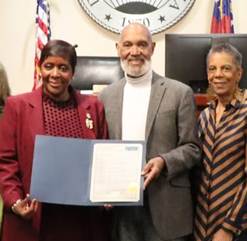
Like millions, I was riveted to the breaking news about the passing of Civil Rights advocate Jesse Jackson and at 5:30 pm, during a commercial, I called Bill Willis to follow up on a conversation we’d had two days before. 

“Will I see you at this evening’s Board of Commissioners meeting (Douglas County, Georgia)  during which I will accept their African American History Month proclamation?  It starts at six and will be preceded by an art exhibition on the third floor.” I thanked him for the heads up and promised to get there as soon as I could.

 Well as it typically is it is for Bill Willis, not only was he there with one of paintings, but the impeccably dressed Willis was there to accept the Commissioners proclamation.

Continue reading Introducing Professor Bill (“Paul Revere”) Willis – by Terry Howard

Renewing Diversity #13: Diversity History as a Foreign Country – by Carlos Cortés

In his mesmerizing novel, The Go-Between, L. P. Hartley wrote one of the finest opening lines of any novel I have ever read:  “The past is a foreign country; they do things differently there.”

That certainly holds true for the historical trajectory of diversity.  At age 91, I’ve lived through myriad changes in the American diversity landscape.  As we wrestle with ongoing, inevitable challenges faced by the diversity movement, it behooves us to thoughtfully consider our past trajectory.  Yet to actually learn from that trajectory, we need to recognize how our presentist lenses can distort the very past that we are trying to understand.

Continue reading Renewing Diversity #13: Diversity History as a Foreign Country – by Carlos Cortés

The legacy of Dr. Gladys West – by Terry Howard  

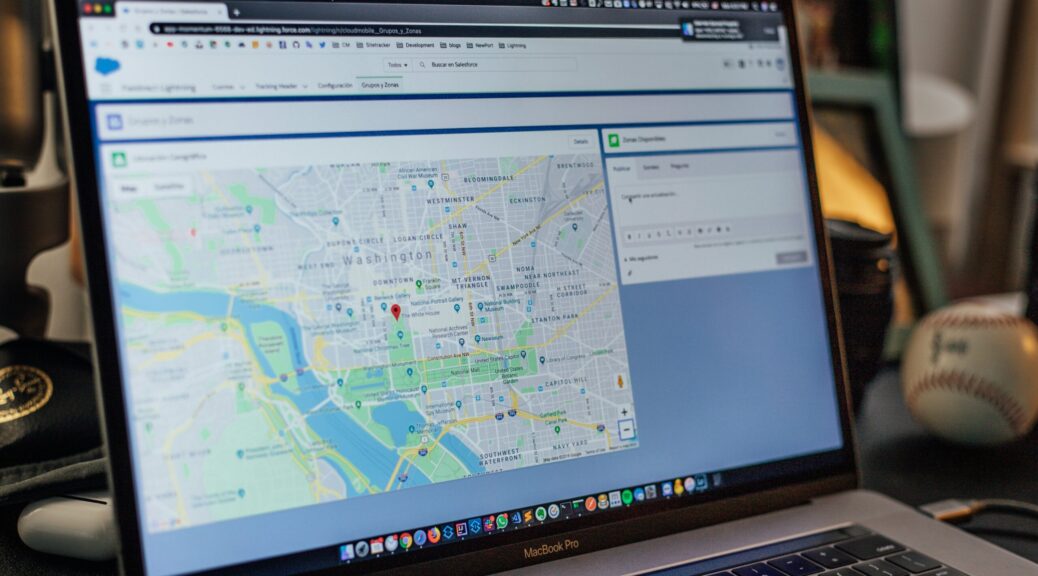
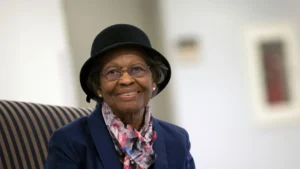
Gladys West “Thanks homegirl,” I said to myself as I left the car’s garage and punched my hotel’s address into my GPS. I thanked her again after the GPS she developed guided me through heavy California traffic and back roads and got me safely to my hotel. And thanks to your legacy, Dr. West, I’m proud and delighted to kick off African American History Month with your incredible story.

Now if anyone is as insecure as I am when you’re about to drive to some unfamiliar place, you’re probably quick to rely on your destination’s address in your GPS. Yes?  No? 

Continue reading The legacy of Dr. Gladys West – by Terry Howard  

Black History: A Personal and Historical Reflection – by Gail Dawson

Origins and Significance of Black History Month

In February 1926, Carter G. Woodson initiated the celebration of Black History Week to honor the achievements and contributions of Black Americans, which had largely been overlooked in mainstream history. Woodson specifically chose February to coincide with the birthdays of Abraham Lincoln and Frederick Douglass, which fall on February 12th and 14th, respectively. Fifty years later, in 1976, the observance was officially expanded to cover the entire month of February. Subsequently, in 1986, Congress passed Public Law 99-244, formally designating February as National Black History Month.

Continue reading Black History: A Personal and Historical Reflection – by Gail Dawson

Recharging African and Jewish American Dialogues – by Terry Howard

“I don’t know if you watched it or not, but this year’s Dr. Martin Luther King Day celebration at Ebenezer Baptist Church here in Atlanta was awesome,” I said to Deborah Levine, Founder/Editor-in-Chief of the American Diversity Report.  Continue reading Recharging African and Jewish American Dialogues – by Terry Howard

Mr. and Mrs. President, tear down those border walls – by Terry Howard

In case you didn’t know, September 12 is the start of HHM (Hispanic Heritage Month). And I’ll be completely honest with you, readers – I missed writing something uniquely significant and celebratory about HHM and other heritage months over the past few years. To be clear, I’m not Hispanic by birth, although that doesn’t matter, nevertheless I still regret missing that annual opportunity. 

Continue reading Mr. and Mrs. President, tear down those border walls – by Terry Howard

Political Violence & Inclusion – by Deborah Ashton

Throughout history, political discourse in the United States has oscillated between civility and conflict. There were notable times when individuals from opposing perspectives engaged in constructive debate, exemplified by the 1965 exchange between author James Baldwin and conservative commentator William F. Buckley Jr., as well as the bipartisan relationships of leaders such as Ronald Reagan and Tip O’Neill during the 1980s. Yet, it is important to recognize that political violence is deeply rooted in the nation’s origins. The American Revolution itself was marked by actions that, had they failed, would have been deemed treasonous. As we complain about masks being worn to hide the perpetrator’s identity, colonists dressed up as Native Americans when they engaged in the Boston Tea Party. Hiding one’s identity is not new.

Continue reading Political Violence & Inclusion – by Deborah Ashton