Category Archives: Go Global

Living and Working in the Global Village

Diversity Marketing and Communication Today – by Anna Kucirkova

Five decades ago, the only consumer that brands cared about was the White Anglo-Saxon Protestants (WASPs). The reason being that they represented the majority of the consumer market. Some years down the line, a few companies/brands realized that directing marketing material towards the African-American ethnic population has the potential to boom up their business. So, they devised multicultural marketing strategies.

But today, a few more years down the line, shows a different consumer picture. Now, the population of America has become progressively diverse. The mixed-race population and Asian people are the two fastest growing groups in the US. On the other hand, there is a lag of growth in the Non-Hispanic white segment of the US population. From July 2015 to July 2016, Asian and mixed-race population grew by 3% while Non-Hispanic whites grew by just 5,000. Research suggests that by 2040, the minority groups today would combine to attain a majority in the US population. So, the marketing strategies that used to work a few decades back would no longer work in the future. This has led to professionals diversifying their marketing procedures.

Continue reading Diversity Marketing and Communication Today – by Anna Kucirkova

The Anglophone Crisis in Cameroon – by OTIA BINIKISEH N. Eric

A reality of Cameroon, the country fondly referred to as “Africa in miniature”, “the land of milk and honey”, the most peaceful country.

Camaroon English Speakers

CameroonFormer Southern Cameroon (Northwest & Southwest regions of Cameroon) is considered a minority group in Cameroon. Approximately 20% of the population (5 Million) of Cameroon are from and reside in these two English-speaking regions. This minority population has been marginalized both in public institutions and state positions. The feeling of marginalization started developing and growing among the anglophone population, when the 1961 Federal Constitution was changed by President Ahidjo in 1972; changing the status of Cameroon from the Federal Republic, to the United Republic of Cameroon. The  sentiment started to develop among the anglophone population that the francophone population was better represented politically, economically and socially. This fueled claims of self-determination within the Anglophone population. (ICG 02/08/2017).


This feeling of marginalization has been justified over the past years, where official documents are mostly released only in French.  There was infiltration of English common law system practiced in the English speaking parts of Cameroon and infiltration of the Anglo-Saxon system of education practiced in the English speaking regions of Cameroon with the French system of education. Worst of all, French speaking teachers who can barely say “good morning” in English, were sent to teach major subjects in Anglo-Saxon schools in the English speaking regions of Cameroon. This has made the Anglophone population feel that their culture and identity is being assimilated and wiped out.

Continue reading The Anglophone Crisis in Cameroon – by OTIA BINIKISEH N. Eric

Secretary of State Madeleine Albright – by Deborah Levine

AlbrightReprinted in honor of Madeleine Albright R.I.P. 1937-2022

Former Secretary of State Madeleine Albright is a petite woman who can fill large university auditorium with her presence. These days, Dr. Albright teaches, lectures and writes. She frequently speaks to university audiences land enjoys telling young people that they can be anything they want to be with hard work. Her audiences listen enthusiastically and a recent crowd at the University of Tennessee at Chattanooga was no exception. A packed house and 2 overflow rooms with video feeds were arranged for the presentation by our 64th Secretary of State. She was the highest ranking woman in government from 1997-2001 and the first female Secretary of State.

Continue reading Secretary of State Madeleine Albright – by Deborah Levine

Ukraine Makes the Headlines, Again – by Dr. Fiona Citkin

I periodically become a target of all-around questioning just because originally—more than 25 years ago—I came to the US from Ukraine as a Fulbright Scholar. Of course, this gives me the leverage to deeper understand what’s going on there, and why. But I do not hold a magic ball that predicts what the future holds in a largely unpredictable country – and even more unpredictable America under the current government. So, let me just answer some of these questions and clarify my positioning. Continue reading Ukraine Makes the Headlines, Again – by Dr. Fiona Citkin

Corporate Governance and Sustainable Development – by Bojana Bogojević

At the present moment, when only a few economies of the world have recovered from the global economic crisis that befell, and only spill-over has occurred for the rest, corporate governance has become a vital solution for the economic growth and sustainable development to which every economy aspires.

What is Corporate Governance?

Corporate Governance is the system of process and rules under which a company is directed and controlled. Corporate Governance isn’t just a set of value statements. There are a significant number of very technical legal requirements that companies must follow in order to demonstrate that they have good corporate governance.

Continue reading Corporate Governance and Sustainable Development – by Bojana Bogojević

Asians Celebrate the New Year – by Dr. Julia Wai-Yin So

The first day of the year in the lunar calendar is to many Chinese, Koreans, and Vietnamese who live outside their home countries, the most important festival of the new year that they celebrate.  Other Asian ethnic groups may join the festivity in their neighborhoods even though they observe their owe New Year days.  For example, the Thais honor their Songkran (Water Festival) in April or the Gujaratis celebrate theirs the day before the Asian Indian Diwali (the Festival of Lights) in late October or early November.  As for the Japanese and Filipinos, they choose to observe the Gregorian New Year.  With this festive day around the corner, let’s look at some of the New Year traditions of Chinese, Koreans, and Vietnamese.

Continue reading Asians Celebrate the New Year – by Dr. Julia Wai-Yin So

Going Global – ADR TRENDS 2019

According to the Conference Board the global economy will slow in key markets such as Europe and Japan and U.S. companies will  struggle with exports to China and mature economies around the world. Yet, for many, doing business globally remains a primary source of revenue and a major goal in 2019. Few are naive about the challenges involved in going global in today’s environment. But expanding the local-global connection will be a 2019 goal for many businesses, leaders, and employees.  Here’s what they will need to consider.

Continue reading Going Global – ADR TRENDS 2019

The Online Experience – ADR TRENDS 2019

Forbes Magazine has listed 11 trends to watch in online technology in 2019. Those trends include increased online sales, more automation, improved interface between humans and Artificial Intelligence (AI), better cybersecurity, faster connections, and the convergence of various technologies along with multiple devices that are inter-connected.

Perhaps the most intriguing, and unexpected, trend predicted is addressing the technology backlash. No details of how this would be done are given. But, the article assures us that headlines about the negative influence of technology on our democratic process, society, and interpersonal relationships will fade away as 2019 progresses.

Continue reading The Online Experience – ADR TRENDS 2019

Global Leadership: Five Steps to Calibrating your Cultural Compass — by Dr. Richard Griffith

Global Leadership today: The modern workplace brims with activity as people dart from meeting to meeting. Sometimes our communication is too brief. At times our messages are not well thought out. Even when the communication is crystal clear, the message can get lost in a wave of workload. But because our organizations tend to rely on best practices, people have a common frame-of-reference when there are misunderstandings. Best practices are a common denominator that allow us to understand and predict behavior, and serve as “true north” as we navigate the complexity of modern organizational life.
As organizations expand internationally and multi-cultural communications between employees, vendors, suppliers, and customers become more frequent, we are finding that the common denominator of best practices begins to unravel. And once we can no longer fall back on best practices, our inner compass can go haywire.

Continue reading Global Leadership: Five Steps to Calibrating your Cultural Compass — by Dr. Richard Griffith

Pastor Paul McDaniel and the Interfaith South — by Deborah Levine

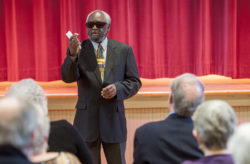
When I arrived at Chattanooga’s Second Missionary Baptist Church, A true Southern gentleman, Pastor Paul McDaniel, met me personally met at the door.   Born in Rock Hill, South Carolina, Pastor McDaniel has been part of the Southern landscape and its African American community for most of his life. After attending Morehouse College in Atlanta, he received a Masters of Divinity degree from Colgate-Rochester Divinity School and a Masters of Arts degree from the University of Rochester in New York. A Chattanooga resident since 1966, Rev. McDaniel stepped down from his post at the Second Missionary Baptist Church after almost 50 years of service.  A larger-than-life figure in the community, I share our conversation in his honor.

Continue reading Pastor Paul McDaniel and the Interfaith South — by Deborah Levine