
Category Archives: Authors A-H

Authors listed by last name A-H

Is Your Backyard Playground Ready for Fall? – by Sheryl Berkley

7 Common Hazards to Look for After Summer Break

As summer winds down and kids head back to school, families often start spending more time in the backyard after school and on weekends. If you have a home playground, now is a good time to take a closer look at it. Months of summer sun, rain, storms and everyday play can leave behind safety hazards that may not be obvious at first glance.

Before the kids return to regular outdoor play, take a few minutes to walk around the playground and surrounding area. A simple inspection can help you spot small problems before they become bigger safety concerns. Here are seven common backyard playground hazards to look for after summer break.

Continue reading Is Your Backyard Playground Ready for Fall? – by Sheryl Berkley →

Legacy of 16-year-old Barbara Johns – by Terry Howard

Exhausted enough for change

pastedGraphic.pngBabara Johns
Note: Not long ago, this author co-sponsored a trip from central Virginia to Farmville, Virginia for a visit to the R. R. Moton Museum . Mounted prominently on the wall in the museum’s auditorium is a picture of 16-year-old Barbara Johns, who led a protest that changed trajectory of history. Here’s her story.

20 years ago, Pulitzer Prize winning columnist Leonard Pitts, Jr. penned words that have held their meaning and significance to this day….“Few forces are more compelling than a soul grown exhausted enough for change.”

Continue reading Legacy of 16-year-old Barbara Johns – by Terry Howard →

When the Infinite Becomes a Circle – by Meena Chopra

 Reflections from a Mahā Kumbh Discussion

(Seeking The Infinite: A Spiritual Journey through the *Maha Kumbh)

Meena At the Gala Opening Event of the 2nd edition of Canada Literature Festival in Mississauga on 14th May, there was a discussion on USA-based Yakub Matthew’s newly published book Seeking the Infinite. It was convened by UK-based noted literary thinker Prabhu Guptara, where I found myself entering not merely a literary conversation, but a strangely layered inner journey. The subject itself, the infinite, already carries a destabilizing quality. It invites thought, yet resists containment within thought. And perhaps that was precisely what made the experience of the discussion both engaging and quietly unsettling.


Continue reading When the Infinite Becomes a Circle – by Meena Chopra →

Middle East Part 1: Ancient Wisdom for a World at War -by Chaim Goldberg

A Single Verse, A Complete Moral Vision

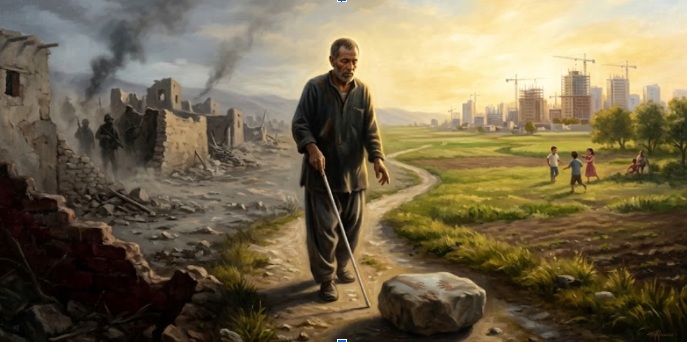
In the book of Leviticus, a short commandment appears: “Do not place a stumbling block before the blind.”

On the surface, it is simple: don’t trip someone who cannot see. But Jewish legal tradition has understood this verse for centuries as something far larger — a comprehensive moral principle about knowledge, power, and responsibility.

The blind person in this verse is never the one at fault. He is the vulnerable party — the one who lacks information, lacks sight, lacks the ability to protect himself. The prohibition is directed entirely at the one who can see — and chooses nonetheless to place an obstacle in his path.

Continue reading Middle East Part 1: Ancient Wisdom for a World at War -by Chaim Goldberg →

Middle East Part 3: Why the American Chassis Doesn’t Fit the Israeli Soul – by Chaim Goldberg

A Meeting That Left Me With Questions

I did not expect the conversation to stay with me the way it did.

I sat with Jonathan Pollard in Jerusalem — a sharp, vital man, the kind you leave with more questions than you arrived with. The meeting was genuinely enriching. And at the same time, something in it placed before me a question I cannot put down:

Not a question about what he did, or what was done to him.

An architectural question.

What does it mean to live inside two states that are not the same kind of thing?

Because Pollard did not inhabit two countries. He inhabited two systems of reality — ones that sometimes use the same words and mean entirely different things. And under pressure, for one terrible moment, the structure cracked.

Continue reading Middle East Part 3: Why the American Chassis Doesn’t Fit the Israeli Soul – by Chaim Goldberg →

Middle East Part 2: Between the Illusion of Death and the Engineering of Life – by Chaim Goldberg

I read the word three times before I understood it wasn’t a translation error.

“The subject demonstrated resistance… focused physical force was applied… she was later found without signs of life.”

The subject. That’s how she was described in the internal report of Iran’s Revolutionary Guards on Nika Shakarami, as exposed by BBC Persian. A sixteen-year-old girl who had gone out to protest the death of Mahsa Amini. A girl the same age as my granddaughter. The same age as the students who stood in front of me in the classroom for thirty years.

Continue reading Middle East Part 2: Between the Illusion of Death and the Engineering of Life – by Chaim Goldberg →

Valuing Human Creativity in the Age of AI – By Meena Chopra

In 2026, the boundary between human creativity and digital intelligence has finally started evaporating into the shadows. We are weaving high contrasts with abstract AI textures to bring timeless art into a new dimension of sight and sound.

There are moments in history when language begins to shift under our feet. Words that once felt stable, art, creation, authorship, originality, begin to blur as new tools enter the landscape of making. Artificial intelligence is one such threshold. This is not a question of acceptance or rejection; it is a question of clarity: what remains essentially human in the act of creation, and where does technology genuinely belong without displacing that essence?

Continue reading Valuing Human Creativity in the Age of AI – By Meena Chopra →

Renewing Diversity  Part 16: Revisiting ‘The Children Are Watching’ – by Carlos Cortés

It’s hard for me to get my head around the fact that it’s been more than a quarter century since the year 2000 publication of my book, The Children Are Watching: How the Media Teach about Diversity.  In that book I proposed a framework for looking at the mass media as a sprawling, multifaceted informal educational curriculum that competes with schools in the teaching process.  Whether or not media makers think of themselves as teachers is irrelevant.  Once they create media, their products become sources from which people learn.  

As the title suggests, the book focused on the theme of diversity.  I argued that the mass media provide a form of informal public multicultural education through the ways they depict groups, portray intergroup interactions, and publicly examine how  institutions and organizations interact with diversity.   Continue reading Renewing Diversity  Part 16: Revisiting ‘The Children Are Watching’ – by Carlos Cortés →

Moral Fault Lines as Muse – by Linda Drattell

Drattell
by Shawn Drattell

Moral fault lines are everywhere we look and serve as a muse for my writing. They are the underlying fissures that can fracture societal cohesion, fragment our understanding of what is right versus wrong, and threaten to break us under severe stress. In my novel, The Peccadilloes of Filamena Phipps, Filamena Phipps, née Ferayinskela, doesn’t ‘fit’ in North Chelsea, an affluent community which prizes homogeneity.

A clique consisting of  Filamena’s neighbors drive informal, but ultimately rigid, community decisions such as where they shop, what they wear, with whom they socialize. Filamena tries to accommodate her neighbors but to them, she’s different; she’s a threat. They want her to conform, forget her own customs, dress and cook and raise her children like they do. Confronted by her neighbors’ bullying, she must decide how much bullying she should tolerate. What happens when she dissents? How can she dissent effectively and still remain a part of her community? 

Continue reading Moral Fault Lines as Muse – by Linda Drattell →

The genius of Oscar and Frank – by Terry Howard

Sorry to disappoint readers – well, maybe some readers anyway – but today’s narrative is not about Tiger Wood’s “driving” (ahem, Land Rovers, not golf balls) skills, Pam Bondi’s firing, the war in Iran, or the Epstein files. It is about my lifelong infatuation with language and how it manifests itself in common types of prose used to educate, criticize, hyperbolize, or just annoy. 

Continue reading The genius of Oscar and Frank – by Terry Howard →