Tag Archives: diversity

Diversity Dilemma: Should there be a Black History Month? – by Deborah Levine

The debate over Black History Month is not new, but it intensified when the Oscar nominees were all Caucasian and earned the hashtag #OscarsSoWhite. Provoked an outcry, it raised questions about the existence of Black Entertainment Television awards (BET) and whether it hurt rather than helped African Americans in Hollywood.

“Either we want to have segregation or integration. And if we don’t want segregation, then we need to get rid of channels like BET and the BET Awards and the Image Awards, where you’re only awarded if you’re black. If it were the other way around, we would be up in arms. It’s a double standard, ” said actress Stacey Dash in Variety.

Continue reading Diversity Dilemma: Should there be a Black History Month? – by Deborah Levine

Diversity and Speech No. 27: Training Future Psychologists Using the Lens of History – by Carlos E. Cortés, Marjorie Graham-Howard

A Co-Authored Interview

Carlos: Marjorie, as a historian, I was blown away by the richness of your class syllabus.  How did you come up with the idea of using history to ground a clinical psychology course?

Marjorie: I was a history major in college, so I have always loved it.  I remember when I first discovered that history is not just facts about wars and dead people, but was an interpretation of past events.  Then I began to learn that most history was controlled by those with power and privilege, which meant there were those whose voices were silenced or never heard from.  I knew it would be important for therapists.  Once I began teaching at Azusa Pacific University, I found that students were often overwhelmed when working with older adults and clients from a different historical era.  They did not know their history, which became a barrier to providing effective treatment.  We decided to add a class to close this gap.

Continue reading Diversity and Speech No. 27: Training Future Psychologists Using the Lens of History – by Carlos E. Cortés, Marjorie Graham-Howard

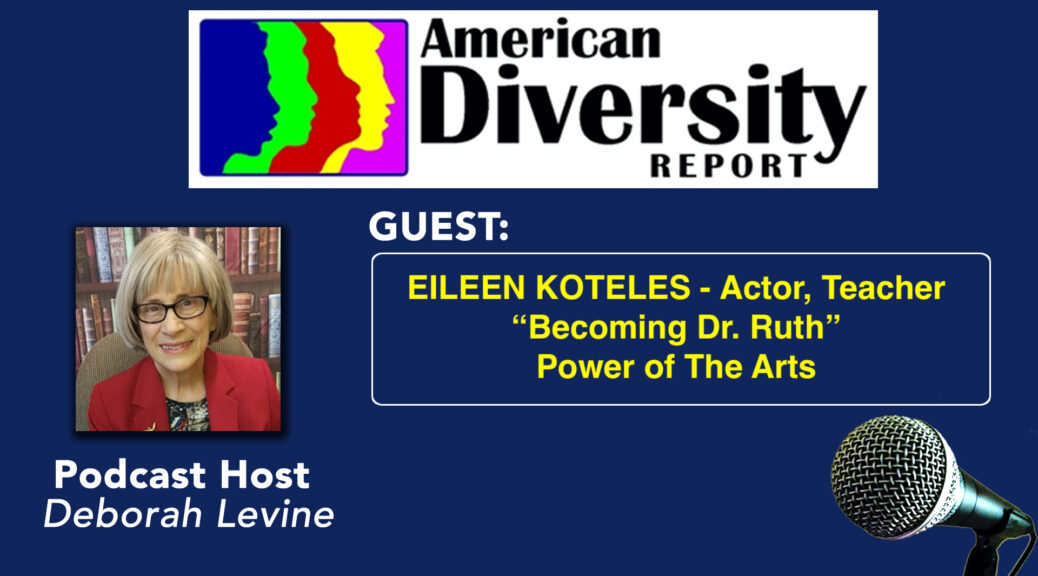
Eileen Koteles Podcast: Teaching Through the Arts

Arts Eileen Koteles is an actor and choreographer. Raising her three sons, she realized the gift of teaching through the Arts. Now returning to the stage, Eileen performs  as Dr. Ruth, an iconic sex therapist who lost her family in the Holocaust.

Eileen finds she is still teaching through the Arts and urges us to support the arts as a platform for tolerance whether theater, writing, poetry, dance, painting, or photography.

Hear Eileen talk about:

1. How does teaching through the Arts apply to diversity and inclusion?
2. What does the one woman show about Dr. Ruth teach us?

CLICK for Podcast

Trends in Diversity, Equity, Inclusion, and Belonging – by Gail Dawson

Following the death of George Floyd and the subsequent protests, the number of diversity-related jobs increased significantly as organizations worked to address issues that could no longer be ignored. Diversity, equity, and inclusion (DEI) became more important as organizations launched initiatives focusing on making meaningful change. While some organizations simply increased their diversity efforts, others created new positions focused on diversity. These positions ranged from entry-level jobs to executive-level positions and spanned all types of organizations including academia. Indeed.com reported that diversity, inclusion, and belonging (DI&B) job postings increased by 123% between May and September of 2020.

Continue reading Trends in Diversity, Equity, Inclusion, and Belonging – by Gail Dawson

Diversity and Speech No. 26: Trends in Student Speech – by Carlos E. Cortés, Steven Petkas

A Co-Authored Interview

Carlos: Steve, now that you’ve retired as Associate Director of Residence Life at the University of Maryland, College Park, I would love to get your thoughts about the changing nature of student speech.  In the twenty-five years that I worked with your department, I saw many changes.

Steve: You’re right.  The two of us certainly had fun designing our Common Ground program back in the 1990s.  That program would bring together diverse groups of students – sometimes more than a dozen – to discuss current equity dilemmas.  A series of four, 90-minute dialogue sessions, all framed around a single provocative question.  Should laws governing abortion be changed?  Should universities use intentional methods to diversify their student populations?  Rousing and illuminating conversations.

Continue reading Diversity and Speech No. 26: Trends in Student Speech – by Carlos E. Cortés, Steven Petkas

Speech vs. Diversity, Diversity vs. Speech – by Carlos E. Cortés

 Edward A. Dickson Lecture
University of California, Riverside

In February, 2018, I began a new scholarly odyssey.  I became an inaugural fellow of the University of California National Center for Free Speech and Civic Engagement.

In my fellowship application I proposed the following question: “over the past fifty years, why have so many diversity advocates become opposed to our nation’s hallowed tradition of free speech?”  However, I soon discovered that I had asked the wrong question.  Instead my question became “over the past fifty years, what has happened when two worthy values collide: inclusive diversity and robust speech?”

Today I invite you to accompany me on part of my personal odyssey.  This involves two acts followed by a brief epilogue.  Please join the conversation by posting questions and comments in the chat box.  I’ll also pause for a few minutes of discussion following each of the three segments.  And if the digital gods should step in and freeze me for a minute or so, please hang around.  Like the Terminator, I’ll be back.

Act One will focus on speech, primarily through the lens of diversity.  Act Two will address diversity, primarily through the lens of speech.  In the epilogue, I will suggest what I think lies ahead for the intersection of diversity and speech.

Continue reading Speech vs. Diversity, Diversity vs. Speech – by Carlos E. Cortés

12 Steps to Diversity Recovery – by Susan McCuistion

Abstract

Our approach to Diversity and Inclusion (D&I) is broken. We have done the same thing over and over for years, expecting better representation and more equitable treatment, all to no avail. In fact, many people still don’t know exactly what D&I is.

At every turn, there’s news about people being mistreated, excluded, and harmed. The social and political unrest often seem impossible to escape. Situations arise on a regular basis that create a social media nightmare for organizations resulting in public shaming and forced apologies. The mental, emotional, and physical toll this turmoil takes impacts us all, regardless of our role— victim, perpetrator, or observer.

We can’t fix the mess we’re in with a 2-hour training session. Creating a world that is truly more equitable for everyone is a process. It takes time and practice.

Cultivating compassion can help us nurture more connected communities and workplaces. On the surface, compassion sounds like a soft skill. However, compassion isn’t just about being kind to other people and doing nice things for them. Instead, it’s an active process through which we build skills and knowledge to understand what kind of help is wanted, rather than assuming what is needed.

This article is distilled from my book, “The D Word: 12 Steps to Diversity Recovery,” which is focused on building the skills needed to bring a more humanitarian approach to D&I using compassion and resilience.

Continue reading 12 Steps to Diversity Recovery – by Susan McCuistion

Diversity Matters: At Boardroom Tables and Beyond – by Kobina Ansah

JuneteenthJuneteenth, or Freedom Day, commemorates the end of slavery in the United States following the surrender of General Robert E. Lee in 1865. Since that day, each year Black communities have commemorated that fateful day by uniting in celebration. Over the last year, however, following the murders of George Floyd and many others, Juneteenth has taken on a new meaning.

As a person of color who has worked in Corporate America and gone on to start my own company, Juneteenth is a time for me to reflect not only on the progress that has been made, but also focus on the steps we need to take to give Black and other minority founders the same opportunities as our non-minority counterparts.

Continue reading Diversity Matters: At Boardroom Tables and Beyond – by Kobina Ansah

Diversity and Speech Part 20: Communicating across Generations – by Carlos E. Cortés

“The past is a foreign country; they do things differently there.”

In those memorable opening lines of his novel, The Go-Between, writer L. P. Hartley captured many dilemmas.  The dilemma of memory.  The dilemma of change.   The dilemma of misunderstanding.

It also captured the dilemma of generations, particularly conversations across generations.  We did things differently then.  They do things differently now.   How are we going to help them understand what we experienced?  How are they going to help us understand what they are experiencing?
Continue reading Diversity and Speech Part 20: Communicating across Generations – by Carlos E. Cortés

The DEI Future: Old, New and Maybe – by Deborah Levine

A Diversity Futurist’s Perspective

DEBORAH LEVINE
Editor-in-Chief Deborah J. Levine

In my more than half a century dealing with diversity, I have seen multiple changes in the field of training, coaching, and consulting.  COVID presents an unprecedented mountain of changes in the DEI field that merit an overview of  the past, present and future.  As much as I appreciate some of you  giving me the title of Diversity Futurist, Diva, Matriarch and Fairy Godmother, I’m well aware of the many experts reading the American Diversity Report and welcome your comments on the future of diversity.

Continue reading The DEI Future: Old, New and Maybe – by Deborah Levine